What is the efficiency of a Hobson's joint?

  • Thread starter Thread starter Stormer
  • Start date Start date
  • Tags Tags
    Efficiency Joint
Click For Summary
SUMMARY

A Hobson's joint is a gearless angled drive, typically fixed at a 90-degree angle, with some versions allowing movement beyond that. Its efficiency is highly dependent on factors such as the friction of the bushings and the load applied. While theoretically, it could achieve 100% efficiency under frictionless conditions, practical applications reveal that efficiency varies based on torque and alignment. The joint is not considered a reliable power transfer device due to rapid wear and poor lubrication issues, making it more suitable for transferring orientation information rather than performing sustained work.

PREREQUISITES
  • Understanding of gearless drive mechanisms
  • Knowledge of friction coefficients and their impact on mechanical systems
  • Familiarity with torque calculations in mechanical engineering
  • Basic principles of lubrication and wear in mechanical components
NEXT STEPS
  • Research the mechanics of gearless drives and their applications
  • Study the effects of friction in mechanical systems, focusing on bushings and bearings
  • Explore torque transmission calculations and their implications in design
  • Investigate alternative power transfer devices that offer greater reliability and efficiency
USEFUL FOR

Mechanical engineers, product designers, and anyone involved in the development of drive systems or mechanical linkages seeking to understand the limitations and applications of Hobson's joints.

Stormer
Messages
121
Reaction score
22
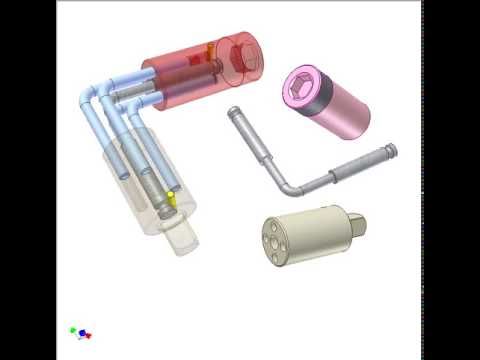
A Hobson's joint is a kind of gearless angled drive. Most often a fixed 90 degree angle, but there is also versions with free moving joints in each axle so it can move to any angle up to a little over 90 degrees. It is today mostly just a novelty and there is very few applications actually using it because a bevel gear or similar is used in stead.
e51fd18fc2054d7d90084dcb73741735.jpg


But how efficient is actually this drive in practice? I know it depends on the friction of the bushings the axles ride in and the load, but what is a ballpark number? For example for some polished stainless axles running in PTFE or oilite bushings (there is usually to small of a space to fit ball bearing linear guides) with "moderate" loads and low speed? I have searched but not found any reliable numbers.
 
  • Like
Likes   Reactions: 256bits
Engineering news on Phys.org
I suggest that you work it out for yourself, initially based on frictionless connections. If you apply a torque T1 to the input, what is the output torque, T2? I have not worked this out, but I think you will find that it is angle dependent.
 
Dr.D said:
initially based on frictionless connections
Will that not just make it 100% efficient? Just like all other gears assuming no friction...
 
The efficiency is not constant, but will be a square or an exponential function of the torque. That is because side forces on the links are compounded from one end of the sleeve to misalign the other.

There is a critical alignment tolerance at which it will lock rather than slide. That is the arctangent of the friction coefficient. If the angle is greater than the critical angle, the rod will stick and not slide in the sleeve. Since the rod force is always concentrated at the same two points, the surfaces of the sleeve and rod will wear rapidly, to approach the critical angle.

Poor lubrication will result in fatigue of the sliding link elbows. There is no redundancy.

I do not think this is a reliable power transfer device. There are more durable solutions that weigh less. It might be used to transfer orientation information, but it cannot be expected to do real work for any long period.
 
  • Like
Likes   Reactions: berkeman, Lnewqban and Spinnor

Similar threads

  • · Replies 7 ·
Replies
7
Views
3K
Replies
7
Views
4K
  • · Replies 26 ·
Replies
26
Views
8K
  • · Replies 1 ·
Replies
1
Views
4K
Replies
2
Views
7K
  • · Replies 7 ·
Replies
7
Views
3K
  • · Replies 6 ·
Replies
6
Views
4K
  • · Replies 2 ·
Replies
2
Views
8K
  • · Replies 1 ·
Replies
1
Views
4K
  • · Replies 4 ·
Replies
4
Views
9K