What Is the First Dimension and Why Is It Considered Nothing?

  • Context: High School 
  • Thread starter Thread starter Spacepantz86
  • Start date Start date
  • Tags Tags
    Dimension
Click For Summary

Discussion Overview

The discussion revolves around the concept of dimensions, specifically the first dimension and its interpretation as "nothing." Participants explore the nature of points and lines, the distinction between dimensions, and the intuitive understanding of these concepts within mathematics and physics.

Discussion Character

  • Conceptual clarification
  • Debate/contested

Main Points Raised

  • One participant suggests that the first dimension could be considered as the observer or nothing, expressing confusion about the concept.
  • Another participant states that a point has zero dimensions, while a line has one dimension, indicating a basic understanding of dimensionality.
  • A participant challenges the separation of a point and a line, arguing that a point is merely a very short line.
  • In response, another participant clarifies that a point is distinct from a line, emphasizing that a point has zero length while a line consists of an infinite set of points.
  • One participant expresses difficulty in reconciling the explanations with their understanding, questioning how two two-dimensional objects can have separate dimensions.
  • Another participant attempts to explain the concept of zero dimensions using an analogy involving integers and the removal of items, asserting that zero is a unique concept that differs from having a very short length.
  • Further clarification is provided regarding the nature of dimensions and how they relate to objects, with an emphasis on the distinction between one-dimensional and two-dimensional spaces.
  • One participant notes that all physical objects have three dimensions and that dimensions are primarily a mathematical construct, mentioning alternative coordinate systems for describing dimensions.

Areas of Agreement / Disagreement

Participants express various interpretations and understandings of dimensions, with no consensus reached on the nature of the first dimension or the relationship between points and lines. Disagreement persists regarding the intuitive grasp of these concepts.

Contextual Notes

Some participants exhibit confusion over the definitions and distinctions between points, lines, and dimensions, indicating a lack of clarity in foundational concepts. The discussion reflects varying levels of familiarity with mathematical terminology and dimensionality.

Spacepantz86
Messages
5
Reaction score
1
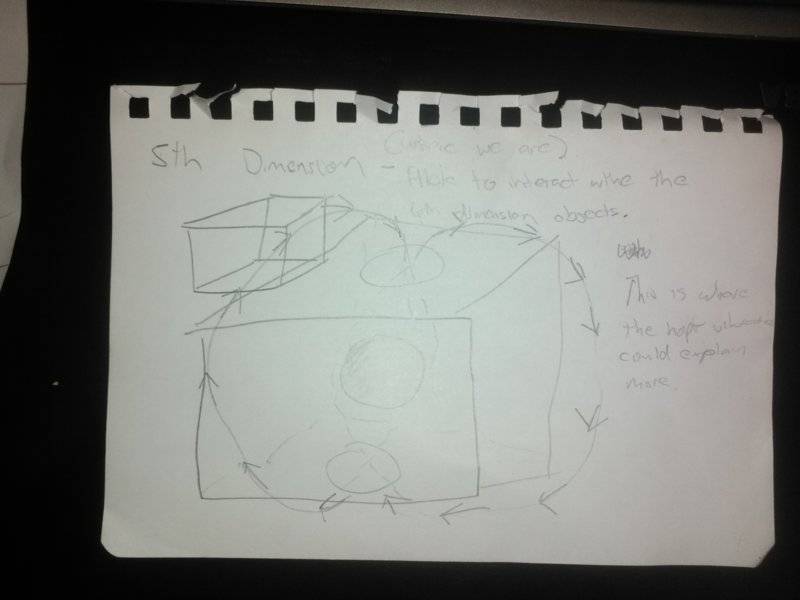
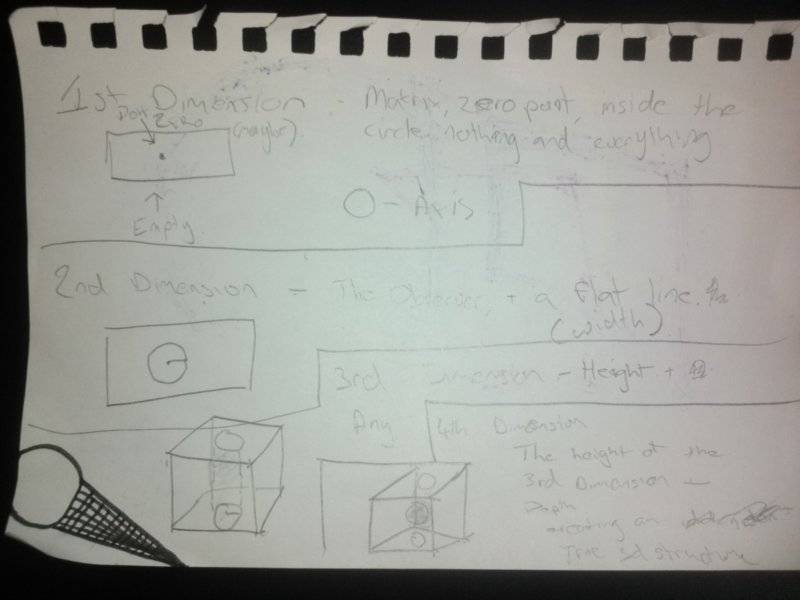
I do not understand the principle, to me it would make more sense if there was no line, there is nothing.

The best way I can think of it would be, the first dimension is the observer, or nothing.

I really don't know, its just this way makes more sense in my head, though I am lacking any knowledge of physics really.

Sorry about my ignorance, just wanting to learn :)
dimensions 1.0.jpg
dimensions 2.0.jpg
 

Attachments

  • dimensions 1.0.jpg
    dimensions 1.0.jpg
    34 KB · Views: 1,010
  • dimensions 2.0.jpg
    dimensions 2.0.jpg
    27.5 KB · Views: 884
Physics news on Phys.org
A point has zero dimension, a line has one dimension, a surface has two dimensions etc.
 
Still does not make sense sorry, A point is just a very very short line, I do not understand how they can be separate?
 
Spacepantz86 said:
A point is just a very very short line

No it's not. A point is a point and a line is an infinite set of points. A point has zero length.
 
I get the explanation, and understand it, but it just won't work in my head.

To the observer, whether it is a line or shape won't matter, its in the 2nd dimension and can only be view in the second dimension. Just like a set of construction plans.

Yeah I don't get, how 2 2d things can have separate dimensions, when they are both two dimensional, belonging in the second dimension.
 
Spacepantz86 said:
I get the explanation, and understand it, but it just won't work in my head.
I feel your pain. The thing about these ideas is that they are not intuitive. What Mathematicians call a point has no size. Take a very short line - then shorter and shorter but it still has some length. A point has no length so it's a different beast altogether.
This may be easier to understand in the world of Integers. Have 100 cans of beans and start removing them, one by one. There will be some cans there until the time you take the last can away and then there are NO cans in the box - same as there are no elephants, no people, no nails , no anything. The "Zero-ness' covers everything, whereas the 'one-ness' of a single can or a single grain of sand only refers to cans or grains. Zero is special. So Zero Dimensions is not the same as something very short.
 
  • Like
Likes   Reactions: Asymptotic
Spacepantz86 said:
I get the explanation, and understand it, but it just won't work in my head.
Then you don't really understand the explanation.

Spacepantz86 said:
To the observer, whether it is a line or shape won't matter, its in the 2nd dimension and can only be view in the second dimension. Just like a set of construction plans.
You might be thinking of a line (one-dimensional) drawn on a piece of paper (essentially two-dimensional if we ignore the fact that the paper has thickness along a third dimension).

If you put a pencil on the line and stay on the line, you can go in only two directions, forward or backward along the line. The motion of the pencil is one-dimensional. If you move the pencil off the line, now it is going off in a completely different direction.

Spacepantz86 said:
Yeah I don't get, how 2 2d things can have separate dimensions, when they are both two dimensional, belonging in the second dimension.
The don't "belong" in "the" second dimension. Two-D objects are elements of two-dimensional space. I brick and a cardboard box are three-dimensional objects. They both have length, width, and depth. The three dimensions aren't really separate on the two objects.
 
It's worth pointing out that nothing we see or feel has less than three dimensions. The dimensions are a mathematical idea. Also, the 'dimensions' we use, don't need to be described with the xyz co ordinates we are familiar with. The dimensions can be described using other co ordinates e.g. polar co ordinates. ('Other co ordinates are available'). But you always need three numbers to describe the position of a point in 3D space.
 

Similar threads

  • · Replies 4 ·
Replies
4
Views
4K
  • · Replies 8 ·
Replies
8
Views
3K
  • · Replies 3 ·
Replies
3
Views
3K
  • · Replies 12 ·
Replies
12
Views
5K
Replies
21
Views
3K
  • · Replies 13 ·
Replies
13
Views
2K
  • · Replies 12 ·
Replies
12
Views
1K
  • · Replies 4 ·
Replies
4
Views
2K
High School The M paradox
  • · Replies 4 ·
Replies
4
Views
956
  • · Replies 14 ·
Replies
14
Views
2K