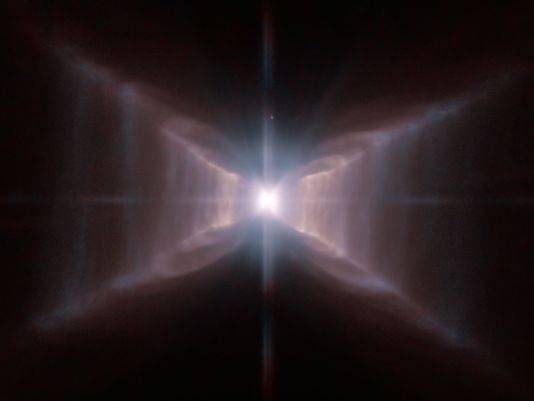
What is the mysterious red rectangle around HD 44179?

8 replies · 3K views · last reply
Dotini
Gold Member
Messages
639
Reaction score
230
How charming!

Hubble image of the Red Rectangle nebula around HD 44179: a bright central star with X-shaped diffuse lobes of reddish-white nebulosity extending diagonally outward against a dark background.

(Photo: ESA/Hubble and NASA)

http://www.usatoday.com/story/tech/sciencefair/2016/04/08/star-red-rectangle-nasa-hubble/82796522/
 
  • Like
Likes   Reactions: OmCheeto and jfizzix
If I had to guess, I would say at least some of the "rectangularity" in the image is likely due to the shape of the aperture on the telescope looking at it. Rectangular irises make rectangular streaks, and hexagonal irises make hexagonal streaks. The nebula is definitely more rectangular than what could be explained by aperture effects, which is pretty darn cool.

See for example this Hubble photo of Sirius
Bright blue-white star at centre with long diffraction spikes forming an X shape extending toward the corners, and a small faint dot at lower left against a dark blue background.

(Source: http://hubblesite.org/newscenter/archive/releases/2005/36/image/a/format/large_web/)

Here, the star is round, but there are well-defined streaks at 90 degree angles. These streaks are purely due to aperture effects.

Pretty, though :)
 
Last edited:
I don't think i has anything to do with the aperture shape. From the photo's source:

The reason for its rectangular appearance is because we're seeing the nebula from an unusual angle. The star is likely shooting out cone-shaped gas clouds, which to us seem to form a rectangle, NASA said.

Besides, most telescopes have round apertures. I don't think I've ever seen one without a round aperture.

jfizzix said:
Here, the star is round, but there are well-defined streaks at 90 degree angles. These streaks are purely due to aperture effects.

Those spikes are diffraction spikes, which have little to do with the shape of the aperture as far as I know.
 
  • Like
Likes   Reactions: davenn
Drakkith said:
Those spikes are diffraction spikes, which have little to do with the shape of the aperture as far as I know.

Those spikes wouldn't be at 90 degree angles unless the light was passing though a rectangular aperture/iris.
 
jfizzix said:
Those spikes wouldn't be at 90 degree angles unless the light was passing though a rectangular aperture/iris.

Sure they will. Take a look at the following picture.
Six telescope aperture diagrams with spider vane configurations (top row) and their corresponding red diffraction spike patterns (bottom row), showing spikes from 2 to 6 vanes.


The aperture with four spider vanes has cross-shaped diffraction spikes.

Source: https://en.wikipedia.org/wiki/Diffraction_spike
 
  • Like
Likes   Reactions: CalcNerd, Borg and davenn
I don't think anything was wrong with apparatus, nature just does interesting things which are not predictable.
Nobody expected a hexagon formation on the north pole of Saturn, but there it is.
 
  • Like
Likes   Reactions: Dotini
rootone said:
I don't think anything was wrong with apparatus, nature just does interesting things which are not predictable.
Nobody expected a hexagon formation on the north pole of Saturn, but there it is.
Yes, this is how I think about it, too. I certainly wouldn't rush to bet the farm on the first explanation offered by a journalist. For me, the endless beauty, variety and novelty of the universe is enough to make me feel loved, charmed and amused.
 
  • Like
Likes   Reactions: Rohe your Boat
Hubble WFPC2 image of the Red Rectangle proto-planetary nebula HD 44179: an X-shaped reddish-orange nebula with a bright white star at its centre.


- "Strange activity at the molecular level"

- A red glow, "Extended Red Emission (conveniently ERE for short) has been known but inexplicable for more than 30 years".

- "Unusual clusters of PAHs that are charged and highly reactive but, at the same time, have a stable, closed-shell electron configuration"

These are the explanation now on offer by writers at space.com.

http://www.space.com/3658-mystery-red-space-glow-solved.html
http://www.space.com/32655-mysterious-red-rectangle-hubble-telescope-sharpest-image.html