What is the Proof of the Pythagorean Theorem?

Click For Summary

Discussion Overview

The discussion revolves around various proofs of the Pythagorean theorem, exploring different methods and interpretations of the theorem's validity. Participants share links to resources, express their thoughts on specific proofs, and engage in debates about the nature of proof itself.

Discussion Character

  • Exploratory
  • Technical explanation
  • Debate/contested
  • Conceptual clarification

Main Points Raised

  • Some participants express excitement about learning proofs of the Pythagorean theorem, indicating a newfound appreciation for mathematical reasoning.
  • One participant shares a link to a resource containing over 360 proofs of the theorem, suggesting a wealth of approaches to the topic.
  • Another participant describes a geometric proof involving squares and areas, presenting a visual method to understand the theorem.
  • Some participants challenge the validity of certain proofs, arguing that they may not constitute true proofs but rather observations or illustrations of the theorem.
  • A participant discusses the uniqueness of right triangles and the implications of dimensional analysis in relation to the theorem.
  • There is mention of the theorem's applicability beyond right triangles, including its use in higher dimensions and vector spaces.
  • Some participants express differing opinions on the intuitiveness of Euclid's proof, with some finding it confusing and others appreciating its geometric nature.
  • Links to various proofs are shared, including Euclid's proof and others that are described as more detailed or intuitive.

Areas of Agreement / Disagreement

Participants do not reach a consensus on the nature of certain proofs, with some asserting that specific examples are not true proofs while others defend their validity. The discussion remains unresolved regarding the best methods to prove the theorem and the interpretations of what constitutes a proof.

Contextual Notes

Some participants note that certain proofs may depend on prior assumptions about side lengths or specific cases, which could limit their general applicability. There is also mention of the historical context of proofs, particularly Euclid's methods, which may not align with modern algebraic approaches.

Nano-Passion
Messages
1,291
Reaction score
0
I just learned the proof for the Pythagorean theorem.. my mind was blown! =D Simply amazing.
 
Mathematics news on Phys.org
Where? (link, please) I didn't know there was a proof... really.
 
Nevermind, Google was of help.

Did anyone else just assume it was a natural implication of the metric of the reals? I feel dumb now.
 
Are we talking about http://www.cut-the-knot.org/pythagoras/index.shtml"

The Pythagorean Proposition contains 360+ proofs of it.
 
Last edited by a moderator:
make a square. make another square inscribed in it, with its vertices on the edges of the square. label edge lengths that are congruent. now, look for shapes and areas and triangles and stuff.
. ._b_____a__
. | . ./ .\ . . . |
a| ./c. . c \ . | b
. |/ . . . . . . \|
. |\ . c. . c. /|
b| . .\ . . . / .| a
. |____\. /__ |
. . . a . . . b

pretend its a square.

now, because of area formulas,
(a+b)^2 = c^2 + 4* ab/2
a²+2ab+b² = c² + 2ab
a²+b² = c²
 
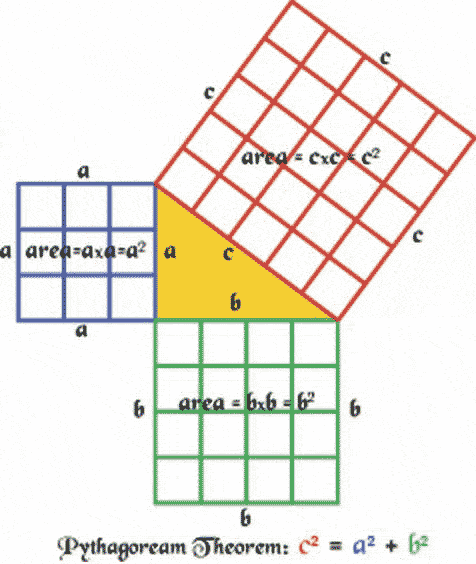
http://www.myastrologybook.com/PythagoreanTheorem16c.gif

I liked this one particularly, the one in the post above is pretty awesome too.

I am now falling in love with proofs... I can't believe I've been using this formula since middle school without knowing its meaning and beauty !
 
Nano-Passion said:
PythagoreanTheorem16c.gif

I liked this one particularly, the one in the post above is pretty awesome too.

Well, that one you mention isn't really a proof at all, it just sort of shows that it works for the case of a triangle with side lengths of 3, 4, and 5.
 
DarthPickley said:
Well, that one you mention isn't really a proof at all, it just sort of shows that it works for the case of a triangle with side lengths of 3, 4, and 5.

Are you sure? It works for any right angle triangle. And the Pythagorean theorem works only for right angle triangles. So?
 
  • #10
Nano-Passion said:
Are you sure? It works for any right angle triangle. And the Pythagorean theorem works only for right angle triangles. So?

First of all, it doesn't work if either of a/b or a/c is an irrational number.
Secondly, it is not proof, it is more of an observation. You need to know lenghts of all sides prior (before) to drawing such a picture. So, you assumed (lenghts of sizes) that theorem works before even drawing such a thing.

In true proof you need to start with right angle triangle of general lenghts of sides then somehow prove the formula.
 
  • #11
A right triangle can be uniquely described by a side length and an angle [itex]\phi[/itex]. Let [itex]c[/itex] be the hypotenuse. By dimensional analysis, the area of the triangle must be [itex]c^2f(\phi)[/itex], where f is some unknown function of phi (pretend we don't know trig). Now, split the triangle into two smaller triangles by drawing a line perpendicular to the hypotenuse that bisects the right angle. Let the hypotenuses of the two smaller triangles be [itex]b[/itex] and [itex]a[/itex]. All three triangles are similar triangles. Thus, the areas of the smaller triangles are [itex]b^2f(\phi)[/itex] and [itex]a^2f(\phi)[/itex], where f is the same function as before (due to the similarity of the triangles). Since the two smaller triangles make up the bigger triangle, their areas must add up to the area of the larger triangle:

[tex]a^2f(\phi) + b^2f(\phi) = c^2f(\phi),[/tex]
and hence
[tex]a^2 + b^2 = c^2.[/tex]
 
  • #12
I really like the geometric proof. The first time I saw it I stared at it for a long time.
 
  • #13
Nano-Passion said:
Are you sure? It works for any right angle triangle. And the Pythagorean theorem works only for right angle triangles. So?

It's an illustration of the Pythagorean Theorem; not a proof, although, if you take the result as a given, then it shows the Pythagorean Theorem works on all similar triangles (6x8x10, 9x12x15, etc).

Plus, while what you say is technically true, it kind of bugs me the way you say it only works for right triangles. How about using the Pythagorean Theorem to find the diagonal of a cube? In other words, l^2 + w^2 + h^2 = d^2, (with length, width, height, and diagonal). Or the diagonal of a 4 dimensional hypercube? Or a 5D hypercube?

Technically, you're compiling a series of right triangles with each additional dimension, but it's still pretty cool that the end result is that the Pythagorean Theorem works in any number of dimensions; not just on triangles.

Or, another version of the Pythagorean Theorem (or at least it looks different until you look closer at it). If you create a 3-dimensional vector, you can measure the angle between that vector and each of the three axes of your coordinate system. If you square the cosines of each of those angles and add them up, they always equal 1.
 
  • #14
gb7nash said:
I really like the geometric proof. The first time I saw it I stared at it for a long time.

do you mean the one supplied by Euclid in his Elements book?

that one... its so impossible to understand without staring at it for a long time!
Its kind of confusing. I don't really like it, mainly because it is one of the least intuitive proofs possible for a pretty simple theorem.

on the other hand, euclid and the other ancient greeks had no knowledge of algebra, so instead of doing more advanced logical processes (like cancellation of multiplication and addition), they just did it by adding in new lines, angles, and other things.
 
  • #15
Proof 2 on this page:

http://www.jimloy.com/geometry/pythag.htm

Euclid's proof (proof 4) looks a lot more detailed (for reasons that you mention)
 
Last edited by a moderator:

Similar threads

  • · Replies 38 ·
2
Replies
38
Views
6K
  • · Replies 2 ·
Replies
2
Views
3K
  • · Replies 6 ·
Replies
6
Views
2K
  • · Replies 3 ·
Replies
3
Views
1K
  • · Replies 8 ·
Replies
8
Views
3K
  • · Replies 6 ·
Replies
6
Views
2K
  • · Replies 105 ·
4
Replies
105
Views
11K
  • · Replies 30 ·
2
Replies
30
Views
4K
  • · Replies 2 ·
Replies
2
Views
3K
  • · Replies 10 ·
Replies
10
Views
2K