Qube
Gold Member
- 461
- 1
1) Question:
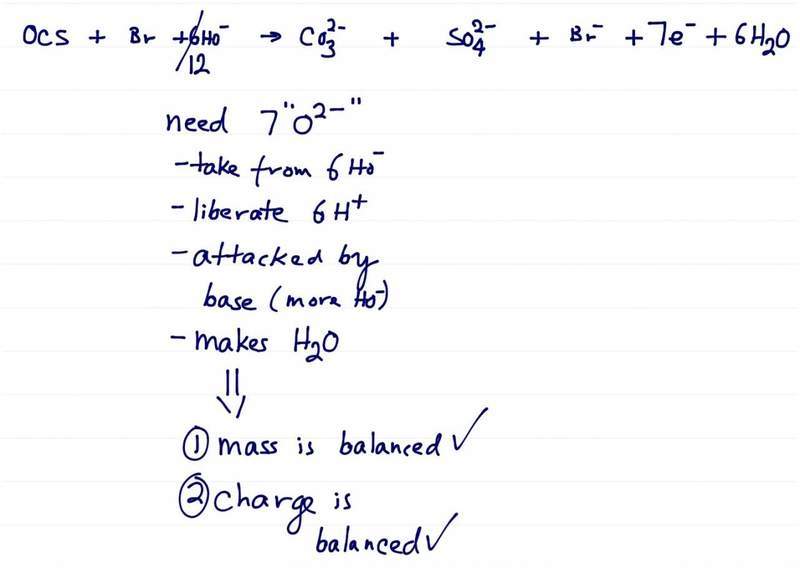
Consider the oxidation of OCS in strongly basic solution by bromine. The products are carbonate ion and sulfate ion. What is the ratio of reactant hydroxide ion to product bromide ion?
2) Considerations and processes (outlined in attached picture of work but I'll rewrite them).
a) Draw up half reaction
b) We need 6 oxygen ions on the reactant side; these come from heterolytic bond clevage of the hydroxide ion.
c) Breaking up the hydroxide ion in such a fashion creates the hydrogen proton, which must be captured by the strongest base in the system at significant concentration (hydroxide ion)
d) We need more reactant HO-.
e) Reaction of hydroxide ion and hydrogen proton forms water (add to product side).
f) Achieve mass and charge balance.
g) Check results.
h) Answer does not match test's answer (also attached).
http://i.minus.com/jbb20xBZGAKu2I.png
Consider the oxidation of OCS in strongly basic solution by bromine. The products are carbonate ion and sulfate ion. What is the ratio of reactant hydroxide ion to product bromide ion?
2) Considerations and processes (outlined in attached picture of work but I'll rewrite them).
a) Draw up half reaction
b) We need 6 oxygen ions on the reactant side; these come from heterolytic bond clevage of the hydroxide ion.
c) Breaking up the hydroxide ion in such a fashion creates the hydrogen proton, which must be captured by the strongest base in the system at significant concentration (hydroxide ion)
d) We need more reactant HO-.
e) Reaction of hydroxide ion and hydrogen proton forms water (add to product side).
f) Achieve mass and charge balance.
g) Check results.
h) Answer does not match test's answer (also attached).
http://i.minus.com/jbb20xBZGAKu2I.png
Last edited by a moderator: