What are these rusty metal pieces in my staircase walls?

  • Thread starter Thread starter Wrichik Basu
  • Start date Start date
  • Tags Tags
    Wall
Click For Summary
SUMMARY

The discussion centers on the discovery of rusted metal pieces within the plastered walls of a staircase in a residential flat. Participants identified these pieces as likely being wall ties or metal mesh used to support plaster, particularly in masonry construction. The presence of rust indicates exposure to moisture, but experts, including a civil engineer, confirmed that these elements do not compromise structural integrity. The building is approximately 13 years old and constructed with regular wall plaster and concrete.

PREREQUISITES
  • Understanding of masonry construction techniques
  • Knowledge of wall ties and their applications
  • Familiarity with plastering methods and materials
  • Basic concepts of structural integrity in buildings
NEXT STEPS
  • Research the role and types of wall ties in masonry construction
  • Learn about the effects of moisture on metal components in building materials
  • Investigate plastering techniques and the use of metal mesh
  • Explore methods for repairing and maintaining plastered walls
USEFUL FOR

This discussion is beneficial for homeowners, civil engineers, construction professionals, and anyone interested in understanding building materials and maintenance, particularly in masonry structures.

Wrichik Basu
Science Advisor
Insights Author
Gold Member
Messages
2,180
Reaction score
2,690
First, I am not an engineer, nor am I formally studying the subject. So, please pardon my ignorance.

I recently found these in the walls of the staircase in our flat:
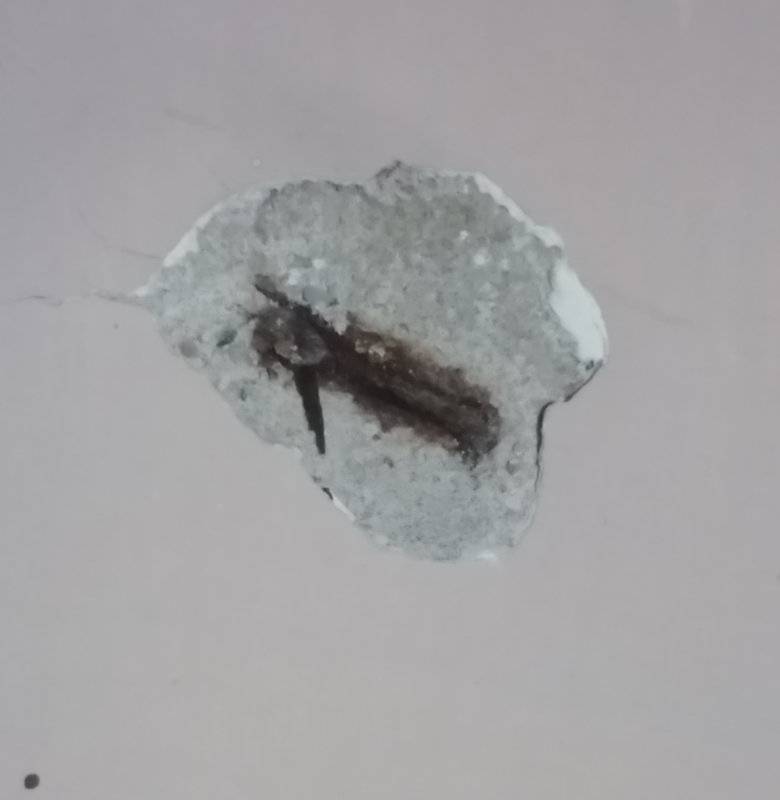
20190309_215727.jpg


The walls of the staircase had not been painted properly by the builder. Due to water seepage and damp, parts of the plaster have absorbed water and swollen up. When I hit them slightly, they broke off, revealing the material inside.

The question is, what are these? Inside the cement, there is some kind of iron rod or twisted wires, that is rusted. They are barely 3mm inside.

My father is a civil engineer. He inspected and said that since these were further away from any beam or column, they would not harm the structural integrity of the building. But he is not sure about what they are.

These are not electric wires, because wires won't go like that. Neither are these parts of beams or columns. But they are visible on all the four walls of the staircase to the terrace: swelling up, breaking on hitting, with rusted iron inside. But these are visible only on the staircase walls - not inside our house.

Anyone has any idea what these are?

If it is related to earthquake protection, then I can say with 99.99% surety that our flat hasn't been built keeping earthquakes in mind (Kolkata is in Zone III according to this).
 

Attachments

  • 20190309_215727.jpg
    20190309_215727.jpg
    19.2 KB · Views: 1,030
Engineering news on Phys.org
Are the walls plaster, or are they sheet rock (wallboard)? If the latter, then these look like staples that hold the sheet rock to the beams underneath. If they are plaster, then these are probably the iron netting that was applied to support the plaster. Are they regularly or irregularly spaced? In either case, I wouldn't worry about it. I would just apply patch to these and re-paint. It looks like mainly surface rust.
 
  • Like
Likes davenn
phyzguy said:
Are the walls plaster, or are they sheet rock (wallboard)? If the latter, then these look like staples that hold the sheet rock to the beams underneath. If they are plaster, then these are probably the iron netting that was applied to support the plaster. Are they regularly or irregularly spaced? In either case, I wouldn't worry about it. I would just apply patch to these and re-paint. It looks like mainly surface rust.
Um, it's regular wall plaster. There's no sheet rock. Bricks laid with concrete, plastered and painted. And they are irregularly spaced.

Actually it's not about worrying; I am interested in knowing what these are. If the walls are made of bricks and concrete, why should it have iron? Am I missing something?
 
Is this a new or old building?
What is behind the staircase wall(s)? ie a wooden framing - probably not.
Or is the brick wall a structural load bearing wall,

I was thinking that what you see is a 'wall tie' that is used to hold two walls together, one at least being masonry,

If structural, then a tie for a veneer of brick that was never built and plastered over with the ties cut off rather sloppily,
Galvanized ties eventually rust in damp environments.
 
  • Like
Likes Wrichik Basu
Wrichik Basu said:
Um, it's regular wall plaster. There's no sheet rock. Bricks laid with concrete, plastered and painted. And they are irregularly spaced.

Actually it's not about worrying; I am interested in knowing what these are. If the walls are made of bricks and concrete, why should it have iron? Am I missing something?

Here in the US, a metal mesh is often applied to the wall to help hold the plaster in place, like in the attached photo. I don't know if that is the case in your house or not. If it is, you could be seeing the metal mesh, or staples that hold the metal mesh to the underlying bricks.

.
plaster-mesh-expanded-wall-plaster-mesh-diamond-metal-lath-wpm-plaster-wall-wire-mesh.jpg
 

Attachments

  • plaster-mesh-expanded-wall-plaster-mesh-diamond-metal-lath-wpm-plaster-wall-wire-mesh.jpg
    plaster-mesh-expanded-wall-plaster-mesh-diamond-metal-lath-wpm-plaster-wall-wire-mesh.jpg
    43.2 KB · Views: 955
256bits said:
Is this a new or old building?
We are living here for 12 years, so it's not more than 13 years old.
jim mcnamara said:
I think @256bits is correct. It probably is one of these:
https://www.designingbuildings.co.uk/wiki/Wall_ties
Could be. Since I haven't seen the walls being built, it could be one of those.
phyzguy said:
Here in the US, a metal mesh is often applied to the wall to help hold the plaster in place, like in the attached photo. I don't know if that is the case in your house or not. If it is, you could be seeing the metal mesh, or staples that hold the metal mesh to the underlying bricks.
I haven't seen that being done anywhere here, so I guess that's not the case.