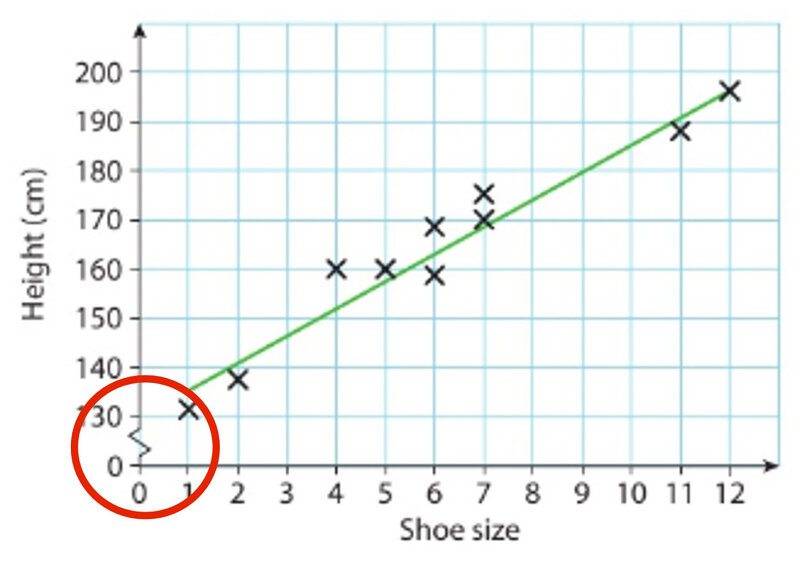
Discussion Overview
The discussion centers around the terminology used to describe a specific mark on the Y-axis of a graph that indicates a discontinuity, where the value of Y jumps from 0 to 130. Participants explore various names and symbols associated with this mark, including its formal designation.
Discussion Character
- Debate/contested
- Conceptual clarification
Main Points Raised
- One participant identifies the mark as a "zigzag" that represents a discontinuity and asks if it has a formal name.
- Another participant states that there is no formal name for it.
- Some participants suggest that the mark can be referred to as an axis break, with various symbols like a squiggle or slanted parallel lines being used to indicate it.
- A participant mentions the term "caesura," suggesting it has a Latin origin meaning a cutting.
- There is a humorous exchange regarding the name "Tresman mark," with one participant asserting it while another dismisses it as incorrect.
- Participants note that a search for "graph axis break symbology" yields terms such as axis break, scale break, and caesura.
Areas of Agreement / Disagreement
Participants express differing views on the formal name of the mark, with no consensus reached on a single term. Multiple competing terms are proposed, and the discussion remains unresolved.
Contextual Notes
Some participants reference external sources and definitions, but there is no agreement on a definitive term. The discussion includes humor and informal exchanges that may affect the seriousness of the terminology debate.
Who May Find This Useful
This discussion may be of interest to individuals studying graphing techniques, mathematical representation, or those curious about terminology in data visualization.