cubby208
- 6
- 0
[Moderator note: Thread moved from technical forum so no template shown]
I am trying to do a simple experiment that estimates the mass of an object based on how an Atwood machine reacts when it is added to one side.
For this experiment we have a pulley with 200-gram masses on either side of the rope. We then set it up so that the right mass was exactly one meter from the floor. Then we would attach the unknown mass to the other time, and measure the time in seconds it took for it to hit the floor.
From this data we calculated that the acceleration was (1 meter / (seconds to fall)^2). We then put it into the following formula.
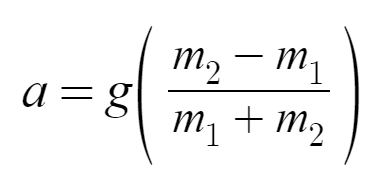
I really don't know where we got this formula from. I also don't know wether the a on one side is expressing acceleration of the system, or just one of the masses.
Since m1 and m2 are both 200 grams we were able to simplify the formula. While simplifying we considered that m2 would be (m1 + mu) (mu being the unknown mass). We then got this formula:
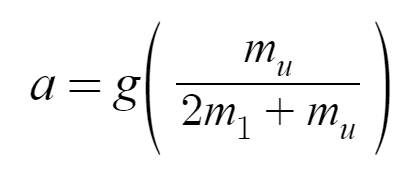
We tried out our first mass and it took it 3.3 seconds to travel one meter.
We plugged everyhing into the formula and got
Unfortunately this did not work out for us. We converted grams to kilograms and substituted everything in. We got a calculated mass that was way too low, the objects actual weight is 12 grams. What did we mess up?
I am trying to do a simple experiment that estimates the mass of an object based on how an Atwood machine reacts when it is added to one side.
For this experiment we have a pulley with 200-gram masses on either side of the rope. We then set it up so that the right mass was exactly one meter from the floor. Then we would attach the unknown mass to the other time, and measure the time in seconds it took for it to hit the floor.
From this data we calculated that the acceleration was (1 meter / (seconds to fall)^2). We then put it into the following formula.
I really don't know where we got this formula from. I also don't know wether the a on one side is expressing acceleration of the system, or just one of the masses.
Since m1 and m2 are both 200 grams we were able to simplify the formula. While simplifying we considered that m2 would be (m1 + mu) (mu being the unknown mass). We then got this formula:
We tried out our first mass and it took it 3.3 seconds to travel one meter.
We plugged everyhing into the formula and got
Unfortunately this did not work out for us. We converted grams to kilograms and substituted everything in. We got a calculated mass that was way too low, the objects actual weight is 12 grams. What did we mess up?