SUMMARY
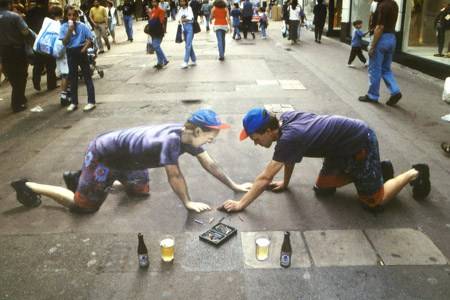
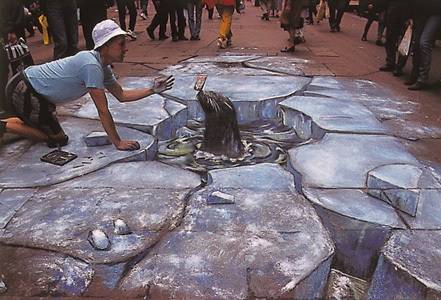
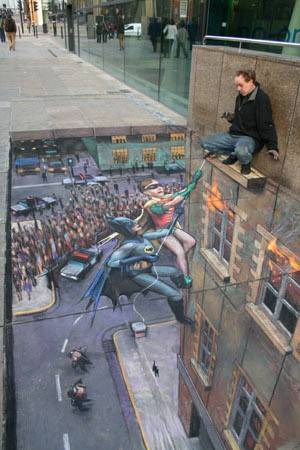
The forum discussion centers on the captivating 3-D chalk drawings of Julian Beever, known for his trompe l'oeil technique that creates optical illusions. Participants express awe at the realism of his work, particularly how it appears from specific angles, while discussing the depth perception mechanisms involved, such as shadows and monocular cues. The conversation also touches on the challenges of viewing these artworks from different perspectives and the psychological effects they can have on viewers. Links to Beever's work and related depth perception concepts are shared for further exploration.
PREREQUISITES
- Understanding of trompe l'oeil art techniques
- Knowledge of depth perception principles, including monocular cues
- Familiarity with optical illusions and their psychological effects
- Basic art appreciation skills
NEXT STEPS
- Research Julian Beever's techniques in creating 3-D chalk art
- Explore the science of depth perception and its visual cues
- Investigate the psychological impact of optical illusions on viewers
- Learn about other artists who utilize similar trompe l'oeil methods
USEFUL FOR
This discussion is beneficial for artists, art students, psychologists interested in perception, and anyone fascinated by optical illusions and visual arts.