Discussion Overview
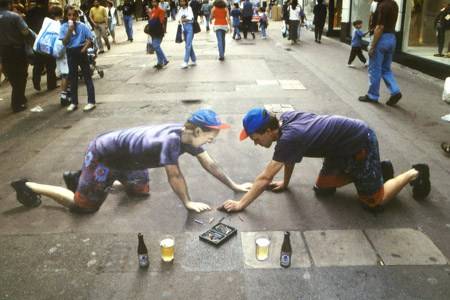
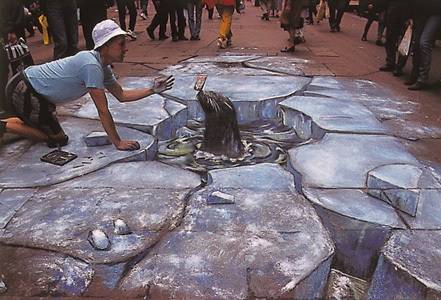
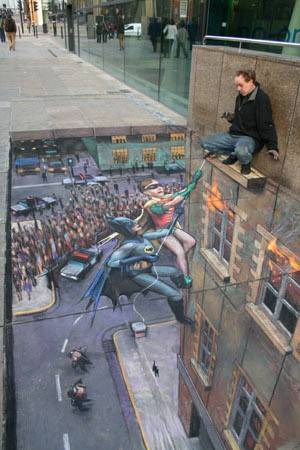
The discussion revolves around the captivating nature of Julian Beever's 3-D chalk drawings, exploring their visual impact, techniques, and the perception of depth they create. Participants share their thoughts on the artistry, compare it with other artists, and delve into the psychological and physiological aspects of depth perception related to these artworks.
Discussion Character
- Exploratory
- Conceptual clarification
- Debate/contested
Main Points Raised
- Some participants express admiration for Beever's work, noting its stunning visual effects and the realism of the drawings.
- Others mention a different artist they believe to be even more impressive, highlighting the subjective nature of artistic appreciation.
- There is a discussion about the optimal viewing angles for these drawings, with some participants suggesting that they are designed to create a specific visual illusion from a particular perspective.
- One participant proposes that the drawings could be replicated using projectors and a "paint by numbers" approach, indicating a potential method for creating similar artworks.
- Several participants discuss the role of shadows and other visual cues in depth perception, with some questioning the accuracy of the commonly cited figures regarding depth perception reliance on shadows versus stereoscopic cues.
- There are mentions of personal experiences with depth perception issues, such as amblyopia, and how individuals adapt to these challenges in various activities.
- Some participants express curiosity about the durability of the chalk drawings and their waterproof properties.
Areas of Agreement / Disagreement
The discussion features a mix of agreement on the impressive nature of Beever's work, but also disagreement regarding the specifics of depth perception and the effectiveness of different visual cues. Multiple competing views on the artists' merits and the techniques used in creating the drawings remain unresolved.
Contextual Notes
Participants reference various visual perception theories and personal experiences, but there are limitations in the clarity of the figures and concepts discussed, as well as the potential for differing interpretations of depth perception cues.
Who May Find This Useful
Individuals interested in art, visual perception, psychology, and those studying or appreciating chalk art and optical illusions may find this discussion relevant.