MHB Which Interval Shows f' Always Increasing?

Click For Summary
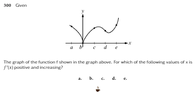
The discussion centers on identifying intervals where the derivative f' is always increasing. Observations indicate that point e is the only location where the slope is consistently increasing. Other points, such as a and d, show decreasing slopes, while point b has a cusp where the derivative does not exist. Point c has a positive slope but is flattening, indicating a decrease in f'. Ultimately, point e is confirmed as the correct answer for where f' is always increasing.
karush
Gold Member
MHB
Messages
3,240
Reaction score
5
View attachment 9411image due to macros in overleaf

well apparently all we can do is solve this by observation
which would be the slope as x moves in the positive direction
e appears to be the only interval where the slope is always increasing
 

Attachments

  • Capture.PNG
    Capture.PNG
    4.2 KB · Views: 153
Physics news on Phys.org
karush said:
image due to macros in overleaf

well apparently all we can do is solve this by observation
which would be the slope as x moves in the positive direction
e appears to be the only interval where the slope is always increasing

You have not correctly understood or interpreted the question. e is a point, not an interval.

"always increase" doesn't mean anything for a point. Either it's increasing at that point or it isn't.
 
Ok good point

Well at point e the slope is increasing
 
At point a the function is decreasing so f' is negative, not positive. At point b there is a cusp so f' does not even exist there. At point c the function is increasing so f' is positive but the graph is "flattening" so f' is decreasing, not increasing. At point d the function is decreasing so f' is negative, not positive. At point e the function is increasing so f' is positive and the graph is getting steeper so f' is increasing. Yes, e is the correct answer.
 
There are probably loads of proofs of this online, but I do not want to cheat. Here is my attempt: Convexity says that $$f(\lambda a + (1-\lambda)b) \leq \lambda f(a) + (1-\lambda) f(b)$$ $$f(b + \lambda(a-b)) \leq f(b) + \lambda (f(a) - f(b))$$ We know from the intermediate value theorem that there exists a ##c \in (b,a)## such that $$\frac{f(a) - f(b)}{a-b} = f'(c).$$ Hence $$f(b + \lambda(a-b)) \leq f(b) + \lambda (a - b) f'(c))$$ $$\frac{f(b + \lambda(a-b)) - f(b)}{\lambda(a-b)}...

Similar threads

  • · Replies 2 ·
Replies
2
Views
2K
  • · Replies 6 ·
Replies
6
Views
2K
  • · Replies 1 ·
Replies
1
Views
1K
  • · Replies 1 ·
Replies
1
Views
1K
Replies
4
Views
2K
  • · Replies 5 ·
Replies
5
Views
2K
  • · Replies 3 ·
Replies
3
Views
1K
Replies
25
Views
5K
  • · Replies 4 ·
Replies
4
Views
1K
  • · Replies 1 ·
Replies
1
Views
1K