Which points on the plane satisfy the given equation?

Click For Summary

Homework Help Overview

The discussion revolves around the equation |y|x = x, exploring which points on the plane satisfy this equation. Participants analyze the implications of the absolute value and consider different cases based on the sign of y, leading to various interpretations of the solutions.

Discussion Character

  • Mixed

Approaches and Questions Raised

  • Participants examine two main cases based on the value of y (y ≥ 0 and y < 0) and derive potential solutions. There is debate over the completeness of these cases, with some suggesting that additional scenarios should be considered, particularly regarding the behavior of x.

Discussion Status

The discussion is ongoing, with some participants offering guidance on how to approach the problem systematically. There is a recognition of differing opinions on the necessity of considering multiple cases, and while some participants agree on the sufficiency of two cases, others advocate for a more exhaustive approach.

Contextual Notes

Participants note that the original poster's reasoning may have overlooked certain solutions, particularly regarding the y-axis and the implications of the absolute value in the equation. There is also mention of a discrepancy between the participants' findings and the book's solutions.

brotherbobby
Messages
774
Reaction score
172
Homework Statement
Indicate the points on the plane ##xOy## that satisfy the given equation : ##\mathbf{|y|x=x}##
Relevant Equations
By definition, the modulus of a number ##|x| = x\; \text{if}\; x \geq 0## and ##|x| = -x\; \text{if}\; x < 0##.
Given the equation : ##|y| x = x##.

Two conditions are possible :

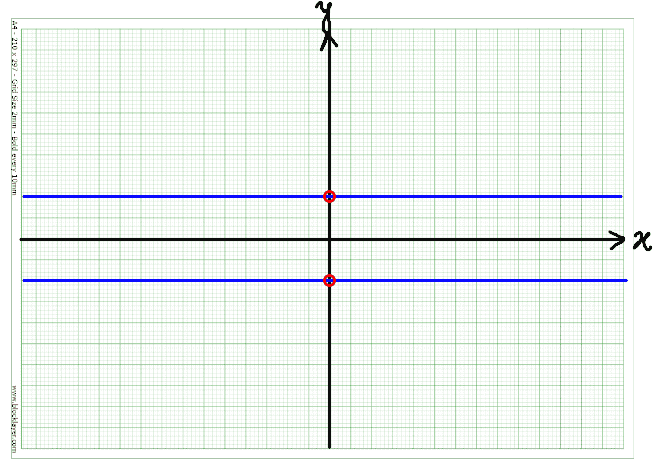
(1) ##\underline{y\geq 0}## : ##xy = x\Rightarrow \boxed{y = 1}\; (x \neq 0)##. We note that except for zero, ##-\infty<x<+\infty## for this case.
(2) ##\underline{y < 0}## : ##-xy = x\Rightarrow \boxed{y = -1}\; (x \neq 0)##. We note that except for zero, ##-\infty<x<+\infty## for this case.
1607440634296.png
Hence the graph for this equation is (shown to the right) :
1607440721560.png
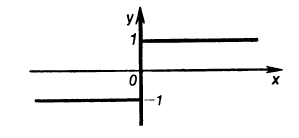
However, it is a different answer as given in the book (shown on the left).

As I have mentioned, ##x \in (-\infty, +\infty)\; \text{but}\; x \neq 0##. Hence I see no reason (for the book) to omit the negative values of ##x## for the solution ##y = 1## and the positive values of ##x## for the solution ##y = -1##.

Where am I going wrong with the reasoning? Or, dare I ask, is the book mistaken?
 
Physics news on Phys.org
brotherbobby said:
Homework Statement:: Indicate the points on the plane ##xOy## that satisfy the given equation : ##\mathbf{|y|x=x}##
Relevant Equations:: By definition, the modulus of a number ##|x| = x\; \text{if}\; x \geq 0## and ##|x| = -x\; \text{if}\; x < 0##.

Given the equation : ##|y| x = x##.

Two conditions are possible :

(1) ##\underline{y\geq 0}## : ##xy = x\Rightarrow \boxed{y = 1}\; (x \neq 0)##. We note that except for zero, ##-\infty<x<+\infty## for this case.
For this case, you have ##xy = x \Rightarrow x(y - 1) = 0## From this we see that x = 0 or y = 1. The first equation is a vertical half-line from the origin up (because ##y \ge 0##).
brotherbobby said:
(2) ##\underline{y < 0}## : ##-xy = x\Rightarrow \boxed{y = -1}\; (x \neq 0)##. We note that except for zero, ##-\infty<x<+\infty## for this case.
Work this part in a similar way as above.
brotherbobby said:
View attachment 273919Hence the graph for this equation is (shown to the right) :View attachment 273920However, it is a different answer as given in the book (shown on the left).

As I have mentioned, ##x \in (-\infty, +\infty)\; \text{but}\; x \neq 0##. Hence I see no reason (for the book) to omit the negative values of ##x## for the solution ##y = 1## and the positive values of ##x## for the solution ##y = -1##.
I don't understand their solution, either. Clearly the point (-1, 1) satisifies the equation |y|x = x, as does the point (1, -1).
Their solution would be correct if the equation had been |x|y = x.
Note that every point on the y-axis (i.e., x = 0) is also a solution. Your graph does not show these points.
brotherbobby said:
Where am I going wrong with the reasoning? Or, dare I ask, is the book mistaken?
 
  • Like
Likes   Reactions: BvU
Thank you for your response @Mark44. I should do the problem again along the lines of what you said.

Problem statement : Indicate the points on the plane ##xOy## that satisfy the given equation : ##\mathbf{|y|x = x}##.

Solution : There are two possible cases.

(1) ##\underline{y \geq 0}## : For this case, we have ##xy = x \Rightarrow x(y-1) = 0 \Rightarrow \boxed{x = 0 \; \text{OR}\; y = 1}##.
(2) ##\underline{y < 0}## : For this case, we have ##-xy = x\Rightarrow xy+x = 0\Rightarrow x(y+1) = 0 \Rightarrow \boxed{x = 0 \; \text{OR}\; y = -1}##.

The graph for the ##\boxed{\text{boxed}}## solutions above is drawn below :

1607512160285.png


I hope this solution is ok. Please note that ##(0,1)## and ##(0,-1)## are both solution points of the equation.
 
brotherbobby said:
Solution : There are two possible cases.
.
Hi. Pardon me chipping in. I also agree your solution looks good now. Can I suggest it sometimes helps to rigorously/systematically consider all possible cases. This is longer but prevents accidentally missing regions. (You missed the y-axis in your first solution.) In this problem there are nine (not two) cases!

x = 0 and y = 0 ⇒ (origin)
x = 0 and y > 0 ⇒ (all points on +y-axis)
x = 0 and y < 0 ⇒ (all points on -y-axis)

x > 0 and y = 0 ⇒ (no points)
x > 0 and y > 0 ⇒ (all points on y = 1 for x∊(0, +∞)
x > 0 and y < 0 ⇒ (all points on y = -1 for x∊(0, +∞)

x < 0 and y = 0 ⇒ (no points)
x < 0 and y > 0 ⇒ (all points on y = 1 for x∊(-∞, 0))
x < 0 and y < 0 ⇒ (all points on y = -1 for x∊(-∞, 0))
 
Steve4Physics said:
In this problem there are nine (not two) cases!
You don't need to consider nine cases. Two cases are sufficient: ##y \ge 0## and ##y < 0##.
Case 1: ##y \ge 0##
The equation becomes ##yx - x = 0 \Leftrightarrow x(y - 1) = 0##
Then x = 0 or y = 1
These equations together with the assumption that ##y \ge 0## give the horizontal line y = 1 and the upper half of the y-axis from the origin up, including the origin.
Case 2: ##y < 0##
The equation becomes -yx - x = 0, or -x(y + 1) = 0.
Then x = 0 or y = -1. These equations together with the assumption that y < 0 give the horizontal line y = -1 and the lower half of the y-axis.
 
Mark44 said:
You don't need to consider nine cases. Two cases are sufficient:
I agree. But as I said "This is longer but prevents [certain types of error]". It is especially useful if a student finds the problem difficult and/or for more complicated problems where it's easier to make mistakes. If confident about doing it correctly in less steps, no problemo!
 
Steve4Physics said:
I agree. But as I said "This is longer but prevents [certain types of error]". It is especially useful if a student finds the problem difficult and/or for more complicated problems where it's easier to make mistakes. If confident about doing it correctly in less steps, no problemo!
The error in the first post was due to the OP not recognizing that the equation yx - x = 0 could be factored to x(y - 1) = 0, with solutions of x = 0 or y = 1.

Adding superfluous cases seems likely to me to increase the chances of errors, not decrease them. If you have two cases, it's easy to see that all bases have been covered. OTOH, if you have nine cases, can you guarantee that there isn't a tenth case that you overlooked?
 
Mark44 said:
OTOH, if you have nine cases, can you guarantee that there isn't a tenth case that you overlooked?
I would use the 'two option approach' here myself. But for more complicated problems I was struggling with, I would consider different strategies. If using 2 options (for a complicated problem), how can I guarantee there isn't a 3rd option I've overlooked?

But I can guarantee these 9 options are exhaustive (though generating more work) :
x = 0 and y = 0
x = 0 and y > 0
x = 0 and y < 0
x > 0 and y = 0
x > 0 and y > 0
x > 0 and y < 0
x < 0 and y = 0
x < 0 and y > 0
x < 0 and y < 0

It's always useful to have an alternative strategy.
 
  • #10
Steve4Physics said:
If using 2 options (for a complicated problem), how can I guarantee there isn't a 3rd option I've overlooked?
If the choices are only ##y \ge 0## or ##y < 0##, can there possibly be another option?
 
Last edited:
  • #11
Mark44 said:
If the choices are only ##y \ge 0## or ##y < 0##, can there possibly be another option?
In general, surely there must be equations (containing absolute-values of variables) that require consideration of more than 2 options? For such equations with two variables, all I'm saying is that considering the nine options guarantees exhaustive coverage.
 
Last edited by a moderator:
  • #12
Steve4Physics said:
In general, surely there must be equations (containing absolute-values of variables) that require consideration of more than 2 options?
Well, sure, but my comments were in regard to the problem in this thread.
Steve4Physics said:
For such equations with two variables, all I'm saying is that considering the nine options guarantees exhaustive coverage.
And I'm saying that even though there were two variables in this problem, only one of themneeded to be considered here as far as the cases are concerned. Either ##y \ge 0## or ##y < 0##. Adding seven more cases in this problem is completely unnecessary.
 
  • #13
It it's a more complicated problem, there could be more than 2 options
Mark44 said:
Well, sure, but my comments were in regard to the problem in this thread.
And I'm saying that even though there were two variables in this problem, only one of themneeded to be considered here as far as the cases are concerned. Either ##y \ge 0## or ##y < 0##. Adding seven more cases in this problem is completely unnecessary.
Agreed. I didn't express myself clearly enough when I said"...it sometimes helps to rigorously/systematically consider all possible cases." I was referring to this general type of problem, not this problem in particular. Sorry for any confusion.
 

Similar threads

  • · Replies 7 ·
Replies
7
Views
2K
  • · Replies 2 ·
Replies
2
Views
1K
  • · Replies 15 ·
Replies
15
Views
2K
  • · Replies 11 ·
Replies
11
Views
3K
  • · Replies 14 ·
Replies
14
Views
4K
  • · Replies 10 ·
Replies
10
Views
2K
  • · Replies 2 ·
Replies
2
Views
2K
  • · Replies 10 ·
Replies
10
Views
2K
  • · Replies 6 ·
Replies
6
Views
2K
Replies
7
Views
2K