LionCereals
- 1
- 0
- TL;DR
- How can I explain the average occupation numbers of a coupled cavity-mirror system?
I am considering the following Hamiltonian:
$$H = -\Delta a^{\dagger}a + \omega_m b^{\dagger}b + g_0 * a^{\dagger}a (b + b^{\dagger})$$
which is the interaction picture optomechanical Hamiltonian for a cavity with movable end mirror. The mirror vibrations are quantized, leading to phonons that are annihilated / created using ##b, b^{\dagger}##. Photons in one cavity mode are created with ##a^{\dagger}##.
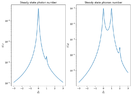
I have plotted the steady-state solution for the average photon number in the cavity, ##n_C##, and the average phonon number in the mirror, ##n_M## as a function of detuning. For this, I used QUTIP and obtained, with the y-axis on log scale (see attachment).This is the typical Lorentzian resonance curve. Now, we clearly see that there are peaks corresponding to ##\Delta = \omega_m$## and ##\Delta = 0##.
I understand the peak at ##\Delta = 0## as then there are lots of photons inside the cavity, so we have a high average photon number and thus a high effective coupling to the mirror, as ##g_0 * n_a## is large.
What I don't understand, however, is why the second peak at ##+\omega_m## is as high as the first peak. Clearly there, we have ##\omega_{in} = \omega_C + \omega_m##, such that the photon - phonon scattering process is resonant. But why has it the same height?
From what I see, if we have (on average) as many phonons in the mirror at ##\Delta = \omega_m## as at ##\Delta = 0##, then the effective coupling strength at both detunings should be equal. But clearly, in the former case there are less photons in the cavity, as they are not resonant with the cavity frequency?
$$H = -\Delta a^{\dagger}a + \omega_m b^{\dagger}b + g_0 * a^{\dagger}a (b + b^{\dagger})$$
which is the interaction picture optomechanical Hamiltonian for a cavity with movable end mirror. The mirror vibrations are quantized, leading to phonons that are annihilated / created using ##b, b^{\dagger}##. Photons in one cavity mode are created with ##a^{\dagger}##.
I have plotted the steady-state solution for the average photon number in the cavity, ##n_C##, and the average phonon number in the mirror, ##n_M## as a function of detuning. For this, I used QUTIP and obtained, with the y-axis on log scale (see attachment).This is the typical Lorentzian resonance curve. Now, we clearly see that there are peaks corresponding to ##\Delta = \omega_m$## and ##\Delta = 0##.
I understand the peak at ##\Delta = 0## as then there are lots of photons inside the cavity, so we have a high average photon number and thus a high effective coupling to the mirror, as ##g_0 * n_a## is large.
What I don't understand, however, is why the second peak at ##+\omega_m## is as high as the first peak. Clearly there, we have ##\omega_{in} = \omega_C + \omega_m##, such that the photon - phonon scattering process is resonant. But why has it the same height?
From what I see, if we have (on average) as many phonons in the mirror at ##\Delta = \omega_m## as at ##\Delta = 0##, then the effective coupling strength at both detunings should be equal. But clearly, in the former case there are less photons in the cavity, as they are not resonant with the cavity frequency?
Attachments