Why are three variables divided by 2 in this pulley constraint equation?

4 replies · 2K views · last reply
guyvsdcsniper
Messages
264
Reaction score
37
Homework Statement
Masses M1 and M2 are connected to a system of strings and pulleys
as shown. The strings are massless and inextensible, and the
pulleys are massless and frictionless. Find the acceleration of M1
Relevant Equations
f=ma
I am having trouble creating the constraint equation for this pulley system.

I don't understand why the last 3 variables of the following constraint is divided by 2?

Could anyone help me understand why this is?
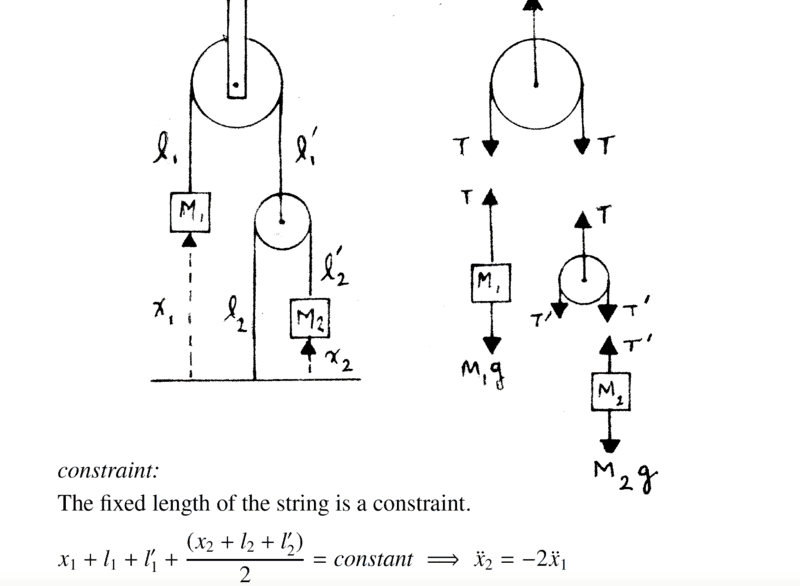
Atwood-type pulley system with a fixed pulley at top and a movable pulley below, masses M1 and M2 hanging on strings, with positions x1 and x2 and string segments labelled l1, l1', l2, l2'; right side shows tension force diagrams T and T' on each pulley and mass, and the constraint equation x1 + l1 + l1' + (x2 + l2 + l2')/2 = constant.
 
quittingthecult said:
I don't understand why the last 3 variables of the following constraint is divided by 2?
That term represents the distance of the second pulley from ground level. (The entire expression is equivalent to saying that the height of the first pulley is fixed.)
 
  • Like
Likes   Reactions: guyvsdcsniper
Doc Al said:
That term represents the distance of the second pulley from ground level. (The entire expression is equivalent to saying that the height of the first pulley is fixed.)
Oh I see. So since there are two strings connected to the second pulley, that distance is halved?
 
quittingthecult said:
So since there are two strings connected to the second pulley, that distance is halved?
Right.
 
  • Like
Likes   Reactions: guyvsdcsniper
quittingthecult said:
...
I am having trouble creating the constraint equation for this pulley system.

I don't understand why the last 3 variables of the following constraint is divided by 2?

Could anyone help me understand why this is?
You can also analyze the system as a mechanism of instantaneous levers.
The anchored pulley works as a type 1 lever (mechanical advantage = 1).
The movil pulley works as a type 2 lever (mechanical advantage = 2 for M2 respect to M1, or 0.5 for M1 respect to M2).

Diagram of three lever classes, each a yellow beam with a green fulcrum triangle, red effort arrow and blue load arrow: Class 1 has fulcrum between effort and load, Class 2 has load between fulcrum and effort, Class 3 has effort between fulcrum and load.
 
  • Like
Likes   Reactions: guyvsdcsniper