Why can't a particle ever reach a non-terminating decimal form radian value?

Click For Summary

Discussion Overview

The discussion revolves around the question of whether a particle can reach a non-terminating decimal form radian value while moving in a circle. It explores the implications of Zeno's paradox and the nature of infinite sequences in relation to physical motion, with participants examining the logic behind the argument that a particle cannot reach certain radian values due to the infinite nature of non-terminating decimals.

Discussion Character

  • Debate/contested
  • Conceptual clarification
  • Mathematical reasoning

Main Points Raised

  • Some participants argue that a particle cannot reach a non-terminating decimal radian value because it must cover an infinite sequence of positions, which they believe cannot be completed.
  • Others counter that the particle can indeed reach an infinite number of real numbers in finite time, suggesting that the completion of the sequence is possible despite its infinite nature.
  • A participant questions the logic that an infinite sequence of steps prevents the particle from reaching a value, asking for clarification on what it means for a particle to complete a sequence.
  • Some participants highlight that the assumption of equal time for each step leads to the conclusion that an infinite number of steps would take infinite time, which they argue is a misunderstanding of how infinite sequences operate.
  • There is a suggestion that the modern understanding of infinite sequences contradicts the idea that a sequence must have a last action to be completed.
  • A participant expresses a desire to understand the modern vision of infinite sequences and their implications for the argument presented.

Areas of Agreement / Disagreement

The discussion features multiple competing views regarding the nature of infinite sequences and their relation to physical motion. There is no consensus on whether the particle can reach non-terminating decimal values, and participants continue to challenge each other's reasoning.

Contextual Notes

Participants reference Zeno's paradox and its implications for motion, indicating a need for clarity on the assumptions made about time and the completion of sequences. The discussion remains focused on the logical reasoning behind the claims rather than resolving the underlying mathematical concepts.

Vinay080
Gold Member
Messages
53
Reaction score
3
Consider a particle P moving in a circle of radius r as shown in the figure.
Premise 1: Position of the particle can be described by the angle θ.
Premise 2: Particle reaches the position with an angle θ if it has covered the angle lesser than θ.
Premise 3: Particle can never reach non-terminating decimal form radian value.
For example: 0.33333...rad; The particle can never reach this radian value because, to reach this value, first particle needs to cover 0.33 rad, then 0.333 rad, then 0.33333, and so on. Particle needs to go on and on, and the sequence of 0.333.. never ends.
Premise 4: As the particle can never reach non-terminating decimal form radian value, it can't even reach neighbor terminating decimal form radian value. For example 0.4 (considering 0.333.. of Premise 3) can never be reached as 0.333... can never be reached.

The argument, as evident, is in the zeno version. But, I am not able to come out of this cage. What is going wrong in this argument? Can the particle never reach non-terminating decimal form value? I think this problem can be generalized to all the physical quantities.
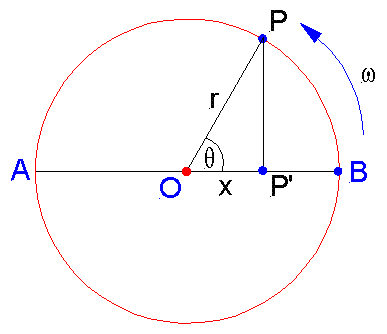
HHnJW.gif


I had discussed a similar problem here: https://www.physicsforums.com/threads/diagonal-length-problem.806206/
 
Last edited:
Physics news on Phys.org
Vinay080 said:
Particle needs to go on and on, and the sequence of 0.333.. never ends.
And all those steps together can be done in finite time.
The resolution is exactly the same as for the linear case (you don't need the circle here at all). You can reach an infinite number of real numbers in a finite time.
 
Particle needs to go on and on, and the sequence of 0.333.. never ends.
mfb said:
And all those steps together can be done in finite time.
The resolution is exactly the same as for the linear case (you don't need the circle here at all). You can reach an infinite number of real numbers in a finite time.

Yes, I agree that, in reality it seems that particle completes the sequence 0.3, 0.33, 0.333, 0.333 and so on, in finite time.
But, the question is about whether particle completes the sequence (0.3, 0.33, 0.333, 0.333...) or not, based on the logic given, i.e 0.333... sequence has no end, so the particle can never complete this sequence, so the particle can never reach the subsequent terminating decimal form radian value. I see this problem as more on how to break this logical reasoning rather than getting satisfied by other reasons.
 
Last edited:
Vinay080 said:
sequence has no end, so the particle can never complete this sequence
There is no reason why the second part should follow from the first one.
 
Vinay080 said:
sequence has no end, so the particle can never complete this sequence,
Why not? What does it even mean for a particle to complete a sequence and why would a sequence being infinite prevent completion.
 
Vinay080 said:
sequence has no end, so the particle can never complete this sequence,

mfb said:
There is no reason why the second part should follow from the first one.

DaleSpam said:
Why not? What does it even mean for a particle to complete a sequence and why would a sequence being infinite prevent completion.
Sorry, I think, I was not clear in my thought.

Let me qutote the premise 3 (modified), which I posted first in the first post of this thread :

Premise 3: Particle can never reach non-terminating decimal form radian value.
For example: 0.33333...rad; The particle can never reach this radian value because, to reach this value, first particle needs to cover 0.33 rad, then 0.333 rad, then 0.33333, and so on. Particle needs to go on and on, and it can never reach 0.333... non-terminating value.

I will be happy if you can please redefine my faults (if there are any).
 
Vinay080 said:
I will be happy if you can please redefine my faults (if there are any).
Perhaps it would help if you were to realize that each of the steps you are describing will take progressively less and less time to complete. The total time taken will be the sum of all those steps - which is finite! and that doesn't correspond to your "never".
 
Vinay080, Zeno's paradox was bad math and logic even when Zeno first proposed it. Your basic error is the same as Zeno's: (As sophiecentaur said) nowhere in anything you've written have you considered the time taken for each step. How can you possibly conclude anything about how long all steps will take unless you've considered how long each individual step takes?
 
Vinay080 said:
Premise 3: Particle can never reach non-terminating decimal form radian value.
For example: 0.33333...rad; The particle can never reach this radian value because, to reach this value, first particle needs to cover 0.33 rad, then 0.333 rad, then 0.33333, and so on. Particle needs to go on and on, and it can never reach 0.333... non-terminating value.
By this logic, you would conclude that the sequence 0.3, 0.33, 0.333, 0.3333, 0.33333, ... diverges to a value of infinity. Do you really believe that? Don't you accept that it converges to ⅓?
 
  • #10
DrGreg said:
By this logic, you would conclude that the sequence 0.3, 0.33, 0.333, 0.3333, 0.33333, ... diverges to a value of infinity. Do you really believe that? Don't you accept that it converges to ⅓?
No, typically, that's not how the [il]logic goes. Typically, it's just a matter of the implicit assumption that each step takes the same amount of time, therefore an infinite number of steps takes an infinite amount of time. That doesn't have anything to do with whether the value converges to 1, it's just a different formulation of an infinite sequence than Zeon used to illustrate the same thing (1/2+1/4+1/8...).
 
  • Like
Likes   Reactions: Vinay080
  • #11
russ_watters said:
No, typically, that's not how the [il]logic goes. Typically, it's just a matter of the implicit assumption that each step takes the same amount of time, therefore an infinite number of steps takes an infinite amount of time. That doesn't have anything to do with whether the value converges to 1, it's just a different formulation of an infinite sequence than Zeon used to illustrate the same thing (1/2+1/4+1/8...).
I think the implicit assumption is more like "any sequence of actions that can be completed must have a last action". The modern vision of infinite sequences makes that assumption false, of course.
 
  • Like
Likes   Reactions: Vinay080
  • #12
Vinay080 said:
The particle can never reach this radian value because, to reach this value, first particle needs to cover 0.33 rad, then 0.333 rad, then 0.33333, and so on.
OK, so what? What is it about "covering" a sequence of positions that you think prevents covering an infinite sequence of positions? You don't even need to go to a non-terminating decimal number like 1/3. You can just consider the infinite number of positions between 0.33 and 0.333. There already are an infinite number of positions there and you seem to accept that that infinite number of points could all be reached, so why not the remaining points between 0.333 and 1/3?

I am trying to help you spot your own error, but if this is just confusing you, then simply google for Zeno's paradox. This is all very standard stuff with lots of information about how it is resolved.
 
  • Like
Likes   Reactions: Vinay080
  • #13
Thank you very much @jbriggs444. I meant exactly what you meant, if I have understood correctly what you meant. I look forward to understand the modern vision of infinite sequences which makes it false. If you have any suggestions on topics/books I should read, I will be privileged. But, @russ_watters "implicit assumption" was new to taste for me. Finally, a good point coming from @DaleSpam will sure help for my further understanding of this concept.
 
Last edited:
  • #14
Vinay080 said:
Thank you very much @jbriggs444. I meant exactly what you meant, if I have understood correctly what you meant. I look forward to understand the modern vision of infinite sequences which makes it false. If you have any suggestions on topics/books I should read, I will be privileged. But, @russ_watters "implicit assumption" was new to taste for me.
Mathematics has a number of notions of "infinity". We are concerned with a specific sort here, the idea of an infinite set. That is, a set that has infinitely many members. Consider, for instance, the natural numbers as a set.

The first thing to remember is that the membership of a set is fixed. It does not change. We view the set of natural numbers is completed whole. It is not something that is a "potential infinity" which is as large as we need it to be for the task at hand. It is not a never ending process where we keep adding numbers to the set forever. The set of natural numbers is fixed and every natural number is a member.

That can be a hard concept to wrap your head around. It is key.

The natural numbers are characterized by the Peano Axioms (http://en.wikipedia.org/wiki/Peano_axioms). Those axioms make explicit that every natural number has a successor. There is no last natural number. There is nonetheless, a set containing all of them.
 

Similar threads

  • · Replies 0 ·
Replies
0
Views
5K
  • · Replies 22 ·
Replies
22
Views
4K
  • · Replies 37 ·
2
Replies
37
Views
10K
  • · Replies 4 ·
Replies
4
Views
4K
  • · Replies 5 ·
Replies
5
Views
3K
  • · Replies 8 ·
Replies
8
Views
5K
  • · Replies 10 ·
Replies
10
Views
6K