Why Did My Second Approach to Finding the Block's Acceleration Fail?

  • Thread starter guyvsdcsniper
  • Start date
  • Tags Tags
    Acceleration
2 replies · 1K views · last reply
guyvsdcsniper
Messages
264
Reaction score
37
Homework Statement
Find the blocks acceleration on a wedge.
Relevant Equations
F=MA
I am currently solving this problem and approached it two different ways. I have attached a ss of the picture for reference.

On my first attempt, shown on the attached image in pen, I used a component of the normal force and weight as my forces in the y direction. I carried out the work and ended up getting the correct answer according to my book.

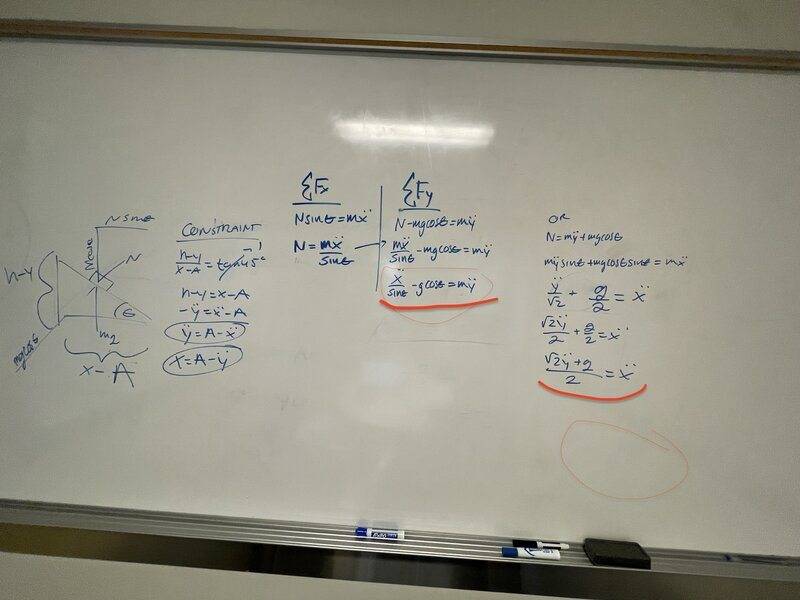
I then tried a different approach, as shown by the image with the whiteboard, and used the actual normal force and a component of the force of gravity. When I used this approach I got stuck and did not see anyway of attaining the correct answer.

What is incorrect about the 2nd approach that is preventing me from getting the right answer?
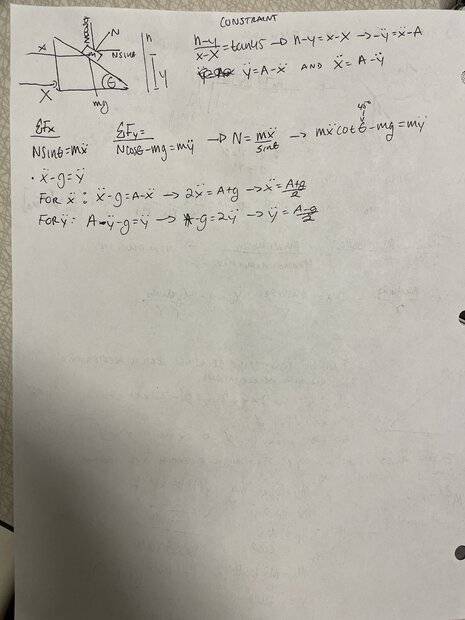
Handwritten work on paper: a block-and-wedge diagram with angle θ, a constraint equation relating x and y, force equations ΣFx and ΣFy with N sinθ = mẍ and N cosθ − mg = mÿ, and solutions for ẍ and ÿ.
Whiteboard showing a wedge and block free-body setup with constraint equations, two Newton's second law equations in x and y, and an alternative set of equations with N = mÿ + mg cos θ, with final results circled in red.
Diagram of a block of mass m resting on a 45 degree wedge that is pushed to the right along a table with acceleration A, with x and y axes drawn beside it.
 
In the whiteboard calculation, it looks like you are taking the y-direction to be perpendicular to the ground for the diagram and the constraint equation:
Handwritten physics diagram of a wedge on a surface with a block on its slope, labeled N, mg, x-A and y, with a constraint equation and the relations y'' = A'' - x'' and T = A - y' on the right.


But when you set up the ##\sum F_y## equation, you switch to taking the y-direction to be perpendicular to the plane (i.e., along the normal force ##N##):
Handwritten whiteboard calculation: sum of Fy equations for a block on an incline, reading N - mg cos θ = m ÿ, then m ẍ / sin θ - mg cos θ = m ÿ, and x ÿ / sin θ - g cos θ = ÿ, with the last line underlined in red.


So, there is an inconsistency in the choice of the y-direction for the whiteboard calculation. ##y## in the constraint equation is not the same as the ##y## in the ##\sum F_y## equation.
 
  • Like
Likes   Reactions: guyvsdcsniper
TSny said:
In the whiteboard calculation, it looks like you are taking the y-direction to be perpendicular to the ground for the diagram and the constraint equation:
View attachment 296975

But when you set up the ##\sum F_y## equation, you switch to taking the y-direction to be perpendicular to the plane (i.e., along the normal force ##N##):
View attachment 296976

So, there is an inconsistency in the choice of the y-direction for the whiteboard calculation. ##y## in the constraint equation is not the same as the ##y## in the ##\sum F_y## equation.
Thank you. That makes it very clear.