Why directional derivatives can exist without continuity while total derivatives imply it

3 replies · 2K views · last reply
Math Amateur
Gold Member
MHB
Messages
3,920
Reaction score
48
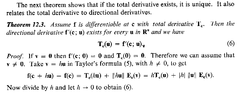
I am reading Tom M Apostol's book "Mathematical Analysis" (Second Edition) ...I am focused on Chapter 12: Multivariable Differential Calculus ... and in particular on Section 12.4: The Total Derivative ... ...I need help in order to fully understand Theorem 12.3, Section 12.4 ...Theorem 12.3 (including its proof) reads as follows:
View attachment 8505

Regarding the above Theorem, I am finding it difficult to understand how, when $$T_c(u) = f'(c;u)$$, that a function can have a finite directional derivative $$f'(c;u)$$ for every $$u$$ but may fail to be continuous at $$c$$ ... whereas! ... for a total derivative ... when a function has a total derivative it is continuous ... YET! ... $$T_c(u) = f'(c;u)$$ ...Can someone please explain what is going on ...
Help will be appreciated ...

Peter
=====================================================================================

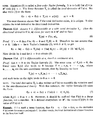
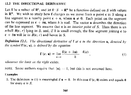
It may help MHB readers of the above post to have access to Section 12.4 on the total derivative ... so I am providing access to the same ... as follows...
View attachment 8506
View attachment 8507
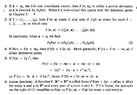
It may also help MHB readers of the above post to have access to Section 12.2 on the directional derivative ... so I am providing access to the same ... as follows...

View attachment 8508
View attachment 8509
Hope that helps ...

Peter
 
Attachments
  • Printed page from Apostol's Mathematical Analysis showing Theorem 12.3 with its proof: the total derivative T_c(u) equals the directional derivative f'(c; u), with equation (6) and the proof dividing f(c + hu) - f(c) by h and letting h tend to 0.
    Apostol - Theorem 12.3 .png
    13.5 KB · Views: 174
  • Scanned textbook page titled 12.4 The Total Derivative, showing equations (3) to (5) defining the error term E_c(h), the first-order Taylor formula, and Definition 12.2 of differentiability at c via a linear map T_c.
    Apostol - 1 - Section 12.4 ... PART 1 .png
    32.7 KB · Views: 185
  • Printed page from a math textbook covering the total derivative: Taylor formula (5), Theorem 12.3 relating total derivative to directional derivatives, Theorem 12.4 on differentiability implying continuity, and an example about linear functions.
    Apostol - 2 - Section 12.4 ... PART 2 ... .png
    41.1 KB · Views: 187
  • Printed page 344 from Section 12.2, The Directional Derivative: text defining f'(c; u) as the limit as h approaches 0 of (f(c + hu) - f(c))/h, equation (1), with a note that u need not have unit norm.
    Apostol - 1 - Section 12.2 ... PART 1 ... .png
    22.5 KB · Views: 166
  • Printed text from Apostol's Mathematical Analysis, items 2 to 6: partial derivative D_k f(c) defined from f'(c; u_k); vector-valued f' formula with components; equation (2) for D_k f(c); F(t) = f(c + tu) and F'(0) = f'(c; u); norm-squared example giving F'(0) = 2c·u; and the definition of linear functions.
    Apostol - 2 - Section 12.2 ... PART 2 .png
    19.5 KB · Views: 163
Peter said:
I am reading Tom M Apostol's book "Mathematical Analysis" (Second Edition) ...I am focused on Chapter 12: Multivariable Differential Calculus ... and in particular on Section 12.4: The Total Derivative ... ...I need help in order to fully understand Theorem 12.3, Section 12.4 ...Theorem 12.3 (including its proof) reads as follows:Regarding the above Theorem, I am finding it difficult to understand how, when $$T_c(u) = f'(c;u)$$, that a function can have a finite directional derivative $$f'(c;u)$$ for every $$u$$ but may fail to be continuous at $$c$$ ... whereas! ... for a total derivative ... when a function has a total derivative it is continuous ... YET! ... $$T_c(u) = f'(c;u)$$ ...Can someone please explain what is going on …
Consider the function f(x, y)= 0 if xy= 0, f(x,y)= 1 otherwise. xy= 0 if and only if x= 0 or y= 0. Think of this as the plane z= f(x,y)= 1 with (x, 0, 1) and (0, y, 1), above x and y axes, lowered down to z= 0. At any point on the x-axis the derivative in the x-direction exists (and is 0). At any point on the y-axis the derivative in the y-direction exists and is 0. At the origin, the derivative in both x and y directions exist. But the function is not continuous on the axes.
 
Peter said:
I am finding it difficult to understand how ... a function can have a finite directional derivative $$f'(c;u)$$ for every $$u$$ but may fail to be continuous at $$c$$.
An example of this is given by the function $f(x,y) = \dfrac{x^2y}{x^4+y^2}$ for all $(x,y)\ne(0,0)$, with $f(0,0) = 0.$ This function has a directional derivative in every direction at the origin. In fact, in the direction of the vector $(u,v)$, \[ \frac{f(hu,hv) - f(0,0)}h = \frac{h^3u^2v}{h(h^4u^4 + h^2v^2)} = \frac{u^2v}{h^2u^4 + v^2}.\] Taking the limit as $h\to0$, \[\lim_{h\to0}\frac{u^2v}{h^2u^4 + v^2} = \begin{cases}0&\text{if }v=0,\\ \frac{u^2}v&\text{if }v\ne0. \end{cases} \] So that limit exists for every direction $(u,v).$

On the other hand, $f(x,x^2) = \dfrac{x^4}{2x^4} \to \frac12$ as $x\to0$. So there are points arbitrarily close to $(0,0)$ at which the function takes the value $\frac12$. Therefore $f$ is not continuous at the origin. Geometrically, what is happening here is that the function tends to $0$ as you approach the origin from any direction in a straight line. But if you approach the origin along the curve $y=x^2$, the function tends to $\frac12$ rather than $0$.

Of course, this function cannot have a total derivative at the origin, because that would imply continuity there.
 
Last edited:
Opalg said:
An example of this is given by the function $f(x,y) = \dfrac{x^2y}{x^4+y^2}$ for all $(x,y)\ne(0,0)$, with $f(0,0) = 0.$ This function has a directional derivative in every direction at the origin. In fact, in the direction of the vector $(u,v)$, \[ \frac{f(hu,hv) - f(0,0)}h = \frac{h^3u^2v}{h(h^4u^4 + h^2v^2)} = \frac{u^2v}{h^2u^4 + v^2}.\] Taking the limit as $h\to0$, \[\lim_{h\to0}\frac{u^2v}{h^2u^4 + v^2} = \begin{cases}0&\text{if }v=0,\\ \frac{u^2}v&\text{if }v\ne0. \end{cases} \] So that limit exists for every direction $(u,v).$

On the other hand, $f(x,x^2) = \dfrac{x^4}{2x^4} \to \frac12$ as $x\to0$. So there are points arbitrarily close to $(0,0)$ at which the function takes the value $\frac12$. Therefore $f$ is not continuous at the origin. Geometrically, what is happening here is that the function tends to $0$ as you approach the origin from any direction in a straight line. But if you approach the origin along the curve $y=x^2$, the function tends to $\frac12$ rather than $0$.

Of course, this function cannot have a total derivative at the origin, because that would imply continuity there.
Thanks Country Boy and Opalg

Peter