Discussion Overview
The discussion revolves around the reasons why planets follow the same curvature at both foci of their elliptical orbits, particularly in the context of Newtonian and Einsteinian gravity. Participants explore the implications of gravitational forces, curvature of space-time, and the mathematical underpinnings of orbital motion.
Discussion Character
- Technical explanation
- Conceptual clarification
- Debate/contested
- Mathematical reasoning
Main Points Raised
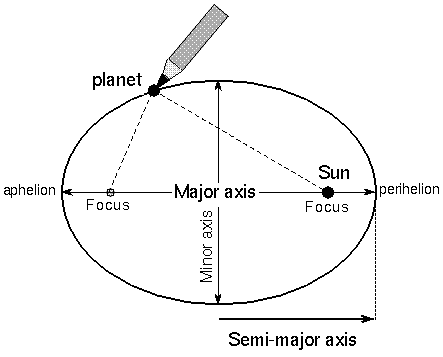
- Some participants note that planets and comets orbit the sun in an ellipse, as described by Kepler's laws, and question how this relates to Einstein's theory where gravity is not viewed as a force.
- One participant suggests that the symmetry in the curvature of orbits arises because, although gravitational force is stronger at perihelion, the planet travels faster at this point, leading to a balance that maintains curvature.
- Another participant emphasizes the mathematical solution provided by Newton, indicating that the increased speed at perihelion compensates for the stronger gravitational force, resulting in similar curvature at apogee.
- Some participants challenge the notion of curvature being consistent across different distances, arguing that curvature does not change with speed and that the far focus would appear almost straight compared to the perihelion.
- There are claims that Einstein's theory is based on the geometry of spacetime rather than curved space, and that the energy equations differ from Newton's, potentially providing insight into the symmetry of orbits.
- Participants discuss the role of centripetal acceleration and conservation of angular momentum in understanding orbital curvature, suggesting that these principles must be considered alongside gravitational forces.
Areas of Agreement / Disagreement
Participants express differing views on the relationship between gravitational force, curvature, and speed. There is no consensus on whether curvature remains consistent across the foci of orbits, with some arguing for symmetry and others challenging this notion based on their interpretations of gravitational effects and spacetime geometry.
Contextual Notes
Limitations in the discussion include assumptions about the nature of curvature in space versus spacetime, the applicability of Newtonian mechanics versus general relativity, and the complexity of mathematical derivations involved in orbital motion.