Why do positive and negative charges repel each other?

Join the discussion
Registration is free. Ask a follow-up in this thread, or start your own.
6 replies · 2K views
xtrubambinoxpr
Messages
86
Reaction score
0
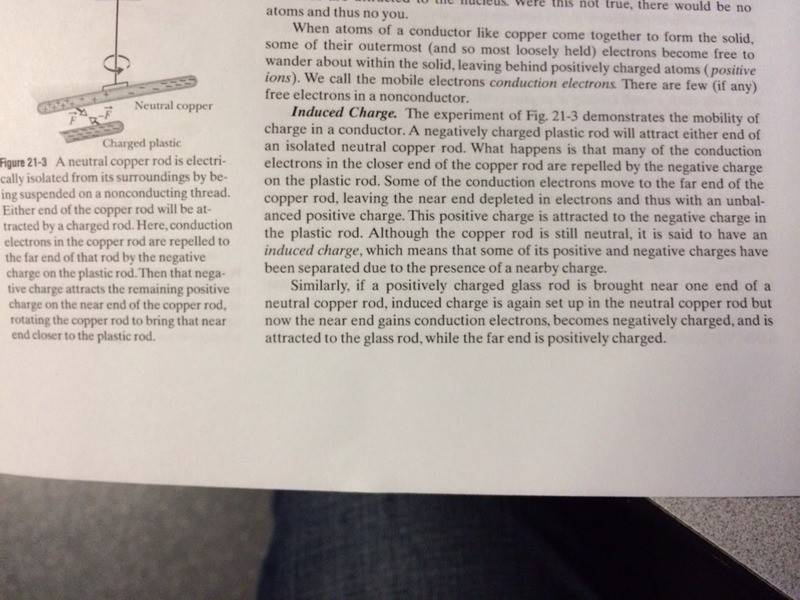
Can anyone explain this excerpt to me? I'm lost on how the positive and negative charges push each other away instead of attract.

Thanks!

P.s

I think this goes in this forum.

ImageUploadedByPhysics Forums1392693395.872396.jpg
 
Physics news on Phys.org
ehild said:
Where have you seen that the opposite charges push away each other?

ehild
On the picture it depicts it. An in the paragraph starting with "some of the electrons" sentence says they are unbalanced. I'm just a little confused on it
 
It's not that the electrons are pushed away by the positive charge at the other end of the rod. They are initially repelled by the negative charge in the other rod that's held up close. The electrons at the far end of the rod are still attracted to the positive end, but they stay at the far end due to the competing force of the other rod.
 
You mean "some of the conduction electrons move to the far end of the cooper rod leaving the near end of the cooper rod depleted in electrons and thus with an unbalanced positive charge"?

The plastic rod is negatively charged. The electrons have negative charge. When the plastic rod is brought close to the cooper, it repels the free electrons of the cooper and they move as far as possible. So the part of the cooper rod which is close to the plastic becomes positive. That part is attracted by the negative plastic rod, and the far end is repelled, but with less force, as it is farther. (The electrons pushed away are attracted to the positive charge remained at the close end, but that force is smaller then that of the plastic rod).

ehild
 
ehild said:
You mean "some of the conduction electrons move to the far end of the cooper rod leaving the near end of the cooper rod depleted in electrons and thus with an unbalanced positive charge"?

The plastic rod is negatively charged. The electrons have negative charge. When the plastic rod is brought close to the cooper, it repels the free electrons of the cooper and they move as far as possible. So the part of the cooper rod which is close to the plastic becomes positive. That part is attracted by the negative plastic rod, and the far end is repelled, but with less force, as it is farther. (The electrons pushed away are attracted to the positive charge remained at the close end, but that force is smaller then that of the plastic rod).

ehild

Ahhhhh i see! Thanks! Silly question I know but Id rather ask now and understand it rather than not know at all!