Math Amateur
Gold Member
MHB
- 3,920
- 48
I am reading D. J. H. Garling's book: "A Course in Mathematical Analysis: Volume I: Foundations and Elementary Real Analysis ... ...
I am focused on Chapter 1: The Axioms of Set Theory ... ...
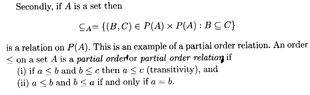
I need some help to clarify an aspect of Garling's definition of a partial order ...Garling's definition of a partial order reads as follows:View attachment 9028
View attachment 9029Garling thus defines a partial order relation as possessing transitivity and anti-symmetry ... but a number of other authors define a partial order as having the property of reflexivity as well ...
... ... an example is Daniel W. Cunningham: Set Theory: A First Course ... who defines a partial order as follows:View attachment 9030Can someone explain why Garling does not include reflexivity in his definition of a partial order ...?
Is it perhaps that it is possible to derive reflexivity from transitivity and anti-symmetry ... but how do we do that ...?Help will be appreciated ...
Peter
Attachments