Why Does Taylor's Theorem Use +O(ε) Instead of -O(ε)?

Join the discussion
Registration is free. Ask a follow-up in this thread, or start your own.
3 replies · 1K views
gionole
Messages
281
Reaction score
24
Homework Statement
Help me with taylor's theorem
Relevant Equations
Help me with taylor's theorem
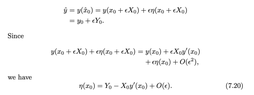
I am trying to grasp how the last equation is derived. I understand everything, but the only thing problematic is why in the end, it's ##+O(\epsilon)## and not ##-O(\epsilon)##. It will be easier to directly attach the image, so please, see image attached.
 

Attachments
  • Screenshot 2023-12-27 at 1.32.29 PM.png
    Screenshot 2023-12-27 at 1.32.29 PM.png
    8.6 KB · Views: 132
Physics news on Phys.org
I am not accustomed the way of the text. What is the text you use ?
 
O-notation tells you about the magnitude of the error in some limit, in this case [itex]\epsilon \to 0[/itex]; the sign of the error can depend on [itex]\epsilon[/itex], so it is conventional to use a plus sign.
 
Reply
  • Like
Likes   Reactions: gionole
The expression, ##f=g+O(\epsilon)## means that there exists such positive number ##M## that ##|f-g| \leq M|\epsilon|##.
OTOH, ##f=g-O(\epsilon)## means ##g=f+O(\epsilon)##, which means that there exists such positive number ##M## that ##|g-f| \leq M|\epsilon|##. This is the same as above. So, one can always use ##+O(\epsilon)##.
 
Reply
  • Like
  • Love
Likes   Reactions: WWGD and gionole