Archeon
- 7
- 0
I am basically just rewriting a question that was posted on other forums.
While watching videos of a MIT lecture on the eigenstates of angular momentum (video: '16. Eigenstates of the Angular Momentum II' by MIT OpenCourseWare) the professor visualized different spherical harmonics for low values of the quantum number l. He showed that for Y(l = 1, m = 0) the function has the following form:
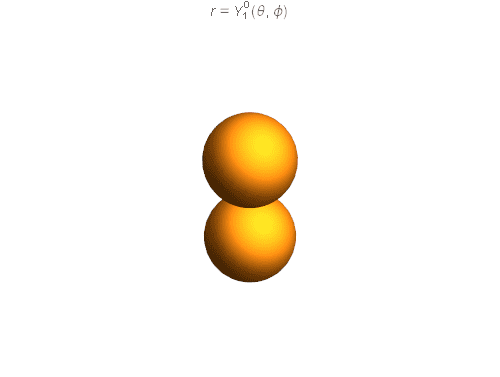
explaining that since m=0 there is no angular momentum L_z and the probability of finding it in the x-y plane is practically zero.
He then went on to show the Y(l=2, m=0) state, as seen below:
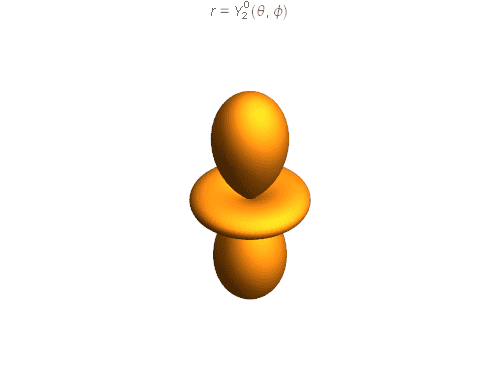
This strikes me as odd, however, as the disk around the z-axis would imply to me that there is a good probability that the particle is spinning along the z-axis and as a result carries some angular momentum L_z > 0. How, if at all possible, can this phenomenon be explained intuitively?
Thanks in advance
While watching videos of a MIT lecture on the eigenstates of angular momentum (video: '16. Eigenstates of the Angular Momentum II' by MIT OpenCourseWare) the professor visualized different spherical harmonics for low values of the quantum number l. He showed that for Y(l = 1, m = 0) the function has the following form:
explaining that since m=0 there is no angular momentum L_z and the probability of finding it in the x-y plane is practically zero.
He then went on to show the Y(l=2, m=0) state, as seen below:
This strikes me as odd, however, as the disk around the z-axis would imply to me that there is a good probability that the particle is spinning along the z-axis and as a result carries some angular momentum L_z > 0. How, if at all possible, can this phenomenon be explained intuitively?
Thanks in advance