Why introduce point D in Euclid's Elements Redux proof

  • Level: High School 
  • Thread starter murshid_islam
  • Start date
  • Tags Tags
    Elements Point
2 replies · 2K views · last reply
murshid_islam
Messages
468
Reaction score
21
TL;DR
Question about a proof from Euclid's "Elements" Redux (by Daniel Callahan and John Casey)
The following proof (in the image below) is from the book Euclid's "Elements" Redux (by Daniel Callahan and John Casey). I did not understand why the point D or the ##\triangle \rm ABD## was necessary. (I mean, what was the "point" of D? :-p) Joking apart, wasn't this sufficient: suppose we have a line segment AB and a point C on AB such that AB=2AC. Let AC = x. Then AB = 2x. Therefore, AB2 = (2x)2 = 4(x)2 = 4(AC)2
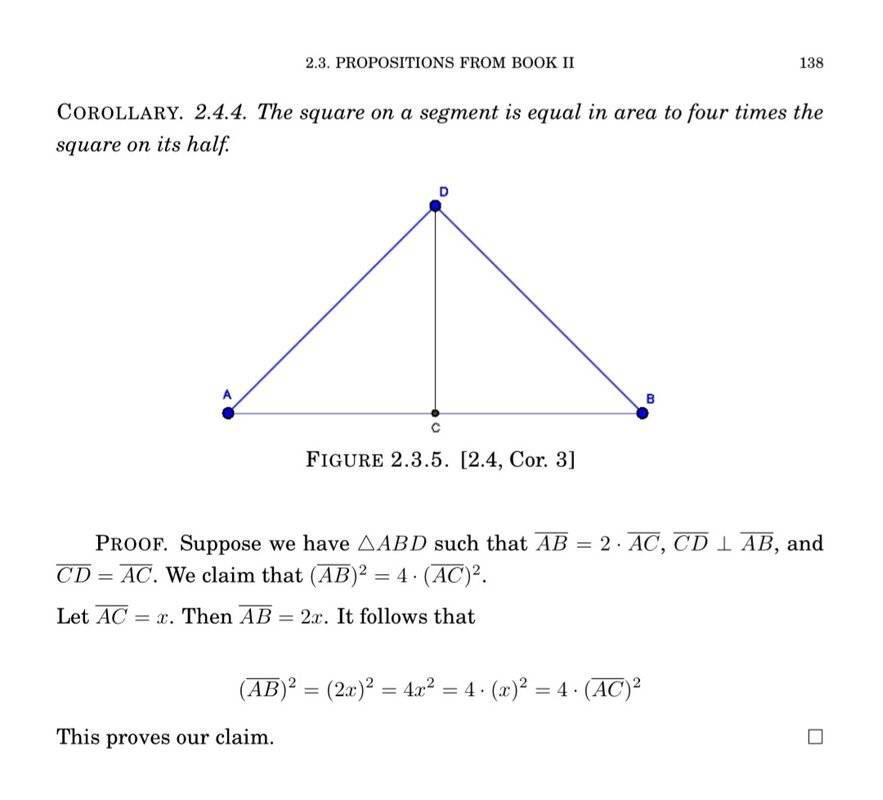
Geometry figure of triangle ABD with base AB, apex D above the midpoint C, and segment CD perpendicular to AB; labels A, B, C, D.
 
Last edited:
anuttarasammyak said:
I see Euclid, Elements II 4 at https://web.calstatela.edu/faculty/hmendel/Ancient Mathematics/Euclid/Euclid II/Euclid 2.4/Euclid.2.4.html .
I assume the corollary you refer, though I cannot find it in above linked page, is the special case AG=GB there.
Since this is a open textbook, it has been updated several times I guess. So, there are several versions of the book available on the internet. Maybe that's what causes the discrepancies between versions.

anuttarasammyak said:
I think he, Euclid or the author, says about geometry not algebra of ##(2x)^2=4x^2##.
In that case, shouldn't it deal with a square instead of a triangle? I still do not understand the relevance of the triangle and point D.