Why is it useful to isolate the highest order derivative when solving DEs?

  • Context: Undergrad 
  • Thread starter Thread starter cocopops12
  • Start date Start date
  • Tags Tags
    Derivative
Click For Summary
SUMMARY

The discussion centers on the importance of isolating the highest order derivative in differential equations (DEs) for both theoretical and computational purposes. Specifically, the example provided illustrates how to apply Euler's method to a second-order differential equation, d²y/dx² = xy + dy/dx, with initial conditions y(0)=1 and y'(0)=1. The process of calculating successive values of y and its derivatives relies on knowing the second derivative, emphasizing the necessity of expressing the DE in the form y'' = f(x, y, y') for effective numerical solutions.

PREREQUISITES
  • Understanding of differential equations, specifically second-order DEs.
  • Familiarity with Euler's method for numerical integration.
  • Basic knowledge of initial value problems and their solutions.
  • Ability to manipulate and solve equations involving derivatives.
NEXT STEPS
  • Study the implementation of Euler's method in numerical analysis.
  • Explore the concept of higher-order derivatives in differential equations.
  • Learn about alternative numerical methods such as Runge-Kutta for solving DEs.
  • Investigate the theoretical foundations of differential equations and their applications in modeling.
USEFUL FOR

Students and professionals in mathematics, engineering, and physics who are working with differential equations, particularly those interested in numerical methods for solving DEs.

cocopops12
Messages
30
Reaction score
0
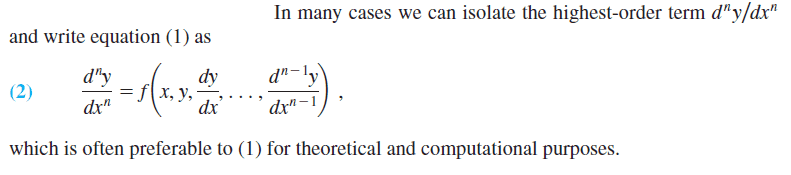
i'm studying differential equations, the book states the following:

11v4f2u.png


i want to know what are some of the "theoretical and computational purposes" behind it?

i always notice the book likes to make the coefficient of the highest derivative equal to 1
but why is that?!
 
Physics news on Phys.org
If you've done Euler's method or separation of variables, you saw in the first order case how you have to solve for the derivative as a function of x and y. This extends to higher orders... suppose we have a second order differential equation

[tex]\frac{d^2 y}{dx^2} = x*y + \frac{dy}{dx}[/tex]
and y(0)=1, y'(0)=1

I want to do an Euler's method kind of calculation. This requires knowing the derivative at every step. Unfortunately I don't have a formula for the derivative, so I have to use the second derivative to re-calculate the derivative each time

y(.1)=y(0)+.1*y'(0) = 1.1
y'(.1)=y'(0)+.1*y''(0)
I know what y''(0) is from the differential equation: y''(0)=0*1+1=1
y'(.1)=1+.1*1=1.1

Now if I want to update to get y(.2) and y'(.2), I need to know what y''(.1) is. So I use the differential equation
y''(.1) = xy+y' = .1*1.1+1.1 = 1.21

Now I can go to x=.2
y(.2)=y(.1)+.1*y'(.1)=1.21
y'(.2)=y'(.1)+.1*y''(.1)=1.221

Now I need to know what y''(.2) is because I want to be able to calculate y and y' at x=.3, etc. So

y''(.2)=x*y+y' = .2*1.21+1.221 = 1.463

Now I can keep going, estimating y(x) for as large a value of x as I want. The computation only required being able to solve for the second derivative of y at each step, since I already knew all the lower derivatives, so it was useful to have the equation in the form y''=f(x,y,y')
 
thank you sir!, haven't studied Euler's Method yet, but i do get the idea.

anyone got more info or examples? :biggrin:
 

Similar threads

  • · Replies 12 ·
Replies
12
Views
7K
  • · Replies 3 ·
Replies
3
Views
3K
  • · Replies 5 ·
Replies
5
Views
2K
  • · Replies 2 ·
Replies
2
Views
4K
  • · Replies 4 ·
Replies
4
Views
3K
  • · Replies 1 ·
Replies
1
Views
1K
  • · Replies 7 ·
Replies
7
Views
3K
  • · Replies 2 ·
Replies
2
Views
3K
  • · Replies 2 ·
Replies
2
Views
4K
  • · Replies 6 ·
Replies
6
Views
3K