Why Is Sin(theta) Squared in This Mechanical Engineering Problem?

Join the discussion
Ask a follow-up here, or get your own question answered by working scientists, mathematicians and engineers — people, not an autocomplete.
Real named experts · corrections over time · the nuance an AI answer skips
6 replies · 2K views
Turborrado
Messages
3
Reaction score
0
Member warned that the homework template must be used
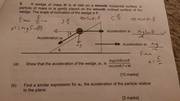
Hi! New to this forum and signed up because I've just started a foundation degree in mechanical engineering, and having been out of education for a very long time beforehand, getting back to grips with mathematics and the like!

Anyway, I would like to ask for some advice on this problem, I know how the top part of the fraction come about, as well as the lower case and upper case m in the lower part of the fraction, but still unsure as to why sin(theta) is squared? Thanks in advance!
IMAG0404.jpg
 

Attachments

  • IMAG0404.jpg
    IMAG0404.jpg
    37.9 KB · Views: 532
Last edited by a moderator:
Physics news on Phys.org
We need to work the whole solution out to tell where does that ##\sin^2 \theta## came from.
So a better way would be that you let us, how you worked out the question and we try to solve your confusion.
 
Hi and thanks for your reply, I have got as far as identifying that the equation shown for a1 is a rearranged F=ma, to a=F/m , the F being mgsin0cos0 and the m being m the lower part of the fraction.

I know m is the mass of the particle on the wedge and M is the mass of the wedge but fail to see how sin0^2 fits in, I would imagine it would be to so with calculating the mass.
 
Turborrado said:
Hi and thanks for your reply, I have got as far as identifying that the equation shown for a1 is a rearranged F=ma, to a=F/m , the F being mgsin0cos0 and the m being m the lower part of the fraction.

I know m is the mass of the particle on the wedge and M is the mass of the wedge but fail to see how sin0^2 fits in, I would imagine it would be to so with calculating the mass.
Did you draw a FBD ?
 
Buffu said:
Did you draw a FBD ?

Here is what I drew, and how far I got. As I understand the surfaces are frictionless so the round particle will fall straight down and the wedge will move to the right.
 

Attachments

  • IMAG0405.jpg
    IMAG0405.jpg
    22.8 KB · Views: 490
Turborrado said:
Here is what I drew, and how far I got. As I understand the surfaces are frictionless so the round particle will fall straight down and the wedge will move to the right.
Normal reaction of sphere on the block is not ##mg\cos\theta##, It is so because the big block is accelerating.

Equate the forces perpendicular to the incline acting on the sphere, from there you will get the correct value of normal reaction. Substitute it in your last equation and you will get the answer.