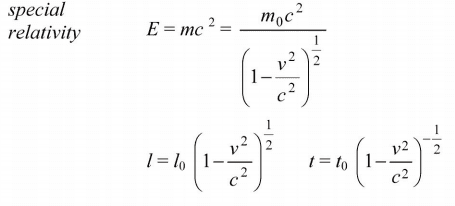
Why is the time dilation equation to the power -1/2?

Join the discussion
Registration is free. Start your own thread to ask a follow-up.
3 replies · 2K views
AishaGirl
Messages
10
Reaction score
0
Hello, AQA is a British exam board and on their paper they have a list of equations. Can someone tell me why the time dilation equation is to the power -1/2?

368440598af9536ec10eb1e6c88f258d.png


Thanks.
 
Physics news on Phys.org
AishaGirl said:
Hello, AQA is a British exam board and on their paper they have a list of equations. Can someone tell me why the time dilation equation is to the power -1/2?
You can get this result in several ways.
1) Consider the time for a single tick of a light clock, using in a frame in which the clock is in motion; and compare with the time for a single tick of the same clock using a frame in which the clock is at rest. Google or a search of this forum for "light clock" will find many good explanations.
2) Calculate the time dilation directly from the Lorentz transformations. To do that you'll need to know what these transformations are and how they're used, but you'll need that to understand any of the relations of special relativity anyway. Again, Google for "Lorentz Transformation" will find many good explanations.

If you find that you need more help after you've tried those two approaches... Come back and show us what you tried and where you got stuck and we can help you over the hard spot.
 
  • Like
Likes   Reactions: AishaGirl
It's a straightforward consequence of Einstein's postulates. I don't think there's more "why" than that. I'd look up the light clock thought experiment, which will let you derive the Lorentz transforms from scratch. The time dilation equation is a special case. I think that's the best answer I can give.

Edit: beaten to it by Nugatory. Not sure why I didn't see that...
 
By following @Nugatory 's suggestion, you'll eventually end up with this identity involving hyperbolic trigonometric functions
##\cosh\theta=\frac{1}{\sqrt{1-\tanh^2\theta}}## [in some form, whether you recognize it or not.]

The following might be a little over level-B... but it might be worth it.
Geometrically, time-dilation arises from a dot-product in spacetime
(since one is projecting the other observer's segment [a hypotenuse] onto the measuring observer's leg--this involves a hyperbolic-cosine).
Since physicists prefer velocity (instead of rapidity-angle) where ##(v/c)=\tanh\theta##, one uses the above identity to write hyperbolic-cosine in terms of hyperbolic-tangent. Thus we see factors like ##\frac{1}{\sqrt{1-(v/c)^2}}.##

Some possibly helpful analogies...
The Euclidean analogue ##\cos\theta=\frac{1}{\sqrt{1+\tan^2\theta}}## would be used to replace ##\cos\theta## with an expression involving a slope ##m##: ##\frac{1}{\sqrt{1+m^2}}.##
The Galilean [i.e. non-relativistic] analogue is ##\rm{cosg\ }\theta=1## (called a Galilean-cosine, as suggested by the mathematician IM Yaglom)... which could represent the Galilean limit of the expression in Special Relativity. Note there is no dependence on velocity here.