Why is there no "mid-Atlantic ridge" on other planets?

  • Context: Undergrad 
  • Thread starter Thread starter Edward Barrow
  • Start date Start date
  • Tags Tags
    Planets
Click For Summary

Discussion Overview

The discussion centers on the absence of mid-Atlantic ridge-like features on other planets, particularly focusing on the presence and implications of plate tectonics on Earth, Mars, Venus, and Mercury. Participants explore theoretical and observational aspects of planetary geology, including the conditions necessary for tectonic activity and the potential reasons for Earth's uniqueness in this regard.

Discussion Character

  • Exploratory
  • Debate/contested
  • Technical explanation
  • Conceptual clarification

Main Points Raised

  • Some participants note that Earth appears to be the only planet in the solar system with active tectonic plates, while others suggest that Mars may exhibit primitive plate tectonics, as indicated by features like Valles Marineris.
  • There is speculation about the role of Earth's atmosphere in facilitating tectonic activity, with some suggesting that the lack of a significant atmosphere on other planets may hinder similar processes.
  • Participants discuss the implications of volcanic activity on Mars, with some arguing that large dormant volcanoes like Olympus Mons could indicate past tectonic activity, while others assert that current volcanic activity is likely not dead.
  • Some contributions mention the cooling of Mars' core as a factor that may have affected its tectonic activity, suggesting that Mars might be in an extinct or severely reduced tectonic state.
  • The necessity of oceans for plate tectonics is raised, with references to educational materials that suggest oceans contribute to the chemical weathering of rocks, potentially influencing tectonic mechanisms.
  • There are inquiries into the effects of celestial bodies, such as the Moon, on Earth's tectonic activity, with suggestions that specific planetary conditions must align for plate tectonics to occur.

Areas of Agreement / Disagreement

Participants express a range of views on the presence and implications of plate tectonics on other planets, with no consensus reached on the reasons for Earth's unique tectonic features or the current state of tectonic activity on Mars.

Contextual Notes

Participants acknowledge various assumptions, such as the dependency of tectonic activity on atmospheric conditions and the role of water in geological processes. There are also unresolved questions regarding the age of Martian geological features and the specifics of volcanic activity on Mars.

Edward Barrow
Messages
25
Reaction score
1
Our planet has scars going all the way around it. The most famous of these is the mid-atlantic ridge.
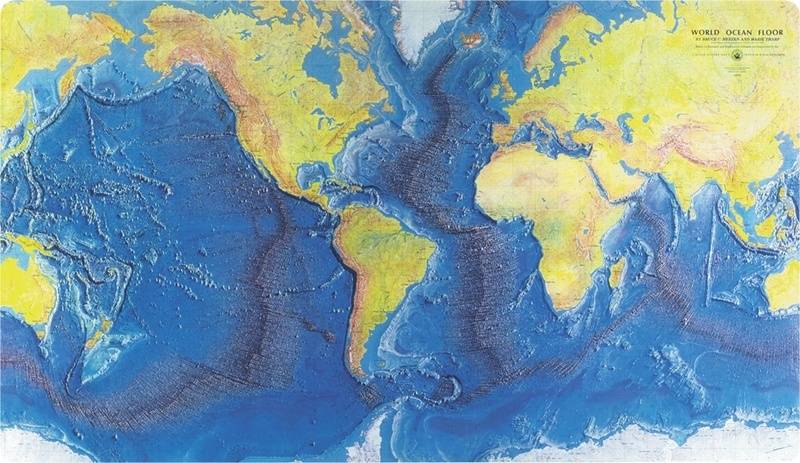
continentalshelf.jpg


How come Earth is unique in this respect? There are none on Mars for example:
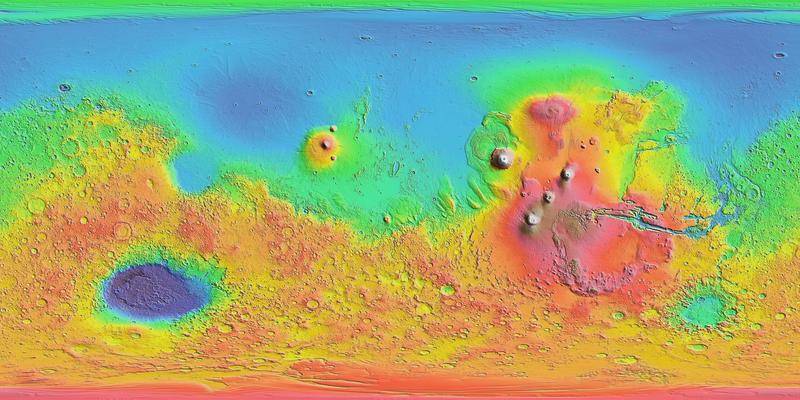
mola_cylin.jpg


How come we don't see any such feature on Mercury, Venus or Mars?
 
Last edited by a moderator:
Astronomy news on Phys.org
Comeback City said:
It seems as if Earth is the only planet in our solar system that has tectonic plates. Here is some info I found.

http://www.wwnorton.com/college/geo/egeo2/content/ch02/article_2.htm

Interesting. According to that article:

"Indeed, the pattern of faults on Venus suggests that plate-tectonics-like movement struggled to begin but never quite succeeded."

So it looks like Venus failed to do what Earth did do. I wonder could the fact Earth has an atmosphere while the other planets don't help explain why Earth got its tectonic plates going while the other planets didn't.
 
Edward Barrow said:
Interesting. According to that article:

"Indeed, the pattern of faults on Venus suggests that plate-tectonics-like movement struggled to begin but never quite succeeded."

So it looks like Venus failed to do what Earth did do. I wonder could the fact Earth has an atmosphere while the other planets don't help explain why Earth got its tectonic plates going while the other planets didn't.
That would be a tough correlation to make. How would you attempt to explain it?
Also, the article states,
"Because Earth's interior has remained warm enough for flow to take place in its mantle."
I'm guessing this is a big factor.
 
1oldman2 said:
It all comes down to "Plate tectonics" a feature that until recently only Earth was believed to possess. http://wsm.wsu.edu/discovery/index.php/2011/04/plate-tectonics-key-to-life-on-earth/
More recently Mars was found to have P. T. While not a ridge "Valles Marineris" is believed to be a product of Martian plate tectonics.
http://newsroom.ucla.edu/releases/ucla-scientist-discovers-plate-237303
The second article talks about how Mars is in a primitive stage of plate tectonics. Could it possibly be a later stage considering the large, dormant volcanoes such as Olympus Mons that could have formed a long time ago due to the plate tectonics?
 
Comeback City said:
The second article talks about how Mars is in a primitive stage of plate tectonics. Could it possibly be a later stage considering the large, dormant volcanoes such as Olympus Mons that could have formed a long time ago due to the plate tectonics?

Recent research has shown there are large oceans of water underneath the surface of the Earth. If these were on Mars, and Mars' atmosphere was stripped away, thus reducing atmospheric pressure and thus reducing the boiling point of water to 10c (which is what it is on Mars), the water underneath the surface of the Earth on Mars would boil into gas, expand and burst out in those volcanoes you see on Mars' surface?
 
Edward Barrow said:
Recent research has shown there are large oceans of water underneath the surface of the Earth. If these were on Mars, and Mars' atmosphere was stripped away, thus reducing atmospheric pressure and thus reducing the boiling point of water to 10c (which is what it is on Mars), the water underneath the surface of the Earth on Mars would boil into gas, expand and burst out in those volcanoes you see on Mars' surface?
These volcanoes are dormant, though. Unless you have a source to prove otherwise?
 
Comeback City said:
The second article talks about how Mars is in a primitive stage of plate tectonics. Could it possibly be a later stage considering the large, dormant volcanoes such as Olympus Mons that could have formed a long time ago due to the plate tectonics?
I do believe I have read that one of the reasons Mars lacks a significant magnetic field is the core has cooled, (I'll see what I can find to cite that) at any rate this would definitely have an effect on plate tectonics, not so much primitive as extinct or severely reduced. It seems Yin from the UCLA site would be a good person to check with concerning the Martian Geology, I'll see what I can find there also.
 
  • Like
Likes   Reactions: Edward Barrow
  • #10
Comeback City said:
These volcanoes are dormant, though. Unless you have a source to prove otherwise?

I'm theorizing that the gas has been ejected at this stage.

Those volcanoes look like zits on a persons face. Almost like they were formed quickly. They look unusually tall.
 
  • Like
Likes   Reactions: 1oldman2
  • #11
Comeback City said:
These volcanoes are dormant, though. Unless you have a source to prove otherwise?
This article implies that Volcanic activity is very likely not dead on Mars.
https://www.volcanodiscovery.com/mars/olympus-mons/evidence-of-recent-volcanic-activity.html
Also the opinion seems to be that plate tectonics is no longer active although the core is believed to be liquid
From, https://science.nasa.gov/science-news/science-at-nasa/1999/ast29apr99_1/
"The discovery of this pattern on Mars could revolutionize current thinking of the red planet's evolution," said Dr. Jack Connerney of NASA's Goddard Space Flight Center, Greenbelt, MD, an investigator on the Global Surveyor's magnetometer team. "If the bands on Mars are an imprint of crustal spreading, they are a relic of an early era of plate tectonics on Mars. However, unlike on Earth, the implied plate tectonic activity on Mars is most likely extinct."
 
  • Like
Likes   Reactions: BillTre
  • #12
1oldman2 said:
This article implies that Volcanic activity is very likely not dead on Mars.
Dormant, not dead. It might take a while to prove it is active though.

Also, do we know how old these meteorites are? If not, they could've been there with the penguins for hundreds of millions of years, and we wouldn't have known. It certainly does prove, though, that there was once volcanic activity on Mars.
 
  • Like
Likes   Reactions: 1oldman2
  • #13
I guess plate tectonics of Earth exist because the interior of Earth is still to some extent fluid not so far under the surface.
Why that seems not to be so for Venus is an interesting question.
 
  • Like
Likes   Reactions: 1oldman2
  • #14
Our Moon has noticeable tidal effects on the oceans and I wonder whether PT could have been enabled by the presence of such a large Moon disturbing theEarth's surface. Venus has nothing significant and the two martian moons are pretty small. As with most planetary features, you need a particular set of circumstances for them to occur. Mass, constituents, age and temperature probably need to be 'just right' to get PT.
We cannot tell what's happening at the internal solid cores of the Gas Giants.
 
Last edited:
  • #15
Edward Barrow said:
How come Earth is unique in this respect?

How come we don't see any such feature on Mercury, Venus or Mars?

In a lecture on the DVDs of the series "The Great Courses: Oceanography" , the presenter said that oceans are necessary for plate tectonics to work. (As to why they are necessarily, there might be several reasons. I'd have to re-watch the DVD to recount them.)
 
  • Like
Likes   Reactions: sophiecentaur
  • #16
Stephen Tashi said:
"The Great Courses: Oceanography" , the presenter said that oceans are necessary for plate tectonics to work. (As to why they are necessarily, there might be several reasons.

Its my understanding that rocks exposed to water (oceans?) change chemically (weathering?) and which alters their density (lighter I think).
This could accentuate density differences between the crust and mantle. Which is probably close to a tectonic driving mechanism.

This chemically altered material eventually subsides into the mantle. Altered material may come up more frequently than unaltered material. Some will instead mix with the body of mantle, changing it to some degree chemically. This might also affect things.

This of course could happen along with everything else discussed.
 

Similar threads

  • · Replies 2 ·
Replies
2
Views
2K
  • · Replies 2 ·
Replies
2
Views
3K
  • · Replies 4 ·
Replies
4
Views
3K
  • · Replies 12 ·
Replies
12
Views
3K
  • · Replies 18 ·
Replies
18
Views
4K
  • · Replies 5 ·
Replies
5
Views
2K
  • · Replies 7 ·
Replies
7
Views
3K
  • · Replies 1 ·
Replies
1
Views
2K
  • · Replies 10 ·
Replies
10
Views
4K
Replies
17
Views
4K