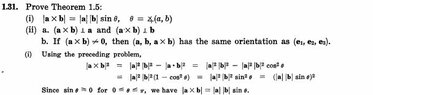
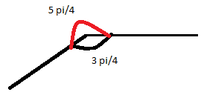
In mathematics, the angles between $0$ and $2\pi$ are all considered *distinct*.
In physics, one often speaks of the "angle between", which is "directionless".
Often, a middle path is to use (mathematical) angles on the interval $(-\pi,\pi]$, and then to see the physical angle as the ABSOLUTE VALUE of the mathematical angle, just as speed is the absolute value of velocity.
Put another way, there is some ambiguity as angle as a function of two RAYS, and angle as a function of two LINES. Part of this has to do with the ambiguities inherent in choosing an orientation (clockwise versus counter-clockwise, in the plane, for example, as being "positive rotation"). Spaces don't come with an orientation, only our descriptions of them do. Thus, in the "physical world" the assignment of SIGN to certain quantities is, in effect, arbitrary. Sometimes it is good to define quantities in such a way as to avoid such niggling questions.