Why is this differential equation non-linear?

Click For Summary

Discussion Overview

The discussion revolves around the characterization of a differential equation as non-linear, specifically questioning the role of the term u=\overset{\cdot }{m} in this classification. Participants explore the implications of treating certain variables as constants and the conditions under which a system can be considered linear or non-linear. The conversation includes theoretical considerations and practical examples related to dynamics and control theory.

Discussion Character

  • Debate/contested
  • Technical explanation
  • Conceptual clarification
  • Mathematical reasoning

Main Points Raised

  • Some participants suggest that the presence of a non-linear term, such as u=\overset{\cdot }{m}, is what makes the differential equation non-linear.
  • Others argue that the inclusion of variables like x_3 in the matrix equation indicates non-linearity, as it is not a constant.
  • A participant points out that if x_3 is treated as a constant, it contradicts the inclusion of its derivative in the discussion.
  • There is a suggestion that non-linear systems cannot simply be made linear, though approximations with linear models are common.
  • One participant emphasizes the complexity of non-linear dynamics and the challenges in finding a suitable model that works across a range of conditions.
  • Confusion arises regarding the distinction between mass (m) and the rate of change of mass (\overset{\cdot }{m}), with participants discussing their implications in the context of thrust generation.

Areas of Agreement / Disagreement

Participants express differing views on the nature of the differential equation and the definitions of the variables involved. There is no consensus on whether the equation can be linearized or how to interpret the relationship between mass and its rate of change.

Contextual Notes

Limitations include potential misunderstandings of the problem's wording and the definitions of terms used in the equations. The discussion reflects a range of interpretations and assumptions about the system being analyzed.

Who May Find This Useful

This discussion may be of interest to students and professionals in physics, engineering, and mathematics, particularly those dealing with differential equations and non-linear dynamics.
PainterGuy
Messages
938
Reaction score
73
Hi,

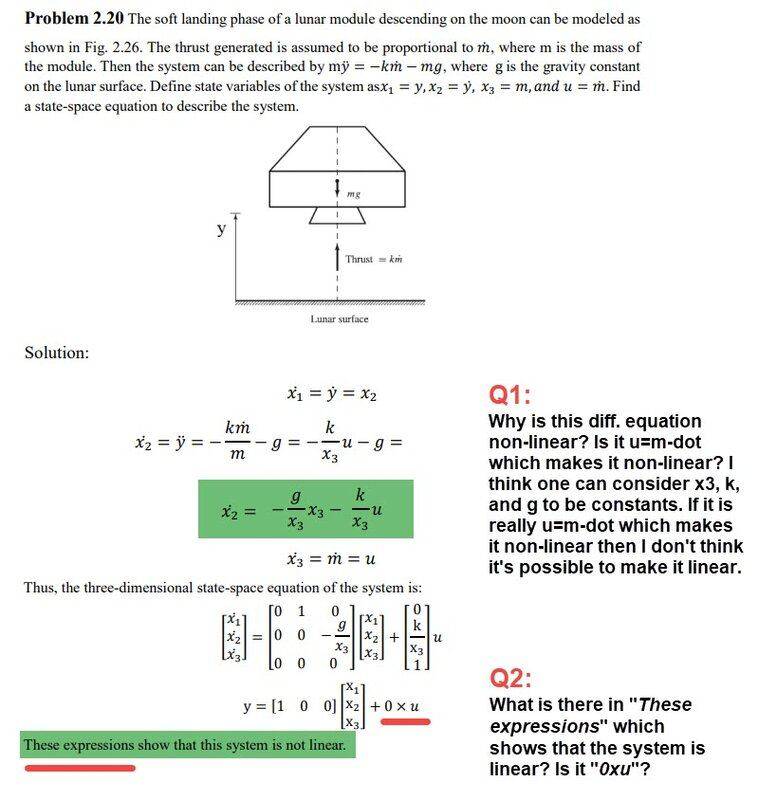
Could you please have a look on the attachment?

Question 1:
Why is this differential equation non-linear? Is it u=\overset{\cdot }{m} which makes it non-linear?

I think one can consider x_{3} , k, and g to be constants. If it is really u=\overset{\cdot }{m} which makes it non-linear then I don't think it's possible to make it linear. Could you please correct me?

Question 2:
What is there in "These expressions" which shows that the system is linear? Is it "0 x u"?
diff_eq_mdot.jpg
 
Last edited by a moderator:
Physics news on Phys.org
Because it contains a non-linear term regardless of how you write it.
 
  • Like
Likes   Reactions: PainterGuy
Mayhem said:
Because it contains a non-linear term regardless of how you write it.

Thank you!

Is that non-linear term u=\overset{\cdot }{m}?

What is there in that equation system which shows that the system is not linear?

Thanks a lot for your time and help!
 
PainterGuy said:
Thank you!

Is that non-linear term u=\overset{\cdot }{m}?

What is there in that equation system which shows that the system is not linear?

Thanks a lot for your time and help!
Since ##u = \dot{m}## and ##x_3 = m## it means that ##\frac{k}{x_3}u = \frac{k}{m}\dot{m}##. Usually, products of the same function (like ##y^n##, where ##n## is some number) and products of functions/dervative of functions (like ##y'y''## or ##yy'''## and similar) is a quick way to qualitatively check if a differential equation is non-linear. I might be wrong though. My only real training in differential equations consist of a mandatory UG course on analysis.
 
  • Like
Likes   Reactions: PainterGuy
In the matrix equation you have for ##x_1,x_2,x_3##, the equation would be linear if the matrix was full of constants. But it has an ##x_3## term in it.
 
  • Like
Likes   Reactions: DaveE and PainterGuy
You said you thought that x3 = m could be considered a constant.
Then why would they include x3 as a state variable, and why would they discuss it's derivative?
"The thrust generated is assumed to be proportional to dm/dt" If m was constant that would be zero.

Also, if a system is non-linear, you can't just make it linear. That's what non-linear means. It is common practice to approximate non-linear systems with linear models though. Is that what you're asking about?
 
  • Like
Likes   Reactions: PainterGuy
DaveE said:
You said you thought that x3 = m could be considered a constant.
Then why would they include x3 as a state variable, and why would they discuss it's derivative?
"The thrust generated is assumed to be proportional to dm/dt" If m was constant that would be zero.

Thank you!

I don't remember much of the control theory but let's try it. I can still figure out the basics.

IMHO, I don't think that the problem is worded properly.

A rocket is propelled forward by a thrust force equal in magnitude, but opposite in direction, to the time-rate of momentum change of the exhaust gas accelerated from the combustion chamber through the rocket engine nozzle. This is the exhaust velocity with respect to the rocket, times the time-rate at which the mass is expelled, or in mathematical terms: {T}={v}\frac{dm}{dt}

where T is the thrust generated (force), \frac{dm}{dt}[\itex] is the rate of change of mass with respect to time (mass flow rate of exhaust), and v is the velocity of the exhaust gases measured relative to the rocket.
<br /> <br /> Source: <a href="https://en.wikipedia.org/wiki/Thrust#Examples" target="_blank" class="link link--external" rel="nofollow ugc noopener">https://en.wikipedia.org/wiki/Thrust#Examples</a><br /> <br /> I don&#039;t think \overset{\cdot }{m} and m are the same things as implied in the question statement; &quot;m&quot; is mass and m-dot is the amount or mass of exhaust gases released per unit time. Please let me know if I&#039;ve it right. I understand, as the fuel is burned, the rocket is supposed to &#039;lose&#039; overall mass. <br /> <br /> <blockquote data-attributes="member: 644223" data-quote="DaveE" data-source="post: 6462655" class="bbCodeBlock bbCodeBlock--expandable bbCodeBlock--quote js-expandWatch"> <div class="bbCodeBlock-title"> DaveE said: </div> <div class="bbCodeBlock-content"> <div class="bbCodeBlock-expandContent js-expandContent "> Also, if a system is non-linear, you can&#039;t just make it linear. That&#039;s what non-linear means. It is common practice to approximate non-linear systems with linear models though. Is that what you&#039;re asking about? </div> </div> </blockquote><br /> Yes, that&#039;s what I&#039;m asking about. I was more interested in the differential equation but looking at the differential equation from practical example would be more productive and helpful. So, how do we proceed? Thanks.
 
PainterGuy said:
I don't think that the problem is worded properly.
Most HW problems are a bit confusing. I think it takes a lot of knowledge and effort to write these well. Unfortunately, many profs don't put in that effort.

PainterGuy said:
I don't think m⋅ and m are the same things as implied in the question statement; "m" is mass and m-dot is the amount or mass of exhaust gases released per unit time.
Yes, they aren't the same. Like distance and speed, for example. But no, I don't think they said they were the same. Maybe you should reread that sentence. It has the form "x" is distance and dx/dt is the amount of distance covered per unit time. Personally, I don't think those are confusing or equivalent.
PainterGuy said:
Yes, that's what I'm asking about. I was more interested in the differential equation but looking at the differential equation from practical example would be more productive and helpful. So, how do we proceed?
That state space equation is a differential equation, or at least a set of equations. You could multiply it all out and reduce the number of equations with substitutions. However, everyone that does this stuff thinks it's easier in the matrix form, a series of first order equations as opposed to one higher order DE.

This subject is much too complicated to cover in a forum like this. Non-linear dynamics is usually a graduate level subject. The problem is that there are lots of types of non-linear systems. You can linearize them with a bunch of first derivatives, or perturbation theory, but then the question immediately arises, "is your model any good?" You may find that you can't get one good model that works over the range of interest.

I did study this stuff decades ago, but don't remember enough to teach it. You can look on YouTube for some Cornell lectures from Steven Strogatz, which are excellent, but they aren't a cookbook approach. It looks like there are a bunch of useful links from a google search for "linearization in modern control theory". Also Wikipedia has some good stuff.
 
  • Like
Likes   Reactions: PainterGuy
I remember this problem given in a textbook, but I cannot remember the textbook. Where was this problem taken from, please.
 
  • #10
mpresic3 said:
I remember this problem given in a textbook, but I cannot remember the textbook. Where was this problem taken from, please.

I was helping someone with the differential equation part. After your post I asked about the book. It's linear system theory by chen.
 
  • #11
Thanks
 
  • #12
DaveE said:
Yes, they aren't the same. Like distance and speed, for example. But no, I don't think they said they were the same. Maybe you should reread that sentence. It has the form "x" is distance and dx/dt is the amount of distance covered per unit time. Personally, I don't think those are confusing or equivalent.
They said, "The thrust generated is assumed to be proportional to \overset{\cdot }{m}, where m is the mass of module."

To me, the statement is saying that that thrust is proportional to the derivative of mass 'm' where 'm' is the mass of module. But, IMHO, the derivative is being taken of mass of gases being emitted at any given time and not of the total mass of module. You see my confusion.

On the other hand, the gas tank is part the module so as the mass of gas tank decreases so does the total mass of module. Perhaps, they are looking at it, in ideal terms, where mass of module is considered separate from the mass of gas tank, and as the gas tank loses mass the module mass still remains constant.

I'd really appreciate if you can comment on it. Thanks in advance!
 
Last edited:
  • #13
PainterGuy said:
the derivative is being taken of mass of gases being emitted at any given time and not of the total mass of module.
I'm not sure I understand what you meant, but this sounds a bit like a second derivative.

PainterGuy said:
the gas tank is part the module so as the mass of gas tank decreases so does the total mass of module. Perhaps, they are looking at it, in ideal terms, where mass of module is considered separate from the mass of gas tank, and as the gas tank loses mass the module mass still remains constant.
Suppose you rocket has a mass described as m ≡ Mrocket + mfuel ≡ Mr + mf. In this model Mrocket is a constant value, and mfuel is being burned. Then I think you can see that their model (the rate that fuel is being used is proportional to thrust) makes sense. So Thrust ∝ dmf/dt.

So now look at dm/dt = d(Mr + mf)/dt = dMr/dt + dmf/dt = dmf/dt, because the derivative of a constant is zero. Thrust isn't about how much mass there is, it's about how much it is changing.
 
  • Like
Likes   Reactions: PainterGuy

Similar threads

  • · Replies 3 ·
Replies
3
Views
3K
  • · Replies 5 ·
Replies
5
Views
2K
  • · Replies 2 ·
Replies
2
Views
3K
  • · Replies 8 ·
Replies
8
Views
2K
  • · Replies 1 ·
Replies
1
Views
2K
  • · Replies 7 ·
Replies
7
Views
3K
  • · Replies 2 ·
Replies
2
Views
3K
  • · Replies 5 ·
Replies
5
Views
3K
  • · Replies 10 ·
Replies
10
Views
5K