Why the rare kaon decay K+ -> pi+ nu nubar req. penguins?

  • Context: Graduate 
  • Thread starter Thread starter rjseen
  • Start date Start date
  • Tags Tags
    Decay Kaon Pi
Click For Summary
SUMMARY

The decay process K⁺ -> π⁺ ν ν-bar is classified as a flavor-changing neutral current (FCNC) and requires a loop (second order weak decay) due to the absence of FCNCs at tree level. The discussion highlights that tree level processes involve charged currents mediated by W bosons, while FCNCs, which change quark flavors without altering charge, necessitate higher-order interactions. The Glashow-Iliopolous-Maiani (GIM) mechanism is pivotal in understanding these processes, predicting the existence of the charm quark. The absence of FCNCs at tree level is a fundamental aspect of the Standard Model's quantum flavor dynamics.

PREREQUISITES
  • Understanding of weak decays, specifically first and second order weak decays.
  • Familiarity with flavor-changing neutral currents (FCNC) and their implications in particle physics.
  • Knowledge of the Glashow-Iliopolous-Maiani (GIM) mechanism and its historical significance.
  • Basic comprehension of Feynman diagrams and loop processes in quantum field theory.
NEXT STEPS
  • Study the Glashow-Iliopolous-Maiani (GIM) mechanism in detail to understand its role in particle physics.
  • Learn about Feynman diagrams, focusing on loop diagrams and their significance in higher-order processes.
  • Explore the implications of flavor-changing neutral currents (FCNC) in the context of the Standard Model.
  • Investigate the properties and discovery of the charm quark, particularly in relation to the November Revolution in particle physics.
USEFUL FOR

Particle physicists, graduate students in theoretical physics, and researchers interested in weak decays and flavor dynamics will benefit from this discussion.

rjseen
Messages
10
Reaction score
0
Hello,

my question is, why does the decay of

K⁺ -> π⁺ ν ν-bar

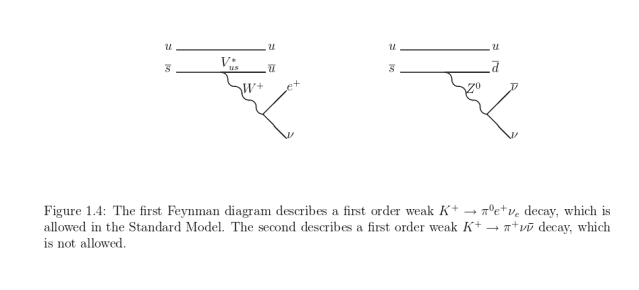
require a loop to be allowed. See images below.*

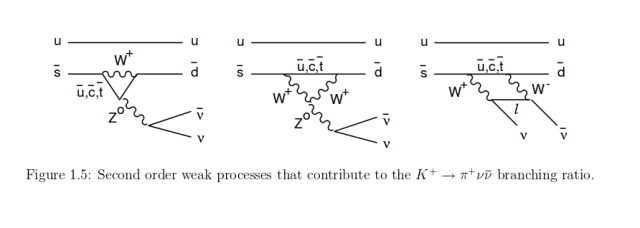
-What is it that makes the decay forbidden in figure 1.4 and not forbidden in figure 1.5?
-What does being a first order weak decay and a second order weak decay mean?
-I suspect the decay is allowed in the standard model for the three modes of decay as seen in the figure 1.5. How are these modes determined?
5bbrra.png
11udao1.png

Thanks in advance,
rjseen
*With acknowledgments to Bipul Bhuyan thesis:
https://www.bnl.gov/userscenter/Thesis/2004/BB-Thesis.pdf
 
Last edited by a moderator:
Physics news on Phys.org
There are no flavour-changing neutral currents at tree level in the Standard Model.

The W boson changes quark flavour, but the Z boson cannot (neither can photons or gluons for that matter)
 
  • Like
Likes   Reactions: vanhees71 and rjseen
Thanks for the quick answer.

I have come across that explanation in various theses, so that's apparently the real thing I have to understand in this.

So, I have understood that the K⁺ -> π⁺ ν ν-bar is called an FCNC, is the flavor part because of the strange anti-quark ending up as a down anti-quark? And the neutral part because the charge of the strange anti-quark equals the down anti-quark?

What is the tree level? Does it refer to first order weak decays? What is the meaning of first order and second order weak decays?rjseen
 
Tree level is without loops. It can be second order (count the number of vertices where W or Z participate) but I don't think that happens.
FCNC: right
 
  • Like
Likes   Reactions: rjseen
One should also stress that the absence of flavor-changing neutral currents (here an anti-s quark changes to an anti-u quark) in the 2nd diagram in the posting #1, i.e., it's due to a Z-boson exchange and thus "neutral") is built in into quantum flavor dynamics by construction. It's one of the basic observable facts going into the model building. It's historically important, because it lead to the socalled GIM mechanism (named after Glashow Iliopolous, and Maiani), i.e., the prediction of the existence of a fourth quark flavor, the charm quark. It has been discovered in terms of the ##J/\psi## meson in November 1974 ("November Revolution"), which is a bound state of an anti-c and a c quark ("Charmonium").

https://en.wikipedia.org/wiki/GIM_mechanism
http://www.scholarpedia.org/article/Glashow-Iliopoulos-Maiani_mechanism
https://en.wikipedia.org/wiki/J/psi_meson
 
  • Like
Likes   Reactions: rjseen
Thank you for your replies! And especial thank you to Vanhees for those links. The one at scholarpedia is really well written for rudimentary understanding.

For future browsers I can try and conclude (or be corrected!):

-There are no Flavor-Changing Neutral Currents (FCNC) in the Tree level (diagram without loops (1)). It has been experimentally determined that flavour changing processes involve charged currents at tree level (2), i.e. stemming from the involvement of a W⁺-boson, which gives a net difference in charge of the in and out products. For example in the first diagram in figure 1.4, the strange anti-quark of charge -1/3 decays into an up anti-quark of charge 2/3. This observation and one in which the, outdated quantum number, strangeness changes by at most one unit in the tree level lead to the formulation of the GIM mechanism (2). Decays with changes in strangeness of two units, as well as decays containing FCNCs, are restricted to second order weak processes which decays by two weak vertices (3). As for the second diagram in figure 1.5, there are three vector bosons but the second W⁺ isn't counted because it connects back to the u,c,t anti-quarks (speculative).

(1): https://en.wikipedia.org/wiki/Feynman_diagram#Loop_order
(2): http://www.scholarpedia.org/article/Glashow-Iliopoulos-Maiani_mechanism#GIM_mechanism
(3)http://www.physnet.org/modules/pdf_modules/m281.pdf
 
In the scholarpedia is however a typo in Eq. (8), concerning the axial U(1) anomaly. It should read
$$\partial_{\mu} j_{5}^{\mu}=-\frac{e^2}{8 \pi^2} {^{\dagger} F}{}^{\mu \nu} F_{\mu \nu}=-\frac{e^2}{16 \pi^2} \epsilon^{\mu \nu \rho \sigma} F_{\mu \nu} F_{\rho \sigma}.$$
See my lecture notes on QFT (the chapter on anomalies in the gauge-theory chapter):

http://fias.uni-frankfurt.de/~hees/publ/lect.pdf

Modulo the sign, which may be due to different conventions for the ##\epsilon##-tensor (a pain when comparing results in different textbooks and/or papers) there's a factor 2.
 

Similar threads

  • · Replies 2 ·
Replies
2
Views
3K