Why would an electron-emitting heated coil require AC?

  • Context: Undergrad 
  • Thread starter Thread starter greypilgrim
  • Start date Start date
  • Tags Tags
    Ac Coil
Click For Summary
SUMMARY

The discussion centers on the necessity of using alternating current (AC) for heating the filament in a Teltron tube, which is essential for effective electron emission. Users reported that a direct current (DC) supply did not produce the expected electron beam, as the negative potential at the anode repelled emitted electrons. The filament's role in thermionic emission requires a positive potential at the anode to facilitate electron flow, which is not achieved with DC. The consensus indicates that AC is preferred for practical reasons, including current supply capabilities and cost-effectiveness.

PREREQUISITES
  • Understanding of thermionic emission principles
  • Familiarity with electron gun operation
  • Knowledge of AC and DC electrical supply characteristics
  • Basic concepts of vacuum tube design and function
NEXT STEPS
  • Research the differences between AC and DC in thermionic devices
  • Study the design and function of electron guns in vacuum tubes
  • Explore the role of anodes and cathodes in electron emission
  • Investigate the practical applications of Teltron tubes in modern technology
USEFUL FOR

Electronics engineers, physicists, and students studying vacuum tube technology or thermionic emission principles will benefit from this discussion.

greypilgrim
Messages
581
Reaction score
44
Hi.

At school, I once worked with a Teltron tube that looked very much like this (I don't remember the brand):
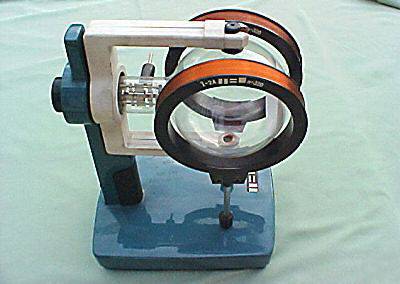
on-Diffraction-Tube-with-Helmholtz-Coils-and-Stand.jpg


The electrons are emitted from a coil that must be heated with a voltage around 5 V. But for some reason, it must be AC, it doesn't work with DC (and it took me a long time of troubleshooting until I found this to be the problem). Why would that matter?
 
Physics news on Phys.org
When you say it "doesn't work", what do you mean? Does the filament glow or not in both cases? Are you reporting an actual event or just reading a written spec / instruction?
There's a theoretical possibility that there is a transformer somewhere I the filament supply. But not likely as 5V is the sort of voltage that many filaments use.
 
I mean that there was no dot caused by the electrons on the fluorescent screen with DC. If the filament was glowing I don't remember (it's a while back), I'm not even sure it can be seen from the outside.

The instruction says AC, but I didn't have an AC supply around back then and thought it shouldn't matter. Only after a long time of troubleshooting I finally dug up an AC supply and voilà, the dot was there.
 
in the diagrams i found on google it seems like the anode is connected electrically to one of the legs of the filament, the filament emits electrons by thermionic emission but if you connect the DC supply such that the leg going to anode is negative then all the electrons will be repelled even though the filament might still shine orange because there is current running through it no matter which way you connect it's legs.In order to form an electron emission beam just a hot filament is not enough you also need an electrode which is at a different (more positive ) potential than the filament itself.
If this were not true every ordinary incandescent bulb would be a vacuum tube.
 
  • Like
Likes   Reactions: marcusl
artis said:
in the diagrams i found on google it seems like the anode is connected electrically to one of the legs of the filament, the filament emits electrons by thermionic emission but if you connect the DC supply such that the leg going to anode is negative then all the electrons will be repelled even though the filament might still shine orange because there is current running through it no matter which way you connect it's legs.In order to form an electron emission beam just a hot filament is not enough you also need an electrode which is at a different (more positive ) potential than the filament itself.
If this were not true every ordinary incandescent bulb would be a vacuum tube.

From what you write, this thread seems to be based on memory of past events. Are you not in a position to repeat the experiment? If not then we may be dealing with evidence based on imperfect recall.
If the filament were coated with the same sort of rare Earth's then every lamp filament would have a cloud of thermionic electrons round it. I have to assume we all know the basics of operation of an electron gun.
You seem to be suggesting that any electron gun needs an AC filament supply. An AC supply can cause Hum on some audio amplifiers so DC filament feed is very often called for..

In a thermionic valve the filament is not 'connected to' the Anode (Apart from via the EHT supply); it is right next to the Cathode and may or may not be connected, depending on the detailed design. (Normal thermionic valves have two distinct connections to the filament and the Cathode potential is always 'near' that of the filament.) It is Anode - Cathode volts that cause the motion of the electron beam. The Anode is tubular in a Teltron tube and is close to the cathode (looks like parallel plates in the diagrams on Wiki etc.. The accelerating voltage is much higher than the voltage across the filament so the polarity of the supply would not be relevant. Have a look at the diagram in this link for a 3D diagram.

The call for AC volts on the Teltron filament is probably based on convenience and AC is cheaper then DC. The Cathode (=filament) will be near Earth potential.
 
  • Like
Likes   Reactions: davenn
I think it is more likely that the DC supply could not furnish the required current.
We do see effects caused by DC filament action in a triode tube because it depends which side of the supply the grid is connected. But I think the effect will be small for the Teltron diode.
 
  • Like
Likes   Reactions: sophiecentaur

Similar threads

  • · Replies 6 ·
Replies
6
Views
2K
  • · Replies 43 ·
2
Replies
43
Views
7K
  • · Replies 10 ·
Replies
10
Views
1K
  • · Replies 13 ·
Replies
13
Views
3K
  • · Replies 10 ·
Replies
10
Views
4K
  • · Replies 12 ·
Replies
12
Views
7K
Replies
6
Views
4K
  • · Replies 3 ·
Replies
3
Views
7K
Replies
11
Views
2K
  • · Replies 17 ·
Replies
17
Views
7K