Would light keep on a straight path after it bends?

  • Context: Undergrad 
  • Thread starter Thread starter danielhaish
  • Start date Start date
  • Tags Tags
    Light Path
Join the discussion
Ask a follow-up here, or get your own question answered by working scientists, mathematicians and engineers — people, not an autocomplete.
Real named experts · corrections over time · the nuance an AI answer skips
16 replies · 2K views
danielhaish
Messages
152
Reaction score
10
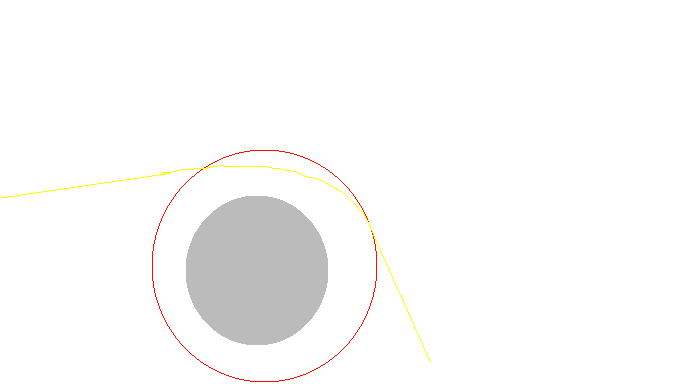
I am asking this question because I dint find a source that explain why the light go in straits line Let say that a light go near very big mass that bend it ,and then the light escape it . would the light change his angle after it band like that
untitled.png

the red part is the range where the mass effect the light .
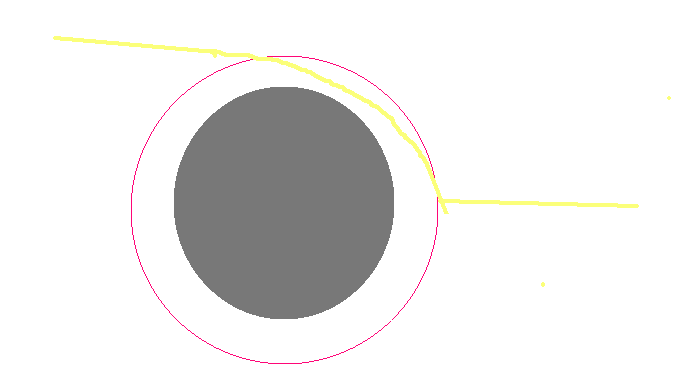
or weather the light continue in the same angle
untitled (2).png
 

Attachments

  • untitled (1).png
    untitled (1).png
    2.6 KB · Views: 177
Last edited by a moderator:
Physics news on Phys.org
PeroK said:
What would a high-speed particle do?
so you are saying that the light would change is angle after escaping like in the first image
 
Gravitational fields have infinite reach, so there's no radius where light isn't affected by gravity.

However, the effect decreases with distance. Qualitatively, the orbit of light isn't very different from other "open" orbits like the blue trajectory in this image from Wikipedia. The exact trajectory isn't quite that shape, but it does become less and less curved the further from the mass it is. It's never exactly straight, but it definitely never has the funny kinks in it that you've drawn in your second diagram.
 
  • Like
Likes   Reactions: danielhaish
danielhaish said:
so you are saying that the light would change is angle after escaping like in the first image
What does "change its angle" mean? Your second diagram wouldn't make any physical sense for a comet, say.

The path of a light ray is effectively a limiting case for the paths of particles with mass.
 
  • Like
Likes   Reactions: Ibix and danielhaish
The light never changed its angle, it was going straight all the time. It's the space the light went through that changed and the light was affected by this. When the light "escaped" it just carried on straight through the space, it's just that space outside the gravitational field is now "straight" again (or straighter as Ibix said)
 
  • Like
Likes   Reactions: danielhaish
MikeeMiracle said:
The light never changed its angle, it was going straight all the time. It's the space the light went through that changed and the light was affected by this. When the light "escaped" it just carried on straight through the space, it's just that space outside the gravitational field is now "straight" again (or straighter as Ibix said)
so I am having here two difference answer one said that the light orbit is the same as practical . and you'r saying that it will become straits again
 
danielhaish said:
Note that, in general, paths taken by light and particles are reversible. Looking at that might be a light ray entering from the left and exiting on the right or vice versa.

Now, if light came in from the right, why would it follow your path?

Whereas, this path makes sense in reverse:

danielhaish said:
 
  • Like
Likes   Reactions: danielhaish
PeroK said:
Note that, in general, paths taken by light and particles are reversible. Looking at that might be a light ray entering from the left and exiting on the right or vice versa.

Now, if light came in from the right, why would it follow your path?

Whereas, this path makes sense in reverse:
because that if the light is not effected by gravity and going through the space straits then when the space will change the light would change back, but if the light effected by gravity because it photon have mass of hv/(c^2) then the direction of the light wouldn't come back to be straits
 
danielhaish said:
because that if the light is not effected by gravity and going through the space straits then when the space will change the light would change back, but if the light effected by gravity because it photon have mass of hv/(c^2) then the direction of the light wouldn't come back to be straits
That makes no sense. In particular, beyond anything else, a photon or particle has no kinematic memory of a direction it was going in at some earlier time.

The diagram above, with the sudden change of direction, makes absolutely no physical sense.

Why are we even discussing this?
 
  • Like
Likes   Reactions: Vanadium 50
danielhaish said:
so I am having here two difference answer one said that the light orbit is the same as practical . and you'r saying that it will become straits again
No. He's saying light follows a geodesic, which is the curved spacetime generalisation if a straight line. In 4d this is correct, although I prefer not to use "straight line" and "geodesic" interchangeably because I think it's confusing.

What you drew, I think, is intended to be the projection of that path on to a 3d spatial plane. This is a curved path. I was talking about this.
 
  • Like
Likes   Reactions: hutchphd
The light would not change back to it's previous direction because it never changed direction to begin with, it was always going straight. It's just the space is goes through was curved close to the star.

Check out this video between 16 minutes & 20 minutes, it does an excellent job of explaining why something going straight "appears" to curve when it's traveling along something which is curved.

 
  • Like
Likes   Reactions: danielhaish
MikeeMiracle said:
The light would not change back to it's previous direction because it never changed direction to begin with, it was always going straight. It's just the space is goes through was curved close to the star.
Consider this:

The Earth is following its (almost) circular orbit around this Sun. This circular orbit is a "straight" line.

If an object followed the Earth's path but moved twice as fast then it would no longer be following a geodesic. Is the circular orbit still a straight line?

This is one reason to prefer spacetime geodesic to "straight line". And "straight line through space" is definitely not right; it must always be through spacetime.
 
  • Like
Likes   Reactions: cianfa72 and danielhaish
PeroK said:
Consider this:

The Earth is following its (almost) circular orbit around this Sun. This circular orbit is a "straight" line.

If an object followed the Earth's path but moved twice as fast then it would no longer be following a geodesic. Is the circular orbit still a straight line?

This is one reason to prefer spacetime geodesic to "straight line". And "straight line through space" is definitely not right; it must always be through spacetime.
ok so let say it always move through space ,and some mass is banding the space so the light looks like it bending for outside observer . then when the light will get far away from the mass it will looks straits again to outside observer even though the light is moving following the same path . so my question is weather the light change is path like practical or it going through the same path which looks difference for outside observer
 
Ok guys, you are right it's "spacetime geodesic" instead of a straight line...

Maybe I am being "wrong" by trying to help the OP here, but I am my experience here sometimes the OP is asking for conceptual guidance and the responses provided are technically accurate but less easy to understand than an answer I would provide and this can confuse the OP, hence I occasionally try and help out.

Judging by the 2nd picture posted by the OP I judged the OP not to understand what a geodesic was and felt a less accurate but easier to understand response was appropriate for this thread but maybe I should not have tried to assist and let you experts give the correct definition.
 
  • Like
Likes   Reactions: PeroK
Let my "pile on" the help here. Please advise as necessary.
I believe the question of the OP is equivalent to: "Does placing a (distant) massive object near the sightline of a (further distant) star change its angular position in our sky?"
The answer is yes and so the second drawing is incorrect. The first drawing should be symmetric but is the more accurate.
 
  • Like
Likes   Reactions: danielhaish