bolbteppa
- 300
- 41
Is it possible to convert a general linear second order boundary value ode
[tex]y'' + P(x)y' + Q(x)y = g(x), y(a) = y_a, y(b) = y_b[/tex]
to a Fredholm integral equation, explicitly determining the Kernel in the process, without removing the [itex]y'[/itex] term? (Here is an example of doing it without the [itex]y'[/itex] term) I seem to be getting stuck.
My answer (computed below if necessary) is
[tex]y(x) = y_a+[\frac{y_b-y_a}{b-a}+\frac{1}{b-a}\int_a^bp(t)y(t)dt + \frac{1}{b-a}\int_a^b[q(t)-p'(t)](b-t)y(t)dt - \frac{1}{b-a}\int_a^bg(t)(b-t)dt](x-a)-\int_a^xp(t)y(t)dt - \int_a^x[q(t)-p'(t)](x-t)y(t)dt+\int_a^xg(t)(x-t)dt[/tex]
How do we write this in terms of an integral kernel, and can we call our result a Green function?
Note: Here is an example from Arfken of how it is done for the simple case of [itex]y''+\omega^2 y = 0, y(0)=0, y(b)=0[/itex]:
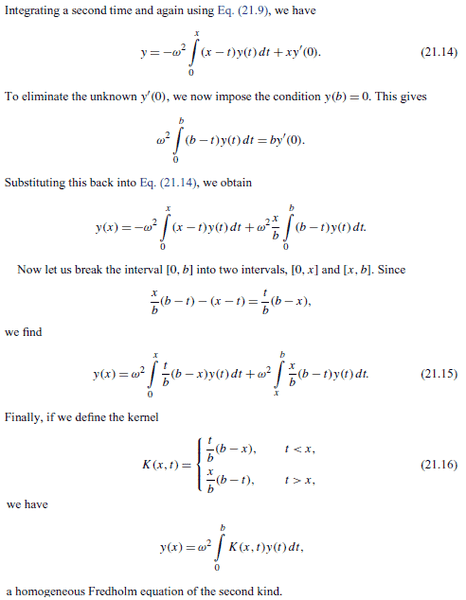
- Computation:
Integrating
[tex]y'' = - P(x)y' - Q(x)y + g(x)[/tex]
gives us
[tex]y'(x) = y'_a -<br /> \int_a^xp(t)y'(t)dt-\int_a^xq(t)y(t)dt+\int_a^xg(t)dt[/tex]
which, on getting rid of the $y'$ term by I.B.P.,
[tex]y'(x) = y'_a +y_ap(a)-p(x)y(x) +<br /> \int_a^xp'(t)y(t)dt-\int_a^xq(t)y(t)dt+\int_a^xg(t)dt[/tex]
gives us
[tex]y'(x) = y'_a +y_ap(a)-p(x)y(x) -<br /> \int_a^x[q(t)-p'(t)]y(t)dt+\int_a^xg(t)dt[/tex]
Integrating to find $y$ gives
[tex]y(x) = y_a+[y'_a +y_ap(a)](x-a)-\int_a^xp(t)y(t)dt -<br /> \int_a^x\int_a^u[q(t)-p'(t)]y(t)dtdu+\int_a^x\int_a^ug(t)dtdu[/tex]
or
[tex]y(x) = y_a+[y'_a +y_ap(a)](x-a)-\int_a^xp(t)y(t)dt -<br /> \int_a^x[q(t)-p'(t)](x-t)y(t)dt+\int_a^xg(t)(x-t)dt[/tex]
or
[tex]y(x) = y_a+[y'_a +y_ap(a)](x-a)-\int_a^xp(t)y(t)dt -<br /> \int_a^x[q(t)-p'(t)](x-t)y(t)dt+\int_a^xg(t)(x-t)dt[/tex]
Now, to remove the undetermined constant [itex]y'_a[/itex] we can use the B.C.
[itex]y(b)=y_b[/itex] to find
[tex]y'_a = \frac{y_b-y_a}{b-a}-y_ap(a)+\frac{1}{b-a}\int_a^bp(t)y(t)dt<br /> + \frac{1}{b-a}\int_a^b[q(t)-p'(t)](b-t)y(t)dt - \frac{1}{b-a}\int_a^bg(t)(b-t)dt[/tex]
So that the solution is
[tex]y(x) = y_a+[\frac{y_b-y_a}{b-a}+\frac{1}{b-a}\int_a^bp(t)y(t)dt +<br /> \frac{1}{b-a}\int_a^b[q(t)-p'(t)](b-t)y(t)dt -<br /> \frac{1}{b-a}\int_a^bg(t)(b-t)dt](x-a)-\int_a^xp(t)y(t)dt -<br /> \int_a^x[q(t)-p'(t)](x-t)y(t)dt+\int_a^xg(t)(x-t)dt[/tex]
[tex]y'' + P(x)y' + Q(x)y = g(x), y(a) = y_a, y(b) = y_b[/tex]
to a Fredholm integral equation, explicitly determining the Kernel in the process, without removing the [itex]y'[/itex] term? (Here is an example of doing it without the [itex]y'[/itex] term) I seem to be getting stuck.
My answer (computed below if necessary) is
[tex]y(x) = y_a+[\frac{y_b-y_a}{b-a}+\frac{1}{b-a}\int_a^bp(t)y(t)dt + \frac{1}{b-a}\int_a^b[q(t)-p'(t)](b-t)y(t)dt - \frac{1}{b-a}\int_a^bg(t)(b-t)dt](x-a)-\int_a^xp(t)y(t)dt - \int_a^x[q(t)-p'(t)](x-t)y(t)dt+\int_a^xg(t)(x-t)dt[/tex]
How do we write this in terms of an integral kernel, and can we call our result a Green function?
Note: Here is an example from Arfken of how it is done for the simple case of [itex]y''+\omega^2 y = 0, y(0)=0, y(b)=0[/itex]:
- Computation:
Integrating
[tex]y'' = - P(x)y' - Q(x)y + g(x)[/tex]
gives us
[tex]y'(x) = y'_a -<br /> \int_a^xp(t)y'(t)dt-\int_a^xq(t)y(t)dt+\int_a^xg(t)dt[/tex]
which, on getting rid of the $y'$ term by I.B.P.,
[tex]y'(x) = y'_a +y_ap(a)-p(x)y(x) +<br /> \int_a^xp'(t)y(t)dt-\int_a^xq(t)y(t)dt+\int_a^xg(t)dt[/tex]
gives us
[tex]y'(x) = y'_a +y_ap(a)-p(x)y(x) -<br /> \int_a^x[q(t)-p'(t)]y(t)dt+\int_a^xg(t)dt[/tex]
Integrating to find $y$ gives
[tex]y(x) = y_a+[y'_a +y_ap(a)](x-a)-\int_a^xp(t)y(t)dt -<br /> \int_a^x\int_a^u[q(t)-p'(t)]y(t)dtdu+\int_a^x\int_a^ug(t)dtdu[/tex]
or
[tex]y(x) = y_a+[y'_a +y_ap(a)](x-a)-\int_a^xp(t)y(t)dt -<br /> \int_a^x[q(t)-p'(t)](x-t)y(t)dt+\int_a^xg(t)(x-t)dt[/tex]
or
[tex]y(x) = y_a+[y'_a +y_ap(a)](x-a)-\int_a^xp(t)y(t)dt -<br /> \int_a^x[q(t)-p'(t)](x-t)y(t)dt+\int_a^xg(t)(x-t)dt[/tex]
Now, to remove the undetermined constant [itex]y'_a[/itex] we can use the B.C.
[itex]y(b)=y_b[/itex] to find
[tex]y'_a = \frac{y_b-y_a}{b-a}-y_ap(a)+\frac{1}{b-a}\int_a^bp(t)y(t)dt<br /> + \frac{1}{b-a}\int_a^b[q(t)-p'(t)](b-t)y(t)dt - \frac{1}{b-a}\int_a^bg(t)(b-t)dt[/tex]
So that the solution is
[tex]y(x) = y_a+[\frac{y_b-y_a}{b-a}+\frac{1}{b-a}\int_a^bp(t)y(t)dt +<br /> \frac{1}{b-a}\int_a^b[q(t)-p'(t)](b-t)y(t)dt -<br /> \frac{1}{b-a}\int_a^bg(t)(b-t)dt](x-a)-\int_a^xp(t)y(t)dt -<br /> \int_a^x[q(t)-p'(t)](x-t)y(t)dt+\int_a^xg(t)(x-t)dt[/tex]