Zaduszki in Poland: Our Local Tradition

  • Thread starter Thread starter Borek
  • Start date Start date
Click For Summary
SUMMARY

The discussion centers on the Polish tradition of Zaduszki, celebrated on November 2nd, where families visit graves to light candles and place flowers in remembrance of deceased relatives. Participants noted the significance of both Zaduszki and All Saints' Day, which occurs on November 1st, highlighting the blend of these observances in Polish culture. The conversation also touched on the use of different materials for grave markers, such as marble and terrazzo, and the emotional impact of these traditions on individuals, particularly in relation to family memories and cultural practices across Eastern Europe.

PREREQUISITES
  • Understanding of Polish cultural traditions, specifically Zaduszki and All Saints' Day.
  • Familiarity with the significance of candle lighting in remembrance practices.
  • Knowledge of cemetery customs and materials used for grave markers, such as marble and terrazzo.
  • Awareness of the differences between Catholic and Orthodox traditions in Eastern Europe.
NEXT STEPS
  • Research the historical origins and variations of Zaduszki across different Eastern European countries.
  • Explore the significance of All Saints' Day and its observance in various cultures.
  • Investigate the materials used in grave markers and their cultural implications in Poland.
  • Learn about the emotional and psychological aspects of remembrance practices in different religious contexts.
USEFUL FOR

This discussion is beneficial for cultural anthropologists, historians studying Eastern European traditions, individuals interested in cemetery customs, and anyone seeking to understand the emotional significance of remembrance practices in Polish culture.

Borek
Mentor
Messages
29,169
Reaction score
4,597
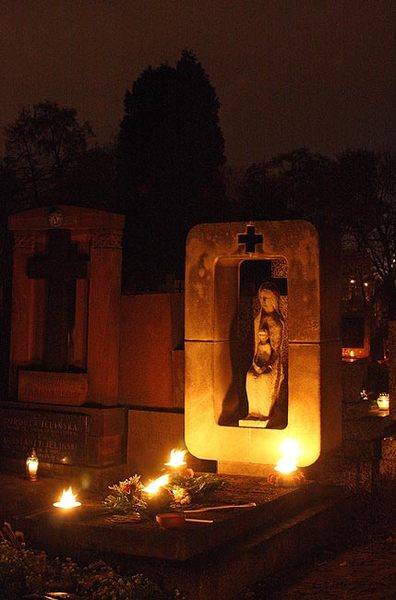
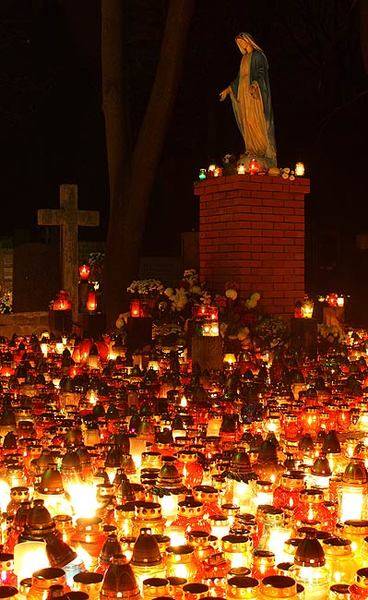
That's our local tradition. On November 1st and 2nd we visit graves of our relatives to light candles and put flowers.

You start with shopping - flowers...
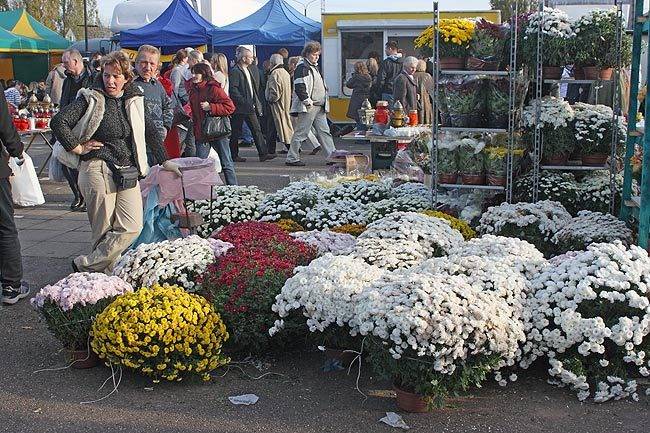
IMG_7922.jpg


and candles (navigating through the crowd; we both did the same mistake of taking pictures WITHOUT people, that was a substantial effort - now we can't show you how the cemeteries really look alike on these days).*
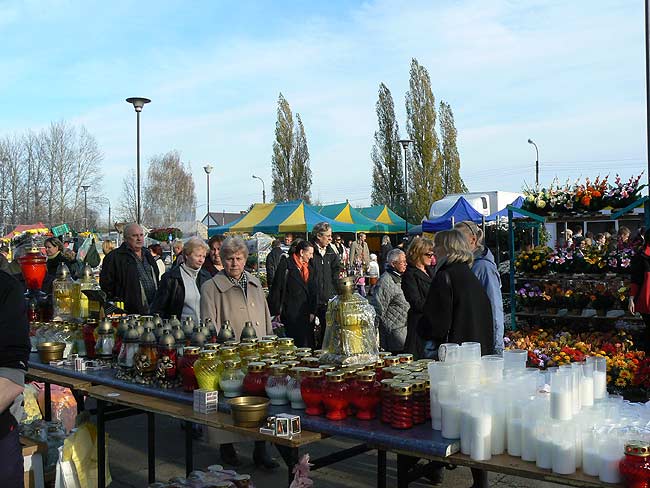
P1070046.jpg


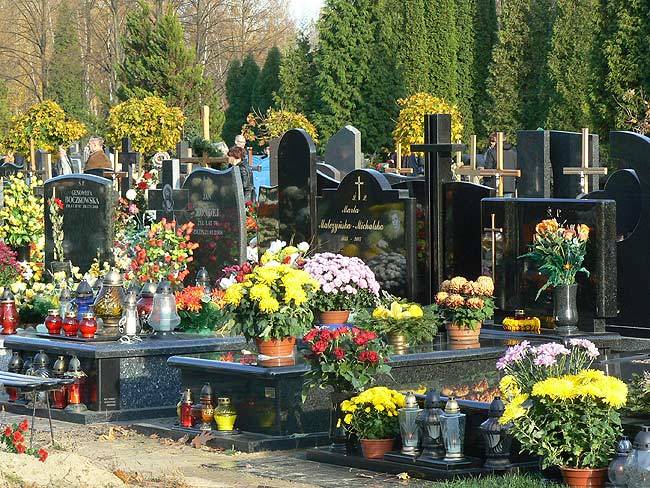
This is particularly expensive part of the cemetery - marbles and other expensive stones used.*
P1070102.jpg


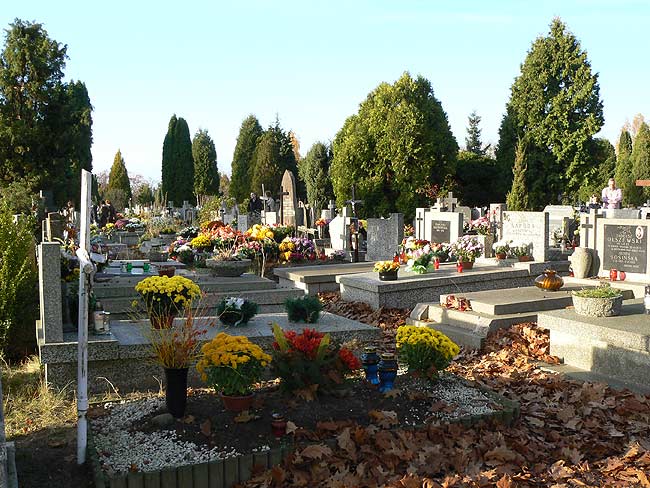
But much cheaper terrazzo is the most popular material.*
P1070115.jpg


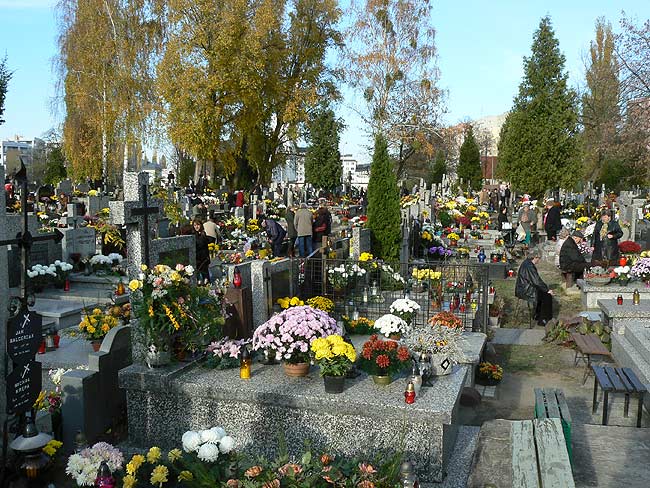
Other cemetery - we have visited three.*
P1070040.jpg


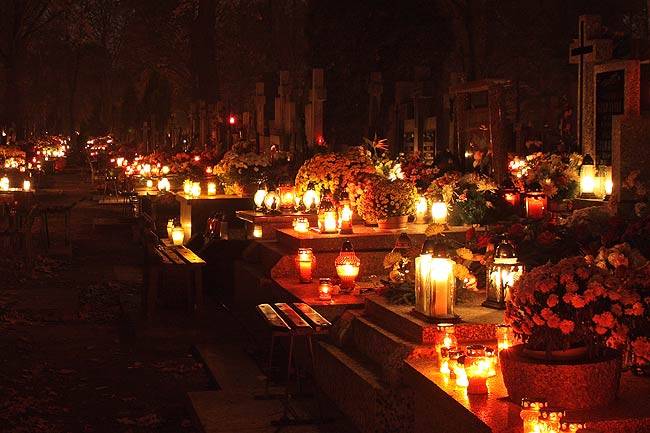
But it gets really nice at the evening, when it is already dark, and you can see all these candles...
IMG_7943.jpg


IMG_7948.jpg


IMG_7956.jpg


As usual, Marzena's pictures with *.
 

Attachments

  • IMG_7922.jpg
    IMG_7922.jpg
    89 KB · Views: 495
  • P1070046.jpg
    P1070046.jpg
    58.4 KB · Views: 468
  • P1070102.jpg
    P1070102.jpg
    99.1 KB · Views: 496
  • P1070115.jpg
    P1070115.jpg
    76.2 KB · Views: 474
  • P1070040.jpg
    P1070040.jpg
    95.1 KB · Views: 524
Last edited:
Physics news on Phys.org
Wow, that's a lovely custom, Borek, and, as usual, your and Marzena's photography documents the whole of it well. You've captured the day remarkably well. Thanks for telling us about it and showing it to us.
 
They also do that in several Catholic cemeteries near me. It may also be the Polish, I'm not sure. There is a really large Polish/ Catholic population here.
Wonderful photos of the market area, what do they call this event?
 
I think there are similar customs throughout Eastern Europe. A close frienda took me to some a small church/chapel, and as we entered the door, we had an option to buy candles and place them for those who are special. The person I was with lit a candle for 'her' three children, which were not hers biologically, but she raised them because the mother couldn't or didn't want to. Similarly, at the monestaries I visited, people bought candles to light for ancestors.
 
Astronuc said:
I think there are similar customs throughout Eastern Europe. A close frienda took me to some a small church/chapel, and as we entered the door, we had an option to buy candles and place them for those who are special.

That's a Catholic tradition, but is quite different from what Borek is showing of candles at cemetaries. Though, yes, I've seen candles at gravesites in Catholic cemetaries...usually at the sites of Slavic and Italian families. I never realized there were special dates associated with the candles, though. I guess my grandparents didn't maintain that tradition. We didn't usually go to the cemetary after Labor Day (in September...that's when we'd replace the flags on one uncle's grave who was killed in war) until Christmas.
 
Thats neat. and Marzena is your wife?
 
hypatia said:
Wonderful photos of the market area, what do they call this event?

Zaduszki, pronounced something like zahdooshki. But see next posts.
 
Wow, quite a lot of comments - which are slightly wrong...

Astronuc said:
I think there are similar customs throughout Eastern Europe. A close frienda took me to some a small church/chapel, and as we entered the door, we had an option to buy candles and place them for those who are special.

Moonbear said:
That's a Catholic tradition

I think it is an Orthodox tradition. What I know for sure is that you will not see it in Poland in Catholic churches, but we have Orthodox minority in the eastern Poland and I think that's what they do.

Moonbear said:
but is quite different from what Borek is showing of candles at cemetaries. Though, yes, I've seen candles at gravesites in Catholic cemetaries...usually at the sites of Slavic and Italian families. I never realized there were special dates associated with the candles, though.

Astronuc said:
All Saints' Day Celebration in Poland; Polish Cemeteries - Nov 1.

Candles on the graves are lit on any occasion - be it birthday or name day, or death anniversary. It s nothing wrong with lighting a candle on every other day, quite often people that are just accidentally close to the cemetary will buy a candle and put it on the grave. But on other days you just can, while on Zaduszki you should.

Page that Astro linked to is not entirely correct. All Saints' Day is on the Novemeber 1st, Zaduszki are on November 2nd. Technically these are two different days and two different holidays, although they got mixed and blended and most people go visit their graves on both days. To some extent that's because November 1st is a public vacation in Poland, while November 2nd is not, making it technically difficult to visit the graves. But most people are not aware of the distinction (including me, I had to check details, I just knew that the situation is not as simple as it looks at the first sight).
 
  • #11
Borek said:
I think it is an Orthodox tradition. What I know for sure is that you will not see it in Poland in Catholic churches, but we have Orthodox minority in the eastern Poland and I think that's what they do.

In the US, it's done in Catholic churches. I don't know about Orthodox churches, because I've never been in one.
 
  • #12
Interesting, didn't know about it. On the second thought - not very surprising. "Catholic" is a very broad term. I suppose when I write "Catholic" I mean "Polish Catholic" (whatever that means).
 
  • #13
Impressive Borek,

All Saints Day is also very important in Southern Germany but almost unknown in the north as well as in the Netherlands, marking the traditional geographic extend of Roman Catholisism in Europe
 
  • #14
The candlelit graves are so beautiful! What a lovely tradition.
 
  • #15
Borek said:
Interesting, didn't know about it. On the second thought - not very surprising. "Catholic" is a very broad term. I suppose when I write "Catholic" I mean "Polish Catholic" (whatever that means).

Well, my grandparent's parish was led by a Polish priest, and they had candles at their church too.

Though, I guess it doesn't surprise me that the traditions vary from country to country, even for something like the Catholic church which is so large across many countries. The Slovaks I work with were initially confused by some of the differences when they started going to church here too...traditions they thought were part of the Catholic tradition turned out to be local traditions that aren't practiced here, and then of course some things I thought were Catholic traditions are local traditions practiced here and not elsewhere.
 
  • #16
The traditions you show in your images are wonderful in their embrace of remembrance. It makes me a bit sad for my father's grave... he wanted to be buried in the Catholic cemetery of my mother's tiny, mostly deserted, two-cross-road hometown, which, this time of year, is very cold and windy, and I'm sure quite lonely... But now, in retrospect and miles away, I can just superimpose his soul on the spirit of your photos, and it all seems okay. Thank you for sharing the photos.
 

Similar threads

  • · Replies 1 ·
Replies
1
Views
4K