What Does Zee Mean by the Equation in QFT Nut, III.6, p. 194?

  • Context: Graduate 
  • Thread starter Thread starter Lapidus
  • Start date Start date
  • Tags Tags
    Qft
Click For Summary
SUMMARY

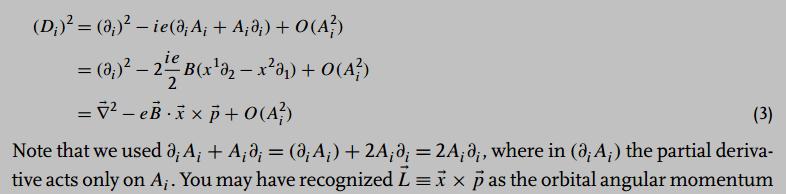
The discussion centers on the interpretation of the equation presented by Zee in "QFT Nut," specifically regarding the expression involving the divergence of a vector field, denoted as ##(\partial_i A_i)##. Participants clarify that this expression vanishes under certain gauge conditions and emphasize the importance of the product rule in quantum field theory. The conversation highlights the confusion caused by Zee's notation compared to more straightforward explanations found in texts like Griffith's "Intro to Electrodynamics." The corrected expression for the momentum operator acting on a wave function is presented as $$(\partial_i A_i + A_i \partial_i) X = 2 A_i \partial_i X$$, illustrating the application of the product rule.

PREREQUISITES
  • Understanding of quantum field theory (QFT) principles
  • Familiarity with vector calculus, particularly divergence
  • Knowledge of operator notation in quantum mechanics
  • Experience with gauge theories and their implications
NEXT STEPS
  • Study the product rule in quantum mechanics and its applications
  • Review Griffith's "Intro to Electrodynamics" for clearer explanations of similar concepts
  • Explore gauge theories in quantum field theory for deeper insights
  • Learn about the implications of operator actions on wave functions in QFT
USEFUL FOR

This discussion is beneficial for physics students, quantum field theorists, and educators seeking clarity on complex notation and concepts in quantum mechanics, particularly those related to gauge theories and operator algebra.

Lapidus
Messages
344
Reaction score
12
..where can be found:
Zee 1.PNG


What in the whole wide world does Zee mean with

zee 2.PNG
??

Thank you
 
Physics news on Phys.org
I guess that ##(\partial_i A_i)##is another way to say div A, which probably vanishes in the gauge Zee is considering. The bracket probably means that the action of the partial derivative is restricted to A.
 
  • Like
Likes   Reactions: Lapidus
But on what else could the partial derivative act on than on A?
 
On what does it act in ##A_i \partial_i##? I mean, you are considering a momentum operator, so it will act on some wavefunction, besides A.
 
  • Like
Likes   Reactions: Lapidus
A better way to write this would be
$$(\partial_i A_i + A_i \partial_i) X = (\partial_i A_i)X + 2 A_i \partial_i X = 2 A_i \partial_i X$$
for some wave function X and ignoring indices there. Just the product rule applied to ##\partial_i A_i X##

Edit: Added missing X
 
Last edited:
  • Like
Likes   Reactions: Lapidus
Got it! Thanks DrDu and mfb!
 
This book by Zee, although apparently written in a quite colloquial way, confuses (at least me) more than it helps. This is an example. Instead of writing the simple matter in a simple way as mfb did in #5 he only gives some short-hand notation, which is more confusing than helpful :-(.
 
Well it's so and so; it seems like a bigger generalization of the derivation of xp -px = i \hbar. Without having to write (xp - px ) f(x) = i \hbar f(x).
Although I think similar expressions were in Griffith's Intro to Electrodynamics.
(feels like Zee's advocate)
 
mfb said:
A better way to write this would be
$$(\partial_i A_i + A_i \partial_i) X = (\partial_i A_i) + 2 A_i \partial_i X = 2 A_i \partial_i X$$
for some wave function X and ignoring indices there. Just the product rule applied to ##\partial_i A_i X##
Just to point out a small misprint (mfb just forgot): there is an X missing in the middle expression$$(\partial_i A_i + A_i \partial_i) X = (\partial_i A_i) X + 2 A_i \partial_i X = 2 A_i \partial_i X$$
 
  • Like
Likes   Reactions: mfb

Similar threads

  • · Replies 13 ·
Replies
13
Views
2K
  • · Replies 2 ·
Replies
2
Views
3K
  • · Replies 2 ·
Replies
2
Views
2K
Replies
18
Views
2K
  • · Replies 1 ·
Replies
1
Views
3K
  • · Replies 3 ·
Replies
3
Views
2K
  • · Replies 11 ·
Replies
11
Views
3K
  • · Replies 8 ·
Replies
8
Views
2K
  • · Replies 2 ·
Replies
2
Views
3K
  • · Replies 1 ·
Replies
1
Views
2K