Understanding Integration by Parts in Quantum Field Theory

Click For Summary
SUMMARY

This discussion clarifies the concept of integration by parts in the context of Quantum Field Theory (QFT), specifically referencing Zee's "QFT in a Nutshell." The integration by parts is applied to the expression involving the Klein-Gordon equation, where the term ##\partial_{\mu}(\phi\partial^{\mu}\phi)## is decomposed into ##\partial_{\mu}\phi\partial^{\mu}\phi## and ##\phi\partial^{2}\phi##. The left-hand side of the integral vanishes under the assumption that the fields decay rapidly at infinity, allowing for the substitution made by Zee. This understanding is crucial for manipulating Lagrangian densities in QFT.

PREREQUISITES
  • Familiarity with Quantum Field Theory concepts
  • Understanding of the Klein-Gordon equation
  • Knowledge of integration techniques in multi-dimensional calculus
  • Basic grasp of Lagrangian density formulations
NEXT STEPS
  • Study the derivation of the Klein-Gordon equation from Lagrangian densities
  • Learn about surface terms in integration within the context of field theory
  • Explore the implications of field decay at infinity in QFT
  • Investigate the role of integration by parts in other QFT calculations
USEFUL FOR

This discussion is beneficial for students and researchers in Quantum Field Theory, particularly those studying Lagrangian mechanics and the Klein-Gordon equation. It is also useful for physicists looking to deepen their understanding of integration techniques in field theory.

looseleaf
Messages
24
Reaction score
1
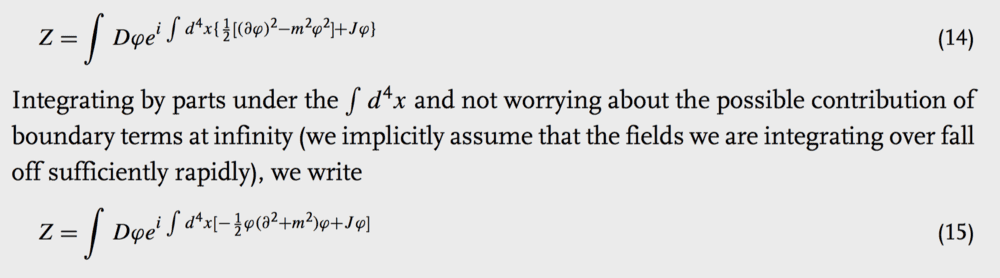
Hello, I'm just starting Zee's QFT in a Nutshell, I'm a bit confused about what he means by "integate by parts under the d4x". Can someone explain what he means by this? I understand how to obtain the Klein-Gordon equation from the free particle Lagrangian density, but not sure why he invokes integration by parts.
Thanks!
Screen Shot 2019-03-22 at 7.57.24 PM.png
 

Attachments

  • Screen Shot 2019-03-22 at 7.57.24 PM.png
    Screen Shot 2019-03-22 at 7.57.24 PM.png
    22 KB · Views: 884
Physics news on Phys.org
Well, you have a ##(\partial \varphi)(\partial \varphi)## term, but ##\varphi\partial ^2 \varphi## is more useful later.

Both arise from the derivative of ##(\varphi)(\partial \varphi)## and that should go to zero for large ##\phi##.
 
  • Like
Likes   Reactions: DarMM
To expand on what @mfb said.

We have:
$$\partial_{\mu}\left(\phi\partial^{\mu}\phi\right) = \partial_{\mu}\phi\partial^{\mu}\phi + \phi\partial^{2}\phi$$
Under the integral:
$$\int{\partial_{\mu}\left(\phi\partial^{\mu}\phi\right)d^{4}x} = \int{\partial_{\mu}\phi\partial^{\mu}\phi \hspace{1pt} d^{4}x} + \int{\phi\partial^{2}\phi \hspace{1pt} d^{4}x}$$
So assuming the left-hand side vanishes we'd have:
$$\int{\partial_{\mu}\phi\partial^{\mu}\phi \hspace{1pt} d^{4}x} = - \int{\phi\partial^{2}\phi \hspace{1pt} d^{4}x}$$
which is exactly the replacement made in Zee.

Since the LHS term is just a surface term it should vanish if the fields decay rapidly. They do, but proving so is a good bit beyond a text like Zee. Basically you'd have to prove a randomly selected field decays at infinity with probability ##1##.
 
  • Informative
Likes   Reactions: mfb

Similar threads

  • · Replies 13 ·
Replies
13
Views
2K
  • · Replies 49 ·
2
Replies
49
Views
7K
  • · Replies 5 ·
Replies
5
Views
2K
  • · Replies 1 ·
Replies
1
Views
2K
  • · Replies 1 ·
Replies
1
Views
2K
  • · Replies 2 ·
Replies
2
Views
2K
  • · Replies 2 ·
Replies
2
Views
3K
  • · Replies 11 ·
Replies
11
Views
2K
  • · Replies 3 ·
Replies
3
Views
1K
  • · Replies 2 ·
Replies
2
Views
3K