What Does Zee Mean by the Equation in QFT Nut, III.6, p. 194?

  • Context: Graduate 
  • Thread starter Thread starter Lapidus
  • Start date Start date
  • Tags Tags
    Qft
Click For Summary

Discussion Overview

The discussion revolves around the interpretation of a specific equation presented in Zee's work on quantum field theory (QFT), particularly focusing on the notation and implications of the equation as it relates to the divergence of a vector field and its application in the context of momentum operators and wavefunctions.

Discussion Character

  • Technical explanation
  • Debate/contested
  • Mathematical reasoning

Main Points Raised

  • Some participants suggest that the term ##(\partial_i A_i)## represents the divergence of the vector field A, which may vanish under certain gauge conditions considered by Zee.
  • There is a question regarding what the partial derivative acts upon, with some participants proposing that it could act on a wavefunction in addition to A.
  • One participant proposes an alternative expression for the equation, applying the product rule to clarify the relationship between the terms involved.
  • Another participant expresses confusion over Zee's notation, suggesting that it complicates rather than clarifies the concepts, contrasting it with a clearer explanation provided by another participant.
  • A later reply draws a parallel between the equation in question and a well-known relation in quantum mechanics, indicating a broader context for understanding the derivation.
  • There are multiple suggestions for rewriting the equation to enhance clarity, with some participants pointing out missing components in earlier expressions.

Areas of Agreement / Disagreement

Participants express differing views on the clarity and utility of Zee's notation, with some finding it confusing while others defend its generalization. There is no consensus on the interpretation of the equation or the best way to express it.

Contextual Notes

Participants note potential ambiguities in the notation and the assumptions underlying the expressions, particularly regarding the application of derivatives and the roles of wavefunctions.

Lapidus
Messages
344
Reaction score
12
..where can be found:
Zee 1.PNG


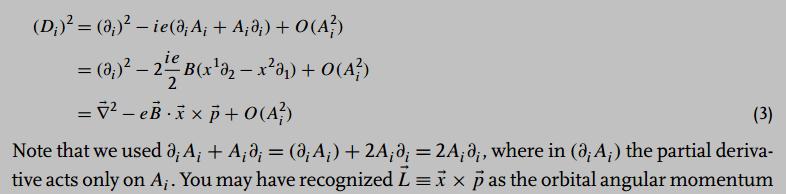
What in the whole wide world does Zee mean with

zee 2.PNG
??

Thank you
 
Physics news on Phys.org
I guess that ##(\partial_i A_i)##is another way to say div A, which probably vanishes in the gauge Zee is considering. The bracket probably means that the action of the partial derivative is restricted to A.
 
  • Like
Likes   Reactions: Lapidus
But on what else could the partial derivative act on than on A?
 
On what does it act in ##A_i \partial_i##? I mean, you are considering a momentum operator, so it will act on some wavefunction, besides A.
 
  • Like
Likes   Reactions: Lapidus
A better way to write this would be
$$(\partial_i A_i + A_i \partial_i) X = (\partial_i A_i)X + 2 A_i \partial_i X = 2 A_i \partial_i X$$
for some wave function X and ignoring indices there. Just the product rule applied to ##\partial_i A_i X##

Edit: Added missing X
 
Last edited:
  • Like
Likes   Reactions: Lapidus
Got it! Thanks DrDu and mfb!
 
This book by Zee, although apparently written in a quite colloquial way, confuses (at least me) more than it helps. This is an example. Instead of writing the simple matter in a simple way as mfb did in #5 he only gives some short-hand notation, which is more confusing than helpful :-(.
 
Well it's so and so; it seems like a bigger generalization of the derivation of xp -px = i \hbar. Without having to write (xp - px ) f(x) = i \hbar f(x).
Although I think similar expressions were in Griffith's Intro to Electrodynamics.
(feels like Zee's advocate)
 
mfb said:
A better way to write this would be
$$(\partial_i A_i + A_i \partial_i) X = (\partial_i A_i) + 2 A_i \partial_i X = 2 A_i \partial_i X$$
for some wave function X and ignoring indices there. Just the product rule applied to ##\partial_i A_i X##
Just to point out a small misprint (mfb just forgot): there is an X missing in the middle expression$$(\partial_i A_i + A_i \partial_i) X = (\partial_i A_i) X + 2 A_i \partial_i X = 2 A_i \partial_i X$$
 
  • Like
Likes   Reactions: mfb

Similar threads

  • · Replies 13 ·
Replies
13
Views
2K
  • · Replies 2 ·
Replies
2
Views
3K
  • · Replies 2 ·
Replies
2
Views
2K
Replies
18
Views
2K
  • · Replies 1 ·
Replies
1
Views
3K
  • · Replies 3 ·
Replies
3
Views
2K
  • · Replies 11 ·
Replies
11
Views
3K
  • · Replies 8 ·
Replies
8
Views
2K
  • · Replies 2 ·
Replies
2
Views
3K
  • · Replies 1 ·
Replies
1
Views
2K