Zero turn radius without using swivel casters

  • Thread starter Thread starter troop231
  • Start date Start date
  • Tags Tags
    Radius Zero
Click For Summary

Discussion Overview

The discussion revolves around the feasibility of using a specific type of wheel with contoured edges on a push mower to achieve a zero or near zero turn radius without employing swivel casters. Participants explore the mechanics and implications of this design choice, considering its potential impact on grass and mowing efficiency.

Discussion Character

  • Exploratory
  • Technical explanation
  • Debate/contested

Main Points Raised

  • One participant proposes that a contoured wheel could allow a push mower to turn with a zero radius by gliding over grass without scalping.
  • Another participant suggests that the mower's design requires pressing down on the handle to turn, indicating that simply replacing the front wheels may not achieve the desired turning capability.
  • Some participants express skepticism about achieving a zero turn radius with only front wheel modifications, citing the fixed rear wheels as a limiting factor.
  • A participant mentions that the term "anti-scalp" refers to the wheel's function in helping the mower deck avoid scalping by lifting over obstacles, rather than the wheel itself preventing damage.
  • One participant questions why manufacturers do not use such wheels if they are effective, implying that there may be overlooked considerations in the proposed design.
  • Another participant suggests exploring omni wheels as an alternative, sharing links to products that may offer similar functionality.
  • A participant shares their experience with omni wheels failing in grass, reinforcing their preference for the spherical wheel design due to space constraints with traditional casters.

Areas of Agreement / Disagreement

Participants express a mix of agreement and disagreement regarding the feasibility of achieving a zero turn radius with the proposed wheel design. There is no consensus on whether the contoured wheel will effectively allow for the desired maneuverability without causing damage to the grass.

Contextual Notes

Some participants note that the effectiveness of the proposed wheel design may depend on specific mower configurations and the mechanics of turning. The discussion highlights the complexity of achieving a zero turn radius with modifications to only the front wheels.

troop231
Messages
5
Reaction score
0
I'm not sure if this question fits here, but I've had trouble finding a good simple physics forum, so I signed up here :)

I'm trying to think if the below wheel (image below) could allow for my push mower to have a zero or near zero turn radius. The edges of the wheel contour up (from the ground upwards), which should bend the blades of grass over and allow the wheel to glide over them (theoretically). The contact point of the wheel is in the middle due to the contoured edges. I would like to use this wheel instead of a swivel caster as it would still allow the mower to track straight much better than using a swivel caster. Also it would bolt right on with no extensive mods that the swivel caster would require.

Am I thinking right? If there is any risk of tearing the grass (scalping) I will abandon this idea. These are called anti-scalp wheels however.

I appreciate your feedback.
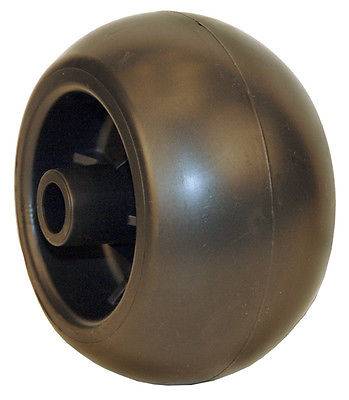
zwrL9mg.jpg
 
Engineering news on Phys.org
Welcome to PF.
It would help if you could identify the make and model of your mower.
Can you post us a web link that shows the caster geometry?
 
Thank you, here is my mower: (standard 20" cut)
A5JExit.jpg


Also I said I don't want to use casters in my original post. The wheel in my first post would bolt right up to the stock axles. My question is, would this style of wheel (contoured edges) simulate zero turning due to the smooth plastic and shape. I don't want it to drag and pull the grass like the stock mower wheels.
 
That mower is designed to be turned by pressing down on the handle to reduce the load on the front wheels, then rotating the mower about some point on the axis of the rear axle.
I would consider replacing only the front wheels with the spherical wheels you have identified.
 
Baluncore said:
That mower is designed to be turned by pressing down on the handle to reduce the load on the front wheels, then rotating the mower about some point on the axis of the rear axle.
I would consider replacing only the front wheels with the spherical wheels you have identified.

I know that. I thought my question was pretty clear. I'm wanting to avoid pushing down on the handle bar and simply rotate the mower instead, hence my post. What I'm more insterested in is the mechanics behind this to see if this is a solid idea. Also, it was my intention of only doing the front wheels that way..

Thank you :)
 
I cannot see how you can possibly get the “Zero turn radius” mentioned in your title by only replacing the front wheels. The two fixed rear wheels set the centre of rotation to be on their common axis and not under the centre of the mower.
 
Baluncore said:
I cannot see how you can possibly get the “Zero turn radius” mentioned in your title by only replacing the front wheels. The two fixed rear wheels set the centre of rotation to be on their common axis and not under the centre of the mower.

Same principle as these mowers: (which is classified as zero turn by the way) Two fixed rear wheels that can move independently from each other (like a push mower) and two front wheels that can either swivel (like the below picture) or a spherical wheel like I proposed which would use sliding friction to recreate the 'zero turn'
http://www.popularmechanics.com/cm/popularmechanics/images/Zs/zero-turn-mowers-04-0513-lgn.jpg
 
Last edited by a moderator:
Well, that shows a spherical wheel being used to set the level of the "mower deck", independent of the ride on frame's casters.
Can you not just copy that?
 
I understand that you think the wheel will «float» on the grass while moving sideways because of the round shape. That may be the case, I couldn't tell. It's probably safe to assume that it will do less damage than a «right angle» wheel. But two comments I want to say to help you in your reflexion.

First, the wheel is called «anti-scalp» because its purpose is to allow the deck of mower (as shown in the picture you posted in post #7) to pivot over a hill or bump to help avoid scalping. The wheel should be slightly lower than the deck so that when the deck approaches the hill the wheel makes contact with the hill first. The wheel then lifts the deck up and over the hill. The scalping it prevents is done by the deck, not the wheel.

Second, if what you propose was effective - as simple as you presented it - then why aren't the mower fitted with these wheels in the first place? The companies that build them are generally not that incompetent.

But enough with the complaints, here is an idea you might like: Omni wheels.

http://www.aliexpress.com/store/product/100mm-Double-Plastic-Omni-Wheel-basic-W049/512426_572721516.html , it works similar to this:


You might even look at the possibility of http://www.omnitrack.us/omnicaster/omnicaster-ball-castors-OC30-35-i.php.
 
Last edited by a moderator:
  • #10
jack action said:
http://www.aliexpress.com/store/product/100mm-Double-Plastic-Omni-Wheel-basic-W049/512426_572721516.html , it works similar to this:
You might even look at the possibility of http://www.omnitrack.us/omnicaster/omnicaster-ball-castors-OC30-35-i.php.

I tried 8" omni wheels last week and they failed miserably in grass due to the rollers being too small, so I'll be returning them. That is why I proposed the spherical (anti-scalp) shaped wheel. Using casters is a last resort as I want to take up less space and a 6-7" caster would require a large envelope for it to work in, thereby reducing the ability to mow up close to objects.
 
Last edited by a moderator:

Similar threads

  • · Replies 8 ·
Replies
8
Views
3K
Replies
27
Views
9K
Replies
6
Views
6K
  • · Replies 5 ·
Replies
5
Views
6K
  • · Replies 11 ·
Replies
11
Views
8K
Replies
1
Views
5K
  • · Replies 9 ·
Replies
9
Views
2K
  • · Replies 2 ·
Replies
2
Views
2K
  • · Replies 11 ·
Replies
11
Views
17K
  • · Replies 7 ·
Replies
7
Views
4K