SUMMARY
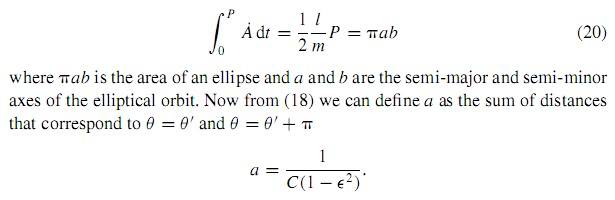
The semi-major axis of an ellipse is defined as a = 1/(C(1 - ε²)), where C is a constant and ε represents the eccentricity of the ellipse. The discussion clarifies that the distances between points on the ellipse are derived from the equations 1/r = C(1 - ε cos(θ - θ')) and 1/r = C(1 + ε cos(θ - θ' - π). The total distance calculation leads to the conclusion that the semi-major axis is half of the derived total distance, confirming the formula provided. This correction is essential for accurate understanding of elliptical geometry.
PREREQUISITES
- Understanding of elliptical geometry
- Familiarity with mathematical constants and variables (C, ε)
- Knowledge of trigonometric functions and their applications
- Basic algebra for manipulating equations
NEXT STEPS
- Study the properties of ellipses in analytical geometry
- Learn about eccentricity and its role in defining conic sections
- Explore the derivation of the equations for conic sections
- Investigate applications of ellipses in physics and engineering
USEFUL FOR
Mathematicians, physics students, and anyone interested in the geometric properties of ellipses and their applications in real-world scenarios.