Can anybody help with this power question?

  • Thread starter Thread starter bear820301
  • Start date Start date
  • Tags Tags
    Power
Click For Summary

Discussion Overview

The discussion revolves around a practice problem related to power factor correction in an electrical circuit. Participants explore how to determine the appropriate size and connection method (series or parallel) for a capacitor needed to correct the power factor from 0.8 to 0.9. The conversation includes theoretical considerations, calculations, and differing interpretations of the problem.

Discussion Character

  • Technical explanation
  • Mathematical reasoning
  • Debate/contested

Main Points Raised

  • One participant suggests that a 13 kVAR capacitor should be connected in parallel to maintain the existing load's power draw at 50 kW at a power factor of 0.8.
  • Another participant questions the provided answer of connecting the capacitor in series, arguing that it may be a typo.
  • Some participants argue that the inductance causing the power factor reduction is in series with the resistance, implying that the added capacitance should also be in series.
  • It is noted that adding capacitance in parallel may not lower the impedance sufficiently to achieve the desired power factor correction.
  • One participant recalculates the impedance after adding a capacitor in parallel, suggesting that the overall impedance decreases, which could lead to an increase in KVA.
  • Another participant provides a different calculation, indicating that the impedance increases and the angle decreases, suggesting a power factor closer to 0.9.
  • There is discussion about the nature of reactive power and whether the active power should remain constant, with some participants expressing uncertainty about the calculations involved.
  • Several participants engage in detailed calculations of the load impedance and the effects of adding the capacitor, leading to differing conclusions about the resultant power factor.
  • Some participants emphasize that the initial power factor was not explicitly stated as lagging, but the context implies it is due to the need for correction with a capacitor.

Areas of Agreement / Disagreement

Participants express differing views on the correct method for connecting the capacitor (series vs. parallel) and the implications of their calculations. There is no consensus on the correct approach or the final outcome of the power factor correction.

Contextual Notes

Participants' calculations vary significantly, with some assuming different initial conditions for the power factor and load characteristics. The discussion reflects a range of interpretations regarding the nature of the load and the effects of adding capacitance.

bear820301
Messages
1
Reaction score
0
Hi Guys,

This is my first post here. I am preparing for the EIT exam in October. I came across this practice problem during my review.

Question:
The circuit shown has a power factor of 0.8. What size capacitor must be added to this circuit to correct the power factor to 0.9?
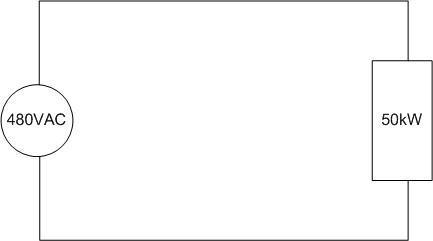
Drawing1.jpg


(A) 10 kVAR in series
(B) 10 kVAR in parallel
(C) 13 kVAR in series
(D) 13 kVAR in parallel

It is easily calculated that the needed reactive power is ~13kVAR. However,the questions is about how to connect it: series or parallel.

I think 13kVAR shall be connected in parallel to ensure that the existing load still draws 50kW at 0.8pf (by maintaining the terminal voltage, given the load is a constant impedance). However, the answer provided is (C). I can see the point of choosing (C) if the load is a constant KVA load. But if this is true, (D) is also a a correct answer isn't it?

Let me know what you guys think.
 
Physics news on Phys.org
I think 13kVAR shall be connected in parallel to ensure that the existing load still draws 50kW at 0.8pf (by maintaining the terminal voltage, given the load is a constant impedance).

Yes, you are correct. I can't imagine why the supplied answer was "C", other than a typo.
 
It could be argued that the inductance in the circuit causing the power factor reduction, is in series with the resistance so the capacitance that must be added must also be in series. Another reason is that adding capacitance in parallel, but not enough to bring the power factor to unity, will raise the impedance, not lower it, reducing the power to the load.
 
skeptic2 said:
Another reason is that adding capacitance in parallel, but not enough to bring the power factor to unity, will raise the impedance, not lower it, reducing the power to the load.

No, not really. When the supply is a voltage source (or at least approx a VS) then the load power is unchanged by the addition of a parallel capacitor. Yes the overall impedance is increased and the reactive power reduced, but that's kind of the point of PFC.
 
After doing a little complex arithmetic, I must change what I posted earlier.

Adding -j13.3 in parallel to a series 50 + j12.5 (for pf = 0.8) results in an impedance of 3.53 - j13.2 or a magnitude of 13.7 KVA with a pf of 0.26.

So contrary to my earlier post the impedance goes down because the capacitance overwhelms the inductance. This means the KVA would increase, not decrease.
 
skeptic2 said:
After doing a little complex arithmetic, I must change what I posted earlier.

Adding -j13.3 in parallel to a series 50 + j12.5 (for pf = 0.8) results in an impedance of 3.53 - j13.2 or a magnitude of 13.7 KVA with a pf of 0.26.

So contrary to my earlier post the impedance goes down because the capacitance overwhelms the inductance. This means the KVA would increase, not decrease.

My calculations are a little different.

For V=480 and P=50 kW at PF=0.8, I calculate Z = 2.949 + j 2.212 ohms for the initial load impedance.

For Q=13 KVAR I calculate the required parallel capacitor impedance is Zc = -j 17.72 ohms.

For the combined parallel impedance of the above I get, Zt = 3.716 + j 1.821 ohms.

As you can see the magnitude of the impedance has increased and it's angle has decreased (such that cos(phi) is now approx 0.9).
 
A reactive current is not necessarily the inductive - it may be capacitive as well. There is nothing said also whether the active power should stay the same.
The reactive (supposedly inductive) power is now 12.5 kVar (50/80 X 100 = 62.5 - 50 = 12.5) slightly less than the capacitive power (from the possibly right C variant) of 13 kVar. Although the capacitor(s) in series with the load will bring its active power drastically down to about 1 tength of what it is now, but, maybe then, the resultant capacitive reactive power will yield the number 0.9?
 
Last edited:
Yuri B. said:
A reactive current is not necessarily the inductive - it may be capacitive as well. There is nothing said also whether the active power should stay the same.
The reactive (supposedly inductive) power is now 12.5 kVar (50/80 X 100 = 62.5 - 50 = 12.5) slightly less than the capacitive power (from the possibly right C variant) of 13 kVar. Although the capacitor(s) in series with the load will bring its active power drastically down to about 1 tength of what it is now, but, maybe then, the resultant capacitive reactive power will yield the number 0.9?

No. You can't calculate the reactive power by just subtracting the real power from the apparent power like that.

It's VAR = sqrt(VA^2 - P^2), which give 37.5 KVAR reactive power!
 
Yes, it is vector sum. (For PF 0.9 the reactive power here should be about 21kVAR).
 
Last edited:
  • #10
uart said:
My calculations are a little different.

For V=480 and P=50 kW at PF=0.8, I calculate Z = 2.949 + j 2.212 ohms for the initial load impedance.

For Q=13 KVAR I calculate the required parallel capacitor impedance is Zc = -j 17.72 ohms.

For the combined parallel impedance of the above I get, Zt = 3.716 + j 1.821 ohms.

As you can see the magnitude of the impedance has increased and it's angle has decreased (such that cos(phi) is now approx 0.9).

For V=480 and P=50 kW at PF=0.8, I calculate Z = 2.949 - j 2.212 ohms for the initial load impedance. 480^2 / [50000 + j37500] please note change in sign of reactance.

For Q=13 KVAR I calculate the required capacitor reactance is Zc = -j 17.72 ohms.

For the combined parallel impedance of the above I get, Zt = 2.281 - j 2.304 ohms. Calculation was done in Excel using the formula IMDIV(IMPRODUCT(COMPLEX(2.949,-2.212),COMPLEX(0,-17.72)),IMSUM(COMPLEX(2.949,-2.212),COMPLEX(0,-17.72))).

This impedance has a magnitude of 3.242 ohms for a total KVA of 71065.

As you can see the magnitude of the impedance has decreased and it's angle has increased (such that cos(phi) is now approx 0.704).
 
  • #11
skeptic2 said:
For V=480 and P=50 kW at PF=0.8, I calculate Z = 2.949 - j 2.212 ohms for the initial load impedance. 480^2 / [50000 + j37500] please note change in sign of reactance.

For Q=13 KVAR I calculate the required capacitor reactance is Zc = -j 17.72 ohms.

For the combined parallel impedance of the above I get, Zt = 2.281 - j 2.304 ohms. Calculation was done in Excel using the formula IMDIV(IMPRODUCT(COMPLEX(2.949,-2.212),COMPLEX(0,-17.72)),IMSUM(COMPLEX(2.949,-2.212),COMPLEX(0,-17.72))).

This impedance has a magnitude of 3.242 ohms for a total KVA of 71065.

As you can see the magnitude of the impedance has decreased and it's angle has increased (such that cos(phi) is now approx 0.704).

OK, granted that the question didn't explicitly say that the initial 0.8 PF was lagging.

However, given that the question say's that the power factor is to be corrected with the addition of a capacitor, is there some particular reason why you chose to assume that the initial PF was leading?
 
  • #12
I believe an inductive load does cause a lagging power factor.

480^2 / (50000 + j37500) = 2.949 - j2.212 The sign of the imaginary part changes when divided into a positive real.
 
  • #13
skeptic2 said:
The sign of the imaginary part changes when divided into a positive real.

Yes exactly, that's why we need a +ive imaginary part of the impedance (eg 2.949 + j2.212) to give rise to a lagging current.

Your load impedance of 2.949 - j2.212 corresponds to a leading current and hence a capacitive load.

The actual load in this question however is clearly NOT capacitive. The question clearly tells us that the addition of more capacitance will correct the power factor, not make it worse.
 
  • #14
"C" is typo as has been mentioned.

Reactive current now at 0.8 PF is 77A.
Reactive current at 0.9 will be 50A.
13 kVAR capacitor provides 27 A reactive.
Connecting the cap in parallel will bring the reactive current to 50 A and the PF to 0.9.
 

Similar threads

  • · Replies 7 ·
Replies
7
Views
3K
  • · Replies 9 ·
Replies
9
Views
17K
Replies
2
Views
4K
  • · Replies 9 ·
Replies
9
Views
2K
  • · Replies 2 ·
Replies
2
Views
6K
  • · Replies 18 ·
Replies
18
Views
3K
Replies
13
Views
4K
  • · Replies 6 ·
Replies
6
Views
4K
  • · Replies 4 ·
Replies
4
Views
2K
  • · Replies 8 ·
Replies
8
Views
4K