| New Reply |
A prime limit that seems to approach a constant |
Share Thread | Thread Tools |
| Feb10-12, 09:49 AM | #1 |
|
|
A prime limit that seems to approach a constant
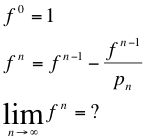
Ok heres the problem:
http://i42.tinypic.com/29288yd.png Using wolfram the first 100 results are these heres a plot of a couple points As you can see it doesn't seem to be approaching exactly zero, even though its very similar to 1/x (exactly the same if you replace Pn with just n) Is there any way to prove whether this does approach 0 or some constant, or is it possible to make a program to approximate it to some extremely large n, to see if its approaching zero or some constant. Thanks in advance, and sorry if the answer is obvious |
| Feb10-12, 10:10 AM | #2 |
|
|
hi robnybod! welcome to pf!
![]() it's decreasing and positive, so it must have a limit to find the limit, use the usual trick of putting fn = fn-1
|
| Feb10-12, 10:20 AM | #3 |
|
|
Thank you!
so according to that it would go to zero, correct? because than f=f(1-1/P(n)) and f goes away, so you're left with -1/P(infinity)=0, which checks |
| Feb10-12, 11:08 AM | #4 |
|
|
A prime limit that seems to approach a constant![]() (the reaoning isn't rigorous, but the result is ok) |
| Feb12-12, 12:41 AM | #5 |
|
|
Good morning,
Your infinite product ∏(1-pi-1), over all primes, does indeed converge to zero, but no fn=fn-1 trick is close to showing why. The standard elementary proof here is to rewrite your limit as (Ʃ1/n)-1 over the positive integers realizing that your limit is an euler product (google, wiki). Note btw that if you add an exponent s to all your primes, your limit equals ζ(s)-1, where ζ(s) is the Riemann zeta function, known to converge for all s>1 (and giving you non-zero limit in this case). |
| Mar6-12, 10:15 AM | #6 |
|
|
Another proof would be to think of function fk as being the probability to pick a natural number that has a factor among all the prime numbers except the first k prime numbers.
f0 = 1, the probability to pick a number that has a factor among all primes is 1 f1 = f0 - f0/p1, the probability to pick a number that has a factor among all prime numbers except the first prime is 1/2 at infinity this translates into lim [itex]_{n->\infty}[/itex]fn = 0 because f[itex]\infty[/itex] is the same as asking what is the probability to pick a natural number that doesn't have a factor among all the prime numbers. Of course all natural numbers have a prime factor or are prime numbers therefore the answer is 0. |
| New Reply |
| Tags |
| prime limit constant |
| Thread Tools | |
Similar Threads for: A prime limit that seems to approach a constant
|
||||
| Thread | Forum | Replies | ||
| New approach to FLT Proof for prime powers of n | Linear & Abstract Algebra | 21 | ||
| An approach to the Twin Prime Conjecture | Linear & Abstract Algebra | 14 | ||
| basic limit question (limit of h as h approach 0) | Calculus & Beyond Homework | 1 | ||
| [SOLVED] A different approach to prime numbers | Linear & Abstract Algebra | 3 | ||
| Fractional Series which approach the square roots of prime numbers. | Linear & Abstract Algebra | 2 | ||