New Reply

Moment of Inertia Problem

 
Share Thread Thread Tools
Nov24-12, 11:04 AM   #1
 
Recognitions:
Gold Membership Gold Member

Moment of Inertia Problem


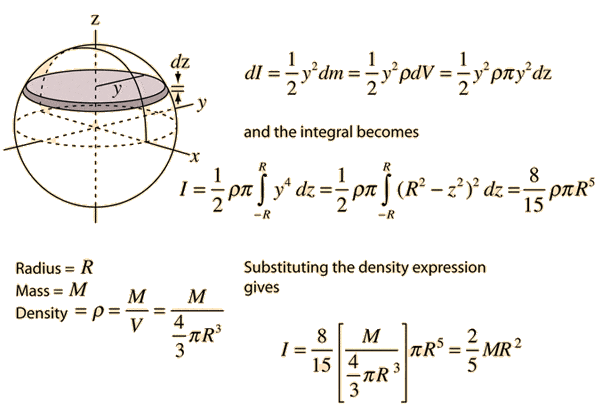
Here's a derviation from HyperPhysics:


He says:

[tex]dV=πy^{2}dz[/tex]


However, if we're finding the surface area of the sphere:

[tex]dA=2πRdz≠2πydz[/tex]


If we cannot use [tex]dA=2πydz[/tex], how come [tex]dV=πy^{2}dz[/tex] is still applicable?
PhysOrg.com
PhysOrg
physics news on PhysOrg.com

>> As chaos celebrates its 50th birthday, biophysicist develops a new method to visualize it
>> Novel features of helium-3 superfluidity discovered with new SQUID detector chip
>> Physics of 'green waves' could make city traffic flow more smoothly
Nov24-12, 11:31 AM   #2
 
Mentor
Blog Entries: 1
Quote by greswd View Post
He says:

[tex]dV=πy^{2}dz[/tex]
That's the volume of those circular disks.

What does finding the surface area of the sphere have to do with this?
Nov24-12, 12:11 PM   #3
 
Recognitions:
Gold Membership Gold Member
Quote by Doc Al View Post
What does finding the surface area of the sphere have to do with this?

If I want to find the MoI of a hollow sphere.

Based on the same assumptions [tex]dA=2πydz[/tex], it should be like that, but it's not .


I'm trying to calculate the MoIs of some hollow objects, not sure what kind of area formula I should use.
Nov24-12, 02:49 PM   #4
 
Mentor
Blog Entries: 1

Moment of Inertia Problem


Quote by greswd View Post
If I want to find the MoI of a hollow sphere.

Based on the same assumptions [tex]dA=2πydz[/tex], it should be like that, but it's not .
Not sure what you mean by "the same assumptions". To find the surface area of that ring, you need the arc length, not the vertical distance (dz).
Nov30-12, 09:05 AM   #5
 
Recognitions:
Gold Membership Gold Member
Quote by Doc Al View Post
Not sure what you mean by "the same assumptions". To find the surface area of that ring, you need the arc length, not the vertical distance (dz).
Yup, that's the perplexing part of the formula [tex]A=2πRz[/tex]


As z tends to zero, that particular segment of a sphere should tend toward a segment of a cone. And for a cone, when z tends to zero

[tex]A→2πrz[/tex]

The difference between the conical area and the area of a cylinder wrapped around it should decrease until they are equal when z tends to zero.
Nov30-12, 09:19 AM   #6
 
Mentor
Blog Entries: 1
Quote by greswd View Post
Yup, that's the perplexing part of the formula [tex]A=2πRz[/tex]


As z tends to zero, that particular segment of a sphere should tend toward a segment of a cone. And for a cone, when z tends to zero

[tex]A→2πrz[/tex]
Again, it's the length of that side that must be used. And that length is not simply z. (It's at an angle.)

The difference between the conical area and the area of a cylinder wrapped around it should decrease until they are equal when z tends to zero.
Their ratio remains finite. They aren't the same.
Nov30-12, 09:47 AM   #7
 
Is this for the moment of inertia of a sphere?
Nov30-12, 09:49 AM   #8
 
Mentor
Blog Entries: 1
Quote by HomogenousCow View Post
Is this for the moment of inertia of a sphere?
A spherical shell.
Nov30-12, 09:56 AM   #9
 
I'm pretty sure it's for a full sphere, that dI there represents the moment of inertia of a single disk at height z, and then he integrates from the bottom to the top.
Nov30-12, 10:01 AM   #10
 
Mentor
Blog Entries: 1
Quote by HomogenousCow View Post
I'm pretty sure it's for a full sphere, that dI there represents the moment of inertia of a single disk at height z, and then he integrates from the bottom to the top.
Yes, that would be correct if he were finding the moment of inertia of a solid sphere, but he's not.
Dec2-12, 02:23 AM   #11
 
Recognitions:
Gold Membership Gold Member
Quote by Doc Al View Post
Again, it's the length of that side that must be used. And that length is not simply z. (It's at an angle.)
That sounds correct.

But why does this not apply to volume integrals?
Dec2-12, 07:11 AM   #12
 
Mentor
Blog Entries: 1
Quote by greswd View Post
But why does this not apply to volume integrals?
Any slant with the side will be a second order correction to the radius and will have no effect on the volume element.

The volume is the area times thickness:
dV = area * dz = πr2dz

If we vary the radius by dr, we get:
dV = π(r + dr)2dz = π(r2 + 2rdr + dr2)dz
dV = πr2dz + 2πrdrdz + πdr2dz

The higher order differentials can be ignored.
Dec2-12, 07:47 AM   #13
 
Recognitions:
Gold Membership Gold Member
Quote by Doc Al View Post
Any slant with the side will be a second order correction to the radius and will have no effect on the volume element.

The volume is the area times thickness:
dV = area * dz = πr2dz

If we vary the radius by dr, we get:
dV = π(r + dr)2dz = π(r2 + 2rdr + dr2)dz
dV = πr2dz + 2πrdrdz + πdr2dz

The higher order differentials can be ignored.
So ignoring the higher order differentials, we still get an exact answer?


What if the external area is perimeter times thickness:

dA = perimeter * dz =2πrdz

Varying the radius by dr, we get:

dA = 2π(r+dr)dz =(2πr+2πdr)dz = 2πrdz + 2πdrdz
Dec2-12, 07:56 AM   #14
 
Mentor
Blog Entries: 1
Quote by greswd View Post
So ignoring the higher order differentials, we still get an exact answer?
Yes, that's how it's done. In the limit as they go to zero, (dx)2 can be ignored compared to dx.
What if the external area is perimeter times thickness:
But the surface area is not perimeter times thickness; it's perimeter times the length of the side.
Dec2-12, 09:37 AM   #15
 
Recognitions:
Gold Membership Gold Member
Quote by Doc Al View Post
Yes, that's how it's done. In the limit as they go to zero, (dx)2 can be ignored compared to dx.

But the surface area is not perimeter times thickness; it's perimeter times the length of the side.
ah, that makes sense.

but then volume can also be considered area times some funny ratio and not just the vertical height dz
Dec2-12, 09:55 AM   #16
 
Mentor
Blog Entries: 1
Quote by greswd View Post
but then volume can also be considered area times some funny ratio and not just the vertical height dz
You can express the length of the side in terms of the height. But that will also depend on the angle.
Dec2-12, 10:29 AM   #17
 
Recognitions:
Gold Membership Gold Member
Quote by Doc Al View Post
You can express the length of the side in terms of the height. But that will also depend on the angle.
yeah it will. so you've already explained why we can use dz for volume integrals, by ignoring the higher order differentials.

but for external area, you said we must account for the slant, I used (r + dr), doesn't that do the job?

I'm afriad my mathematical understanding is really sketchy.
New Reply
Thread Tools


Similar Threads for: Moment of Inertia Problem
Thread Forum Replies
Another moment of inertia problem. help! Introductory Physics Homework 7
Moment of inertia problem...please help !!! Introductory Physics Homework 6
moment of inertia problem Introductory Physics Homework 8
Moment of Inertia problem Classical Physics 3
What are moment of inertia, mass moment of inertia, and radius of gyration? Introductory Physics Homework 1