| New Reply |
why does the ICs(AD620AN) gets damaged? |
Share Thread | Thread Tools |
| Dec25-12, 12:05 PM | #1 |
|
|
why does the ICs(AD620AN) gets damaged?
Hi:
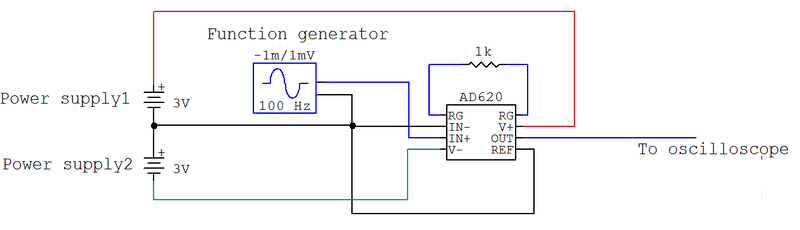
I bought six instrument amplifiers(AD620AN), i tested these ICs,all ICs was work properly but later the ICs gets damaged(5 five of 6 ICs gets damaged) i was very carefully(by reading datasheet) about power supply and input voltage i used this circuit(to make AD620AN work as just amplifier): ![]() so i wondering: Why does these ICs gets damaged(not working properly)!!?? |
| Dec25-12, 03:32 PM | #2 |
|
That's a nice part and i'd hate to be failing them, too.
It's hard to troubleshoot without observations on the actual setup. Two things that happen a lot: 1. Grounding through oscilloscope's reference lead - be aware it connects through 'scope chassis and power cord to building ground and eventually to earth. If either your function generator or your power supply tries to send any current to earth, it'll flow through your circuit and 'scope probe reference lead on its way there. If you ever see a small spark when connecting 'scope ground lead you have this problem. Look for it with a meter. 2. Power supplies - generally they have an active regulator inside that might go through a transient state on powerup or powerdown. Connect a meter, preferably an analog one , to your supply and switch power off and on a few times. If the meter reverses or shows a brief overvoltage then that's likely the culprit. It may not happen every time, and may depend on which supply comes on first.. This is rare but real on dual supply systems- If one supply forces any current backward through the other one at powerup, usually through capacitance,, well,, i've seen that cause "regulator latchup" which causes overvoltage. That's a sneaky one. good luck, old jim |
| Dec25-12, 04:12 PM | #3 |
|
Mentor
|
@samaaa: One other possibility might be latchup due to ESD. It isn't usually a big problem with analog circuits, but it still is a possibility.
Has the humidity been low in your area while this has been going on? If the humidity is low, and there is a source of ESD buildup (like when you slide off your chair to stand up at your lab bench), then if you touch the unprotected leads/wires in your circuit, you can introduce an ESD "hit" into the circuit, and this can lead to latchup and chip damage. You should make a habit of grounding yourself to Earth ground before touching any exposed, powered-up circuitry. Even better is to wear an ESD grounding strap that you can buy inexpensively at electronics stores. Do the failed chips get hot when you power them up? Do your power supplies have current meters on them? If so, watch for high current events that correspond to when the circuits fail. That would be an indication that latchup may be the problem. The source of the latchup would be ESD or the power supply sequencying issues brought up by Jim. |
| Dec25-12, 04:16 PM | #4 |
|
Mentor
|
why does the ICs(AD620AN) gets damaged?
An update -- I just checked the datasheet, and the very high input impedance and low operating current imply extensive use of CMOS circuitry inside this part. That would make it more vulnerable to ESD hits causing latchup.
|
| Dec25-12, 04:31 PM | #5 |
|
|
i will check the power supply as soon as. |
| Dec25-12, 04:44 PM | #6 |
|
|
i touched the input lead"input pin" many times and many times the input lead"input pin" was floating, so:if the input pin was floating ,does the IC get dameged? [/QUOTE] thanks.... |
| Dec25-12, 05:00 PM | #7 |
|
Berkeman has a good thought there on ESD.
I grew up in South Florida and never experienced static electricity until i moved up north. Humidity in near-tropics is so high it's just not a problem there. So i just don't think about it enough. Do you live in a dry climate? There exists special conductive mats for workbench surface. They are somewhat expensive. http://www.isconline.com/product/821...at.html?cid=14 Here's a DIY approach for static conrol, you might place a carpet remnant that's been treated this way on your workbench and earth ground it.. http://www.888400floor.com/flooring-...y-control.html EDIT just a thought... with your gain of 50, a DC offset of just 0.04 volts would drive the amplifier to its limit and make it appear "latched". Be very sure your function generator has no DC offset. old jim |
| Dec25-12, 05:45 PM | #8 |
Recognitions:
|
While you are experimenting with the circuit, a 1M resistor connected between IN- and IN+ probably won't affect how the circuit works but it will prevent static problems. If your circuit is designed to have an input that can be "unplugged", you need to include something like that in the design, so the input can never be left floating. As well as the static sensitivity, RF electrical noise or EM radiation might induce enough voltage on a high impedance "floating" input to overload the amplifier and make the output "latch up" to one of the supply rails. |
| Dec25-12, 07:33 PM | #9 |
|
|
|
| Dec25-12, 07:48 PM | #10 |
|
Mentor
|
|
| Dec26-12, 08:50 AM | #11 |
|
Recognitions:
|
While testing these (open loop bandwidth?), a 1:10 potential divider (say, 100k and 12k) at the input might give adequate protection.
|
| Dec26-12, 11:41 AM | #12 |
|
|
jim hardy,yes i live in dry climate
thanks for all, i will take your advice . |
| New Reply |
| Thread Tools | |
Similar Threads for: why does the ICs(AD620AN) gets damaged?
|
||||
| Thread | Forum | Replies | ||
| Extracting video from damaged VCDs | Computers | 4 | ||
| Help me….my hard disk is damaged!!! | Computers | 13 | ||
| 'miracle drug' can wake brain-damaged patients | General Discussion | 12 | ||
| What electronic comonents damaged in an EM Pulse | Electrical Engineering | 3 | ||