| New Reply |
Finding resistor's voltage with current and voltage sources present |
Share Thread | Thread Tools |
| Jul16-12, 09:16 PM | #1 |
|
|
Finding resistor's voltage with current and voltage sources present
What is the voltage across R2? You should convert the 4 V source and resistor into a current source as your first step.
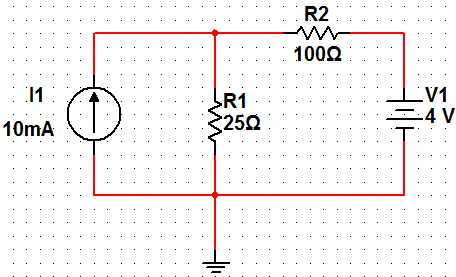
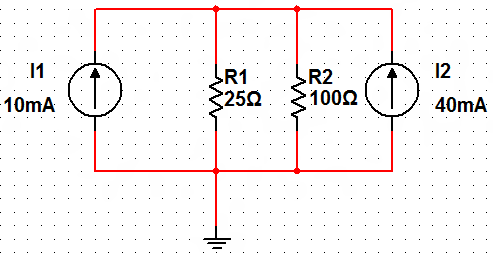
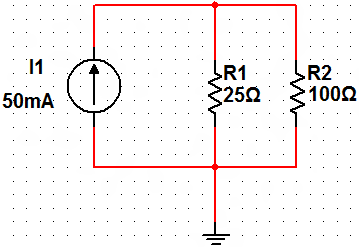
![]() The first thing I did is create a second current source out of the 4 V voltage source and the series resistor R2. I called it I_2. I_2 = E/R_2 = 4V/100Ω = 40 mA This gives us: ![]() We can combine the parallel current sources I_1 and I_2: I = I_1 + I_2 = 10 mA + 40 mA = 50 mA ![]() By the current divider rule, I_R2 = (R_T*I)/R2 = (20Ω*50mA)/100Ω = 10 mA V_R2 = I_R2*R2 = 10mA * 100Ω = 1 V However, when I run a simulation of the original circuit using MultiSim, I get 3 V through R2. Where am I going wrong? |
| Jul16-12, 09:41 PM | #2 |
|
Mentor
|
The difficulty appears to be that you are assuming the resistor, R2 in the original circuit has the same voltage across it as the resistor, R2, in the last two circuits. |
| Jul17-12, 07:54 AM | #3 |
|
|
I'm stuck. I think I understand what you mean that R2 in the new (simplified) circuit cannot be treated the same as R2 in the original circuit. Am I correct up to the point where I found a combined 50 mA current source acting on two parallel resistors R1 and R2?
If so, how do I get back to finding the voltage for R2 in the original circuit. |
| Jul17-12, 08:07 AM | #4 |
|
Mentor
|
Finding resistor's voltage with current and voltage sources present |
| Jul17-12, 08:56 AM | #5 |
|
Recognitions:
|
Oops, my mistake. What you are using is not what I think of as current divider rule, but it's okay. |
| Jul17-12, 09:06 AM | #6 |
|
|
Anyway, using your advice to find the voltage across R1 in the simplified circuit, I've found the voltage across R2 using Kirchhoff's Voltage Law on the original circuit: ![]() Using the current divider rule: [tex]I_{R1}=\frac{(20\Omega )(.05 A)}{(25 \Omega )}=.04A[/tex] [tex]V_{R1}=\left (I_{R1} \right )\left (R_1 \right )=\left ( .04A \right )\left (25\Omega \right )=1V[/tex] E - VR2 - VR1 = 0 VR2 = E - VR1 = 4V - 1V = 3V |
| New Reply |
| Tags |
| current source, resistor, simulation, voltage source |
| Thread Tools | |
Similar Threads for: Finding resistor's voltage with current and voltage sources present
|
||||
| Thread | Forum | Replies | ||
| How does voltage stay the same at all points in a circuit when a resistor is present? | Introductory Physics Homework | 4 | ||
| Figuring out voltage across resistor and current in loop given initial voltage input | Engineering, Comp Sci, & Technology Homework | 2 | ||
| current and voltage sources | Introductory Physics Homework | 6 | ||
| Finding current across a capacitor in a circuit with two AC voltage sources | Introductory Physics Homework | 13 | ||
| Ideal voltage/current sources | Electrical Engineering | 3 | ||