Is there a formula for these circles?

  • Context: Graduate 
  • Thread starter Thread starter arkajad
  • Start date Start date
  • Tags Tags
    Circles Formula
Click For Summary
SUMMARY

This discussion focuses on the generation of self-similar patterns using six 2x2 complex matrices from the group SL(2,C) and their application through linear fractional transformations (Mobius transformations) on the complex plane. The participant successfully derived a formula for the radius of the central circle, R = (1+k)/(1-k), specifically for k=0.7, yielding R = 5.66. Additionally, they explored the relationships between the diameters of surrounding circles, establishing that the diameter of larger circles satisfies (1+sqrt(2))*r = R, while smaller circles follow r = R/(1+sqrt(2)). The discussion also highlights the complexity of deriving a simple formula due to the non-commuting nature of the transformations involved.

PREREQUISITES
  • Understanding of complex matrices, specifically from the group SL(2,C).
  • Knowledge of linear fractional transformations (Mobius transformations).
  • Familiarity with fractal generation techniques, particularly using the Quantum Fractal Generator.
  • Basic concepts of Lie spheres geometry and relativistic transformations.
NEXT STEPS
  • Research the properties and applications of SL(2,C) matrices in complex analysis.
  • Explore the mathematical foundations of Mobius transformations and their geometric interpretations.
  • Learn about fractal generation algorithms and their implementation in software tools.
  • Investigate Lie spheres geometry and its relevance to transformations in higher dimensions.
USEFUL FOR

Mathematicians, physicists, and computer scientists interested in fractal geometry, complex transformations, and the application of group theory in visual pattern generation.

arkajad
Messages
1,481
Reaction score
4
I have six 2x2 complex matrices from the group SL(2,C). Each line is a matrix: first row, second row.

\left(<br /> \begin{array}{cc}<br /> \left\{\frac{1}{\sqrt{1-k^2}},\frac{k}{\sqrt{1-k^2}}\right\} &amp; \left\{\frac{k}{\sqrt{1-k^2}},\frac{1}{\sqrt{1-k^2}}\right\} \\<br /> \left\{\frac{1}{\sqrt{1-k^2}},\frac{i k}{\sqrt{1-k^2}}\right\} &amp; \left\{-\frac{i k}{\sqrt{1-k^2}},\frac{1}{\sqrt{1-k^2}}\right\} \\<br /> \left\{\frac{k+1}{\sqrt{1-k^2}},0\right\} &amp; \left\{0,\frac{1-k}{\sqrt{1-k^2}}\right\} \\<br /> \left\{\frac{1-k}{\sqrt{1-k^2}},0\right\} &amp; \left\{0,\frac{k+1}{\sqrt{1-k^2}}\right\} \\<br /> \left\{\frac{1}{\sqrt{1-k^2}},-\frac{i k}{\sqrt{1-k^2}}\right\} &amp; \left\{\frac{i k}{\sqrt{1-k^2}},\frac{1}{\sqrt{1-k^2}}\right\} \\<br /> \left\{\frac{1}{\sqrt{1-k^2}},-\frac{k}{\sqrt{1-k^2}}\right\} &amp; \left\{-\frac{k}{\sqrt{1-k^2}},\frac{1}{\sqrt{1-k^2}}\right\} \\<br /> \end{array}<br /> \right)

Let us take k=0.7 and act with these matrices on the complex plane via linear fractional transformations (Mobius transformations):
z\mapsto\frac{az+b}{cz+d}.
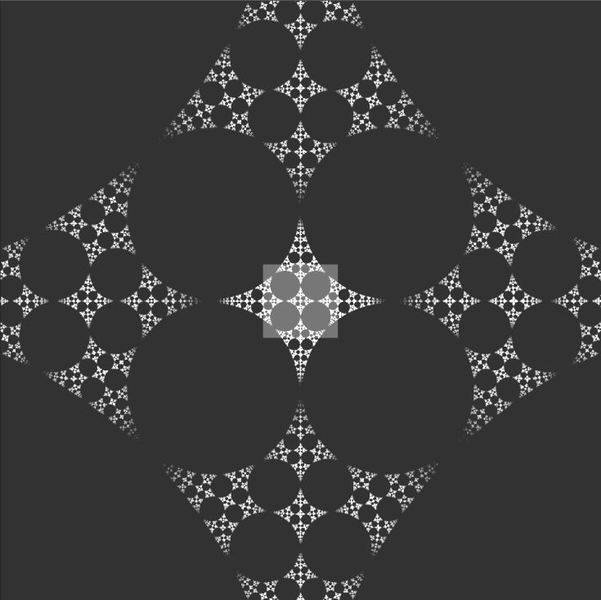
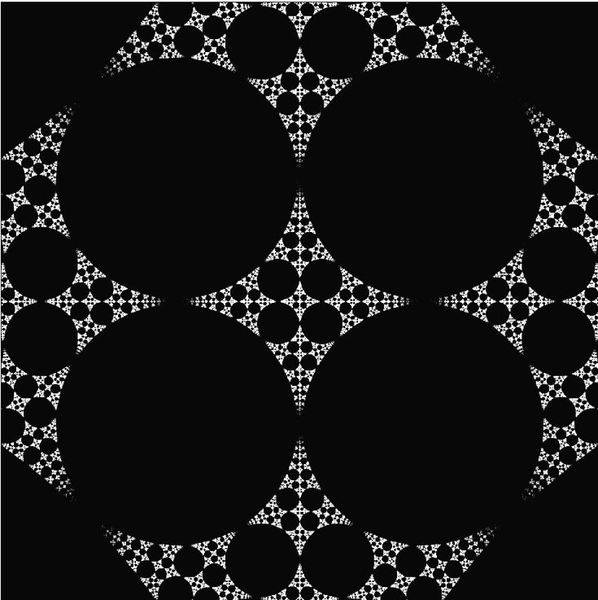
Selecting an arbitrary starting point and applying consecutively randomly selecting matrices several millions of times ("Chaos Game") we create a pattern. Here is the pattern in the square -8&lt;x,y&lt;8
oct_st_8.jpg

The pattern seems to be self-similar. Here is the central square -1&lt;x,y&lt;1
oct_st_1.jpg


Question: Is it possible, looking at the transformations to find a formula for the centers and the radii of all these circles? What kind of a formula would it be? A closed algebraic expression? An algorithm?

P.S. You can create this pattern yourself using Quantum Fractal Generator. Just choose Alpha=0.7, Chaos Game, Fractal Type: PlatonicOcta, Display Type Stereographic, XY LIMIT 8.0, Fractal Algorithm: Chaos Game, Color Scheme: Grayscale, 10 mln iterations.
P.S2: Your computer will crash if you try to implement the transformations as described in my post. The trick is to do it on the Riemann sphere rather than on the complex plane.
 
Last edited:
Physics news on Phys.org
Update

After asking the above question I started playing with numbers. I think I have the formula for the radius of the central white circle:

guess_1.jpg


The formula is:

R =\frac{1+k}{1-k}

For k=0.7 this gives R = 5.66...

It seems to work. But I do not know why it is so. And I do not know anything about the black holes.
 
Interesting picture, and I have no idea how you generated it.

As far as I can see, all other diameters follow from geometry. The diameter of the big holes in the red circle satisfies (1+sqrt(2))*r = R, the smaller circles (similar to the big ones) have (1+sqrt(2))r' = (sqrt(2)-1)r.

$$r=\frac{R}{1+\sqrt{2}}$$
And we have a scaling factor of
$$s=\frac{\sqrt{2}-1}{\sqrt{2}+1} =(\sqrt{2}-1)^2$$
 
mfb said:
Interesting picture, and I have no idea how you generated it.

As far as I can see, all other diameters follow from geometry. The diameter of the big holes in the red circle satisfies (1+sqrt(2))*r = R, the smaller circles (similar to the big ones) have (1+sqrt(2))r' = (sqrt(2)-1)r.

$$r=\frac{R}{1+\sqrt{2}}$$
And we have a scaling factor of
$$s=\frac{\sqrt{2}-1}{\sqrt{2}+1} =(\sqrt{2}-1)^2$$

Wow! I did not notice it. And it was in plain sight. Thanks!

Explaining how the picture is generated would require some space. The same for my guess about the formula for the radius of the white circle (I calculated the infinitesimal area change of the square of the fourth transformation and looked for the solution of it being = 1).
 
Nope!

Nope. For k=0.6 we get this picture:

guess6.jpg


Not that simple. My formula for the radius of the white circle still works - it is R=4 this time (The whole picture is from -8 to 8). But the smaller black circles do not touch. It was the particularity of k=0.7 that they seemed to be tangent.
 
Last edited:
  • Like
Likes   Reactions: 1 person
arkajad said:
For k=0.6 we get this picture:

That's really neat!
 
Greg Bernhardt said:
That's really neat!

Thanks. Perhaps it is of interest that my six matrices describe six special Lorentz transformations, all with velocity v = 0.88 c, but in six different directions (+/- of each of three coordinate axes). The picture arises as the result of the relativistic light aberration when a monkey is piloting the UFO (able to instantly accelerate and change direction) with a joystick with six positions, and the monkey, looking at a fixed star, is randomly manipulating the joystick 100 mln times.
 
Update

I have found the algorithm for generating white (maximum density of hits) circles. The idea is that the Mobius group acts on the 3-dimensional space of circles (in mathematics this is a part of "Lie spheres geometry"). So given the transformations, and starting with one circle (say, a great circle on the sphere), we can generate generations of new circles. One can write the algorithm for doing this. There is no simple formula as we are dealing here with a composition of non-commuting maps (relativistic boosts in different directions) Here is the result (of course it makes no sense to generate circles that are too small to be seen as such on the image):

plcol06.jpg


They fit perfectly the structure that is seen on the fractal:

circles06.jpg


(Colors inverted, circles and fractal overimposed).

With black circles it is more difficult. In fact thy are not circles - they are circle-like shapes contained in circles.
 
Update

Update: I managed to make an animation going through the different values of the velocity parameter (from about 0.999 c to about 0.5 c)

https://www.youtube.com/watch?v=NL13EC9Im1E
 

Similar threads

  • · Replies 4 ·
Replies
4
Views
3K
  • · Replies 21 ·
Replies
21
Views
1K
Replies
4
Views
2K
  • · Replies 1 ·
Replies
1
Views
3K
  • · Replies 12 ·
Replies
12
Views
2K
  • · Replies 2 ·
Replies
2
Views
2K
  • · Replies 2 ·
Replies
2
Views
2K
  • · Replies 0 ·
Replies
0
Views
2K
  • · Replies 4 ·
Replies
4
Views
3K
  • · Replies 1 ·
Replies
1
Views
2K