Troubleshooting Ln: Tips to Improve Sleep

Click For Summary

Homework Help Overview

The discussion revolves around understanding the relationship between the complex variable version of arcsinh and its integral representation. Participants are exploring differentiation techniques related to the function y = ln[x + (1 + x^2)^(1/2)] and its connection to arcsinh(x).

Discussion Character

  • Exploratory, Conceptual clarification, Mathematical reasoning

Approaches and Questions Raised

  • Participants are attempting to differentiate the function y = ln[x + (1 + x^2)^(1/2)] and relate it to the derivative of arcsinh(x). Some express confusion about the differentiation process and the algebra involved.

Discussion Status

There are multiple lines of reasoning being explored, with some participants providing clarifications and hints. Guidance has been offered regarding the differentiation process, but a consensus on the approach has not been reached.

Contextual Notes

Participants are grappling with the complexity of the differentiation and the algebraic manipulation required to connect the two forms of the function. There is an acknowledgment of the potential for confusion in the steps involved.


Focus
Messages
285
Reaction score
3
I've had troubled sleep because of this...:cry:
ln.jpg

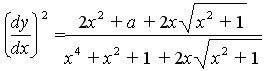
I tryed a lot and got this...
metryln.jpg

Can you spot any mistakes or give me hints on how to approach this
Thanks
 
Physics news on Phys.org
That is an equation that shows the "complex variable" version of arcsinh (x) as equal to the integral version of it (on real values). Like a definition. You obtain the first with the complex functions sinhz and some algebra, and the second one with a trigonometric substitution (or using mathematica, hehe)
 
SebastianG said:
That is an equation that shows the "complex variable" version of arcsinh (x) as equal to the integral version of it (on real values). Like a definition. You obtain the first with the complex functions sinhz and some algebra, and the second one with a trigonometric substitution (or using mathematica, hehe)
I am so confused...I know that the second one can be obtained by using y=arsinh(x) but I can't get the log of the function to differentiate to that:rolleyes:
 
It helps a lot if you write it clearly! I think you mean that IF
[tex]y= ln\left[x+ (1+x^2)^{\frac{1}{2}}\right][/tex]
then
[tex](1+x^2)\left(\frac{dy}{dx}\right)^2= 1[/tex]
which is the same as saying that
[tex]\frac{dy}{dx}= \frac{1}{(1+x^2)^{\frac{1}{2}}}[/tex]
 
HallsofIvy said:
It helps a lot if you write it clearly! I think you mean that IF
[tex]y= ln\left[x+ (1+x^2)^{\frac{1}{2}}\right][/tex]
then
[tex](1+x^2)\left(\frac{dy}{dx}\right)^2= 1[/tex]
which is the same as saying that
[tex]\frac{dy}{dx}= \frac{1}{(1+x^2)^{\frac{1}{2}}}[/tex]
The problem is I can't derive [tex]\frac{dy}{dx}= \frac{1}{(1+x^2)^{\frac{1}{2}}}[/tex] from [tex]y= ln\left[x+ (1+x^2)^{\frac{1}{2}}\right][/tex]...
I can only derive it from y=arsinh(x)
 
Focus said:
The problem is I can't derive [tex]\frac{dy}{dx}= \frac{1}{(1+x^2)^{\frac{1}{2}}}[/tex] from [tex]y= ln\left[x+ (1+x^2)^{\frac{1}{2}}\right][/tex]...
I can only derive it from y=arsinh(x)

It seems like it pops right out from the chain rule.
 
Yep.
[tex]y= ln\left[x+ (1+x^2)^{\frac{1}{2}}\right][/tex]so
[tex]y'= \frac{1}{x+(1+x^2)^{\frac{1}{2}}}\left(1+(\frac{1}{2})(1+ x^2)^{-\frac{1}{2}}(2x)\right)\)[/tex]
Now factor that
[tex](1+ x^2)^{-\frac{1}{2}}[/tex]
out of the numerator and every thing else cancels!
 
Hmmm...I tried that but I'll do it again, cheers for the help :smile:
 

Similar threads

  • · Replies 4 ·
Replies
4
Views
2K
  • · Replies 8 ·
Replies
8
Views
1K
  • · Replies 5 ·
Replies
5
Views
2K
  • · Replies 2 ·
Replies
2
Views
3K
  • · Replies 4 ·
Replies
4
Views
1K
  • · Replies 5 ·
Replies
5
Views
2K
Replies
9
Views
2K
  • · Replies 2 ·
Replies
2
Views
3K
  • · Replies 12 ·
Replies
12
Views
2K
  • · Replies 4 ·
Replies
4
Views
2K