Undergrad Proof to the Expression of Poisson Distribution

Click For Summary
A Poisson distribution describes the number of times an event occurs in a fixed interval, assuming events occur independently and at a constant rate. The probability of an event is proportional to the interval's length, and two events cannot occur simultaneously. The Poisson distribution can be derived as a limiting case of the binomial distribution by considering the probability of a single event in a small interval and taking the limit as the interval approaches zero. The relationship between the binomial and Poisson distributions is established through the convergence of probabilities as the number of trials increases. This discussion outlines the foundational principles and derivation of the Poisson distribution's probability expression.
Anakin Skywalker
Messages
1
Reaction score
0
Hello.
Given a range of time in which an event can occur an indefinite number of times, we say a random variable X folows a poisson distribution when it follows this statements:
  • X is the number of times an event occurs in an interval and X can take values 0, 1, 2, …
  • The occurrence of one event does not affect the probability that a second event will occur. That is, events occur independently.
  • The rate at which events occur is constant. The rate cannot be higher in some intervals and lower in other intervals.
  • Two events cannot occur at exactly the same instant.
  • The probability of an event in an interval is proportional to the length of the interval.
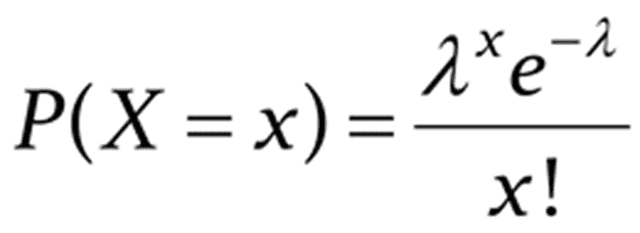
And in this case the probability related to x is given by the expression below:
poisson-formula.png


I would like to know how this expression is deduced.

P.S.: I used the informations in the wikipedia's page, so I'm not so sure that these topics are right.
https://en.wikipedia.org/wiki/Poiss..._Poisson_distribution_an_appropriate_model.3F
 
Physics news on Phys.org
The Poisson distribution can be deduced as a limiting case of the binomial distribution.

Let the probability of exactly one event occurring in a period of length ##\delta t## be ##g(\delta t)##, and define
$$\lambda\triangleq \lim_{\delta t\to 0}\frac{g(\delta t)}{\delta t}$$

Then if ##X(T)## is the number of events occurring in a period of length ##T## and ##n## is a positive integer, we have
$$Pr(X(T)\leq x)=Pr (B_n\leq x)$$
where ##B_n## is a binomial random variable with parameters ##(n,g(T/n))##.

Hence ##Pr (B_n\leq x)## is constant over ##n## and hence its limit as ##n\to\infty## exists and is equal to ##Pr(X(T)\leq x)##.

But the number of events occurring in a period of length ##T## is also equal to the Poisson random variable ##Y(\lambda,T)## for the number of events in time period ##T## with frequency ##\lambda##.

So we have
$$Pr(Y(\lambda,T)\leq x)=\lim_{n\to\infty}Pr(B_n\leq x)$$
and it can be shown that the expression on the RHS is equal to the formula for the Poisson CDF.

I've left some steps out because I'm a bit rushed this morning, but this should at least give an idea of how it's done.
 
The standard _A " operator" maps a Null Hypothesis Ho into a decision set { Do not reject:=1 and reject :=0}. In this sense ( HA)_A , makes no sense. Since H0, HA aren't exhaustive, can we find an alternative operator, _A' , so that ( H_A)_A' makes sense? Isn't Pearson Neyman related to this? Hope I'm making sense. Edit: I was motivated by a superficial similarity of the idea with double transposition of matrices M, with ## (M^{T})^{T}=M##, and just wanted to see if it made sense to talk...

Similar threads

  • · Replies 12 ·
Replies
12
Views
4K
  • · Replies 2 ·
Replies
2
Views
2K
Replies
4
Views
2K
  • · Replies 4 ·
Replies
4
Views
2K
  • · Replies 4 ·
Replies
4
Views
2K
Replies
1
Views
3K
  • · Replies 6 ·
Replies
6
Views
2K
  • · Replies 1 ·
Replies
1
Views
2K
  • · Replies 7 ·
Replies
7
Views
2K
  • · Replies 4 ·
Replies
4
Views
2K