Rick16
- 213
- 71
- Homework Statement
- Examine the following processes, and state for each one whether it is possible or impossible, according to the Standard Model (which does not include GUTs, with their potential violation of the conservation of lepton number and baryon number). In the former case, state which interaction is responsible -- strong, electromagnetic, or weak; in the latter case, cite a conservation law that prevents it from occurring.
- Relevant Equations
- Latex does not work in this field, so how am I supposed to put equations here?
This is problem 2.7 from Griffiths' Introduction to Elementary Particles. Here are the two reactions that I am trying to examine:
(c) ##\Sigma^0\rightarrow\Lambda+\pi^0##
(g) ##\Delta^+\rightarrow p+\pi^0##
According to Griffiths' solutions, (g) is possible, (c) is not possible due to violation of energy conservation. I don't really see a difference between the two cases. I have tried to draw diagrams for each. (g) should look like this:
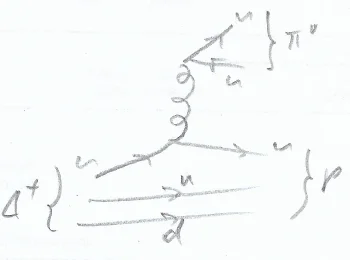
Is this correct? If it is correct, then why can't (c) be like this:
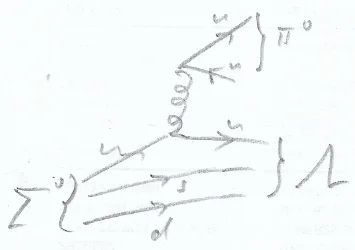
The two decays look identical, so why would one be allowed and the other one not?
(c) ##\Sigma^0\rightarrow\Lambda+\pi^0##
(g) ##\Delta^+\rightarrow p+\pi^0##
According to Griffiths' solutions, (g) is possible, (c) is not possible due to violation of energy conservation. I don't really see a difference between the two cases. I have tried to draw diagrams for each. (g) should look like this:
Is this correct? If it is correct, then why can't (c) be like this:
The two decays look identical, so why would one be allowed and the other one not?