How do I find deflection in this beam?

  • Thread starter Thread starter raymanmusic
  • Start date Start date
  • Tags Tags
    Beam Deflection
Click For Summary
SUMMARY

To find the deflection at point C of a beam with a roller connection at B and an external pin at A, first determine the reactions at A and B for equilibrium. The modulus of elasticity (E) and moment of inertia (I) are essential for calculating deflection. Various formulas exist for different scenarios, and the deflection can be approximated by summing the deflections from case 1 and case 4. For precise calculations, analyzing the beam from first principles is necessary.

PREREQUISITES
  • Understanding of beam equilibrium and reactions
  • Knowledge of modulus of elasticity (E) and moment of inertia (I)
  • Familiarity with beam deflection formulas
  • Basic mathematical skills for calculations
NEXT STEPS
  • Research beam deflection formulas specific to various loading conditions
  • Learn how to calculate reactions at supports in beam problems
  • Explore software tools for beam analysis, such as SAP2000 or ANSYS
  • Study the principles of structural analysis for more complex beam configurations
USEFUL FOR

Structural engineers, civil engineering students, and professionals involved in beam design and analysis will benefit from this discussion.

raymanmusic
Messages
30
Reaction score
1
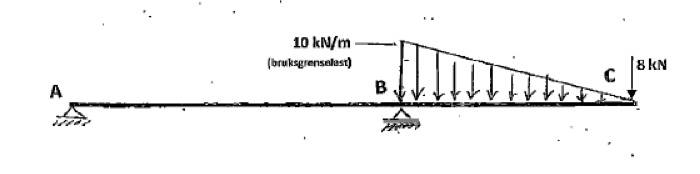
How do I find deflection (displacement) in point C at the end of the beam? Answer is to be given in mm. There is a roller connection (only Fy) in B and an external pin in A (Fy and Fx).
2vwzre8.jpg
 
Engineering news on Phys.org
As in all beam problems, first determine the reactions at A and B which put the loaded beam in equilibrium.

Once that is done, you can determine the deflection at C from first principles (if you like doing the math) or you can use software which analyzes beam problems.

To find the true deflection of the beam, you will need to know the modulus of elasticity (E) and the moment of inertia (I) of the beam.
 
See this attachment:
http://www.advancepipeliner.com/Resources/Others/Beams/Beam_Deflection_Formulae.pdf

The deflection of your beam would be approximately equal to the sum of the deflections from case 1 and case 4. Your beam is not exactly fixed at point B so the deflection at C will only be approximate. Like I said earlier, in order to find the exact amount of deflection, you would have to analyze the beam from first principles.
 

Similar threads

  • · Replies 8 ·
Replies
8
Views
2K
Replies
3
Views
3K
  • · Replies 8 ·
Replies
8
Views
2K
Replies
6
Views
4K
  • · Replies 6 ·
Replies
6
Views
4K
  • · Replies 4 ·
Replies
4
Views
6K
  • · Replies 2 ·
Replies
2
Views
3K
  • · Replies 13 ·
Replies
13
Views
5K
  • · Replies 8 ·
Replies
8
Views
2K
Replies
3
Views
2K