Metric tensor Definition and 212 Threads
-

Undergrad Raising and lowering indices using metric tensor
I'm in trouble with the notations used to rise or lower indices in tensor calculus. Consider the following: $$g_{\mu \nu} g^{\nu \rho} \text{ vs. } g_{\mu \nu} g^{\rho \nu}$$ Pick the former: there two way to see it: in the first we can say ##g_{\mu \nu}## acts on ##g^{\nu \rho}## as...- cianfa72
- Thread
- Contraction Einstein notation Index notation Metric tensor Tensor calculus
- Replies: 9
- Forum: Special and General Relativity
-
Undergrad Do existing EFE solutions support Closed Timelike Curves?
Hi, I'm curious about the following: taking the point of view of the standard physics of spacetime including EFE's solutions, are there solutions that admit Closed Timelike Curves (CTC) ? In other words: do exist global topologies and Lorentzian metrics solutions of the EFE that support CTCs ... -

Undergrad How do non-diagonal indices of a metric allow for local flatness?
I'm having trouble understanding the local flatness of GR. So far, my interpretation was that it meant that the metric tensor at an infinitesimal point in spacetime will be equal to some multiple of the Minkowski metric since that's the metric that preserves the speed of light/spacetime...- Sciencemaster
- Thread
- General relaivity Isomorphism Manifold Metric tensor Minkowski
- Replies: 22
- Forum: Special and General Relativity
-
Undergrad How to calculate basis vectors from metric tensor (as a matrix)?
As I understand from my self-study (and I'm well aware I may be wrong, so please correct me and/or point me in the right direction etc if so), the metric tensor is more or less what describes the shape of a manifold. It's the fundamental object from which most things tend to be derived from...- Tachytaenius
- Thread
- Basis vectors Metric tensor
- Replies: 6
- Forum: Special and General Relativity
-
O
High School Proper time of the observer resting in CMB reference frame
Does t in a(t) in the FLRW metric correspond to the proper time of the immortal observer, who’s been resting in the CMB reference frame since its emission? -
Undergrad Notion of parallel worldlines in curved geometry
The notion of spacetime curvature is just the same as geodesic deviation. Therefore take for instance two bodies at different altitudes from Earth surface. In order to evaluate their geodesic deviation the two worldlines must start parallel in spacetime (actually in tangent spaces at both...- cianfa72
- Thread
- Connection Curvature of space Geodesic equation Geodesics Metric tensor
- Replies: 5
- Forum: Special and General Relativity
-
Undergrad Pseudo-Riemaniann isometries
I'd ask for clarification about the symmetries of (pseudo) Riemannian manifold ##M## of dimension ##n##. The set of smooth vector fields ##\Gamma(TM)## forms a vector space over ##\mathbb R##; the commutator defined as $$[X,Y](f):=X(Y(f)) - Y(X(f))$$ turns it into a (infinite dimensional) Lie...- cianfa72
- Thread
- Isometry Killing vector Metric tensor Riemannian geometry
- Replies: 4
- Forum: Differential Geometry
-

Graduate Spacetime interval in Galilean relativity
In this [1] video, EigenChris mentions that there is no spacetime distance in Galilean relativity. And in this [2] video he replies to a comment as follows: > @hariszachariades8299: If the "spacetime separation vector" has components ##(\Delta x,\Delta t)##, there is no combination ##a\Delta...- LightPhoton
- Thread
- Galilean relativity Galilean transformation Metric tensor Spacetime interval Vector analysis
- Replies: 8
- Forum: Special and General Relativity
-

Undergrad Embedding Diagram of Weyl Metric in ##R^3##
Is it possible to make an embedding of the ##\phi##=constant slice of a Weyl metric in ##R^3##? In particular, I'm thinking of a metric where the components are both ##\rho## and ##z## dependent.- Onyx
- Thread
- General relativity Metric tensor Weyl
- Replies: 6
- Forum: Special and General Relativity
-
Undergrad Metric Tensor on ##S^1## x ##S^2##
How do I find the metric tensor on ##S^1## x ##S^2##?- Onyx
- Thread
- Manifold Metric tensor Topological spaces
- Replies: 6
- Forum: Topology and Analysis
-

Undergrad Definition of time-independent scalar field in GR
I was wondering how the notion of a time-independent field translates into the context of General Relativity. In order to specify my confusion, consider a scalar field ##\phi## in Schwarzschild spacetime with usual coordinates ##(t,r,\theta,\phi)##. Its metric is $$g = - f(r) \, dt^2 + f(r)^{-1}...- Clvrhammer
- Thread
- General relativity Metric tensor Scalar field Time-independent
- Replies: 4
- Forum: Special and General Relativity
-

Graduate Inferring coordinate change from the form of the metric
In Dirac's discussion of gravitational waves ("GTR", Chap. 33), he is working in the case where ##g_{\mu\nu}## are plane waves: waves moving in one direction only. In this case, ##g_{\mu\nu}## is a function of the single variable ##l_\sigma x^\sigma##. Here ##l_\sigma## is the wave vector, and...- Kostik
- Thread
- Coordinate transformation Metric tensor Plane waves
- Replies: 10
- Forum: Special and General Relativity
-

Graduate On the order of indices of the Christoffel symbol of the 1st kind
Homework Statement: The order of indices of the Christoffel symbol of the 1st kind seems to vary from source to source. Is there a preference, and if so why? Relevant Equations: Christoffel symbol of the 1st kind. The 1st definition of the Christoffel symbol of the 1st kind I came across was...- ric peregrino
- Thread
- General relaivity Metric tensor Tensor calculus
- Replies: 19
- Forum: Special and General Relativity
-
Undergrad Correct Description of Black Hole Interior
Does the interior coordinate patch of the Schwarzschild analytic extension really describe the interior of a black hole? After all, that portion would have mass. Also, is there a way to describe just a black hole’s with regular spherical coordinates?- Onyx
- Thread
- Black holes Manifolds Metric tensor
- Replies: 24
- Forum: Special and General Relativity
-
Undergrad On the physical meaning of Minkowski's spacetime model
Hi, I was thinking about the following. Suppose we have a geometric mathematical model of spacetime such that there exists a global map ##(t,x_1,x_2,x_3)## in which the metric tensor is in the form $$ds^2 = c^2dt^2 - (dx_1)^2 + (dx_2)^2 + (dx_3)^2$$ i.e. the metric is in Minkowski form...- cianfa72
- Thread
- Inertial reference frames Metric tensor Minkowski Special relativity Special relativity clocks
- Replies: 40
- Forum: Special and General Relativity
-

Undergrad Do Metric Tensors Always Have Inverses?
I am reading about musical isomorphisms and for the demonstration of the index raising operation from the sharp isomorphism, we have to multiply the equation by the inverse matrix of the metric. Can we assume that this inverse always exists? If so, how could I prove it?- jv07cs
- Thread
- Inverse matrix Isomorphism Metric Metric tensor
- Replies: 8
- Forum: Linear and Abstract Algebra
-
E
Undergrad Is There an Identity for Different Vectors in Dimensional Regularization?
In dimensional regularization I have seen this relation ##k^{\mu}k^{\nu}=\frac{1}{D}g^{\mu\nu}k^2## but this seems to hold for same types of four vectors k. Is there any similar identity for different vectors like ##k^{\mu}p^{\nu}=\frac{1}{D}g^{\mu\nu}k.p## ?- Elmo
- Thread
- Metric tensor
- Replies: 10
- Forum: High Energy, Nuclear, Particle Physics
-
High School Creating Metric Describing Large Disk
How can I create a metric describing the space outside a large disk, like an elliptical galaxy? In cylindrical coordinates, ##\phi## would be the angle restricted the the plane, as ##\rho## would be the radius restricted to the plane. I think that if ##z## is suppressed to create an embedding...- Onyx
- Thread
- Cylindrical coordinates Galaxy Metric tensor
- Replies: 3
- Forum: Special and General Relativity
-
P
Graduate Why Can't I Derive Eq.(7) from Phys.Lett.B Vol.755?
I encountered a problem in reading Phys.Lett.B Vol.755, 367-370 (2016). I cannot derive Eq.(7), the following snapshot is the paper and my oen derivation, I cannot repeat Eq.(7) in the paper. ##g^{\mu\nu}## is diagonal metric tensor and##g^{\mu\mu}## is the function of ##\mu## only...- PRB147
- Thread
- equation General relativity Metric tensor
- Replies: 8
- Forum: Quantum Physics
-

Undergrad Action of metric tensor on Levi-Civita symbol
We know that a metric tensor raises or lowers the indices of a tensor, for e.g. a Levi-Civita tensor. If we are in ##4D## spacetime, then \begin{align} g_{mn}\epsilon^{npqr}=\epsilon_{m}{}^{pqr} \end{align} where ##g_{mn}## is the metric and ##\epsilon^{npqr}## is the Levi-Civita tensor. The...- Baela
- Thread
- Differential forms Levi-civita Metric tensor Tensor calculus
- Replies: 11
- Forum: Special and General Relativity
-
High School What is the metric for a bag-of-gold spacetime?
What is the metric for a bag-of-gold spacetime?- Onyx
- Thread
- General relativity Metric Metric tensor Spacetime
- Replies: 9
- Forum: Special and General Relativity
-
Undergrad Intra-Universe Wormhole Metrics
Are there any metrics for intra-universe wormholes?- Onyx
- Thread
- General relativity Metric tensor Wormholes
- Replies: 14
- Forum: Special and General Relativity
-
High School Find Geodesics in Dynamic Ellis Orbits Metric
Does anyone see a way I can find geodesics in the metric ##ds^2=-dt^2+dp^2+(5p^2+4t^2)d\phi^2## (ones with nonzero angular momentum)? I'm hoping it can be done analytically, but that may be wishful thinking. FYI, this is the metric listed at the bottom of the Wikipedia article about Ellis Wormholes.- Onyx
- Thread
- Dynamic Geodesics general relativity Metric tensor Orbits Wormholes
- Replies: 92
- Forum: Special and General Relativity
-
High School Calculate Unit Normal Vector for Metric Tensor
How do I calculate the unit normal vector for any metric tensor?- Onyx
- Thread
- General relativity Metric Metric tensor Normal Tensor Unit Vector
- Replies: 21
- Forum: Special and General Relativity
-
High School Calc. Christoffel Symbols of Hiscock Coordinates
The Hiscock coordinates read: $$d\tau=(1+\frac{v^2(1-f)}{1-v^2(1-f)^2})dt-\frac{v(1-f)}{1-v^2(1-f)^2}dx$$ ##dr=dx-vdt## Where ##f## is a function of ##r##. Now, in terms of calculating the christoffel symbol ##\Gamma^\tau_{\tau\tau}## of the new metric, where ##g_{\tau\tau}=v^2(1-f)^2-1## and...- Onyx
- Thread
- Christoffel Christoffel symbols Coordinates General relativity Metric tensor Symbols
- Replies: 11
- Forum: Special and General Relativity
-
Undergrad Calculating Spacetime Around Multiple Objects
In describing the spacetime around a massive, spherical object, one would use the Schwarzschild Metric. What metric would instead be used to describe the spacetime around multiple massive bodies? Say, for example, you want to calculate the Gravitational Time Dilation experienced by a rocket ship...- Sciencemaster
- Thread
- Cosmology General relativity Gravitation Metric Metric tensor Multiple Spacetime
- Replies: 7
- Forum: Special and General Relativity
-
High School Sign of Expansion Scalar in Expanding FLRW Universe
Considering the FLWR metric in cartesian coordinates: ##ds^2=-dt^2+a^2(t)(dx^2+dy^2+dz^2)## With ##a(t)=t##, the trace of the extrinsic curvature tensor is ##-3t##. But why is it negative if it's describing an expanding universe, not a contracting one?- Onyx
- Thread
- Cosmology Expansion General relativity Metric tensor Scalar Sign Tensor calculus Universe
- Replies: 35
- Forum: Special and General Relativity
-
F
Insights Yardsticks to Metric Tensor Fields
I asked myself why different scientists understand the same thing seemingly differently, especially the concept of a metric tensor. If we ask a topologist, a classical geometer, an algebraist, a differential geometer, and a physicist “What is a metric?” then we get five different answers. I mean...- fresh_42
- Thread
- Fields Metric Metric tensor Tensor
- Replies: 7
- Forum: Differential Geometry
-
Undergrad Calculate Gaussian Curvature from 4D Metric Tensor
I've been trying to find a way to calculate Gaussian curvature from a 4D metric tensor. I found a program that does this in Mathematica using the Brioschi formula. However, this only seems to work for a 2D metric or formula (I would need to use something with more dimensions). I've found...- Sciencemaster
- Thread
- Curvature Curvature of spacetime Gaussian Mathematica Metric Metric tensor Program Python
- Replies: 14
- Forum: Special and General Relativity
-
Graduate Proper Volume on Constant Hypersurface in Alcubierre Metric
I'm wondering if there is a way to find the proper volume of the warped region of the Alcubierre spacetime for a constant ##t## hypersurface. I can do a coordinate transformation ##t=τ+G(x)##, where ##G(x)=\int \frac{-vf}{1-v^2f^2}dx##. This eliminates the diagonal and makes it so that the...- Onyx
- Thread
- Alcubierre warp drive Constant General relativity Metric Metric tensor Volume
- Replies: 7
- Forum: Special and General Relativity
-
C
Undergrad Calculating Relative Change in Travel Time Due to Spacetime Perturbation
Suppose you have the following situation: We have a spacetime that is asymptotically flat. At some position A which is in the region that is approximately flat, an observer sends out a photon (for simplicity, as I presume that any calculations involved here become easier if we consider a...- cicero
- Thread
- Change General relativity Metric tensor Perturbation Spacetime Time Travel
- Replies: 3
- Forum: Special and General Relativity
-
SH2372 General Relativity - Lecture 4
0:00 The metric tensor 12:55 Curve lengths 28:17 Metric compatibility of connections 35:47 The Levi-Civita connection 40:27 Induced metrics 50:12 Curvature and the metric 1:04:18 Killing fields and symmetries- Orodruin
- Media item
- Curvature tensor Metric tensor
- Comments: 0
- Category: Relativity
-
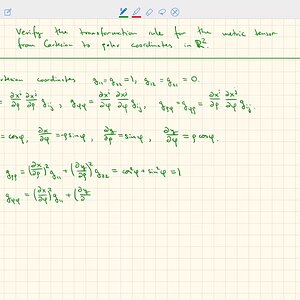
SH2372 General Relativity (7X): Coordinate transformation of metric components
- Orodruin
- Media item
- Coordinate transformation Metric tensor
- Comments: 0
- Category: Relativity
-
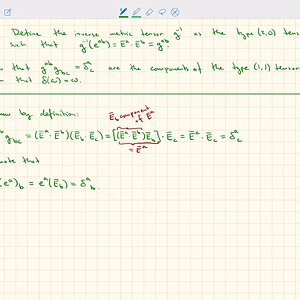
SH2372 General Relativity (6X): The inverse metric tensor
- Orodruin
- Media item
- Metric tensor
- Comments: 0
- Category: Relativity
-
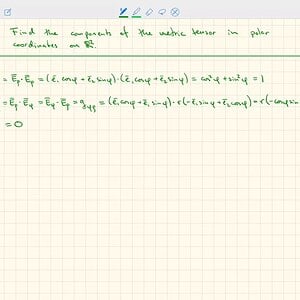
SH2372 General Relativity (5X): Metric components in polar coordinates
- Orodruin
- Media item
- Metric tensor Polar coordinates
- Comments: 0
- Category: Relativity
-
Undergrad Raising/Lowering Indices w/ Metric Tensor
I'm still confused about the notation used for operations involving tensors. Consider the following simple example: $$\eta^{\mu \sigma} A_{\mu \nu} = A_{\mu \nu} \eta^{\mu \sigma}$$ Using the rules for raising an index through the (inverse) metric tensor ##\eta^{\mu \sigma}## we get...- cianfa72
- Thread
- Indices Metric Metric tensor Tensor
- Replies: 8
- Forum: Special and General Relativity
-

Derivative of Determinant of Metric Tensor With Respect to Entries
We know that the cofactor of determinant ##A##, is $$\frac{\partial A}{\partial a^{r}_{i}} = A^{i}_{r} = \frac{1}{2 !}\delta^{ijk}_{rst} a^{s}_{j} a^{t}_{k} = \frac{1}{2 !}e^{ijk} e_{rst} a^{s}_{j} a^{t}_{k}$$ By analogy, $$\frac{\partial Z}{\partial Z_{ij}} = \frac{1}{2 !}e^{ikl} e^{jmn}...- yucheng
- Thread
- Derivative Determinant Metric Metric tensor Tensor Tensor calculus
- Replies: 14
- Forum: Calculus and Beyond Homework Help
-

Undergrad Variation of Four-Velocity Vector w/ Respect to Metric Tensor
Hi everyone! I'm having some difficulty showing that the variation of the four-velocity, Uμ=dxμ/dτ with respect the metric tensor gαβ is δUμ=1/2 UμδgαβUαUβ Does anyone have any suggestion? Cheers, Rafael. PD: Thanks in advances for your answers; this is my first post! I think ill be...- Hubble_92
- Thread
- Metric Metric tensor Tensor Variation Vector
- Replies: 2
- Forum: Special and General Relativity
-
A
Undergrad Deriving Contravariant Form of Levi-Civita Tensor
The covariant form for the Levi-Civita is defined as ##\varepsilon_{i,j,k}:=\sqrt{g}\epsilon_{i,j,k}##. I want to show from this definition that it's contravariant form is given by ##\varepsilon^{i,j,k}=\frac{1}{\sqrt{g}}\epsilon^{i,j,k}##.My attemptWhat I have tried is to express this tensor...- AndersF
- Thread
- Contravariant Derivation Form Levi-civita Metric tensor Tensor Tensor algebra
- Replies: 1
- Forum: Special and General Relativity
-
A
Undergrad Showing Determinant of Metric Tensor is a Tensor Density
I'm trying to show that the determinant ##g \equiv \det(g_{ij})## of the metric tensor is a tensor density. Therefore, in order to do that, I need to show that the determinant of the metric tensor in the new basis, ##g'##, would be given by...- AndersF
- Thread
- Change of basis Density Determinant Metric Metric tensor Tensor Tensor algebra Transformation law
- Replies: 4
- Forum: Special and General Relativity
-
A
Undergrad Expressing Vectors of Dual Basis w/Metric Tensor
I'm trying to understand why it is possible to express vectors ##\mathbf{e}^i## of the dual basis in terms of the vectors ##\mathbf{e}_j## of the original basis through the dual metric tensor ##g^{ij}##, and vice versa, in these ways: ##\mathbf{e}^i=g^{ij}\mathbf{e}_j##...- AndersF
- Thread
- Basis Dual Dual basis Metric Metric tensor Tensor Tensor algebra Tensor notation Tensors Vectors
- Replies: 8
- Forum: Special and General Relativity
-

Graduate Deriving Essential Quantities from Metric Tensor for GR Calculations
I am working on a computational project about General Relativity. In this process, I want to code 'the stuff' that can be derivable from the metric tensor. So far, I have coded Riemann Tensor, Weyl Tensor, Einstein Tensors, Ricci Tensor, Ricci scalar. What are the other essential/needed...- Arman777
- Thread
- Metric Metric tensor Tensor
- Replies: 20
- Forum: Special and General Relativity
-
A
Divergence in Spherical Coordinate System by Metric Tensor
The result equation doesn't fit with the familiar divergence form that are usually used in electrodynamics. I want to know the reason why I was wrong. My professor says about transformation of components. But I cannot close to answer by using this hint, because I don't have any idea about "x"...- Astrocyte
- Thread
- Coordinate Coordinate system Divergence Metric Metric tensor Spherical System Tensor
- Replies: 2
- Forum: Advanced Physics Homework Help
-

High School Metric tensor for a uniformly accelerated observer
Hello all, let's suppose we have, in a flat spacetime, two observers O and O', the latter speeding away from O, with an uniform acceleration ##a##. In the Minkowski spacetime chart of O, the world-line of O' can be drawn as a parable. We know that the Lorentz boost at every point of the...- Pyter
- Thread
- Metric Metric tensor Observer Tensor
- Replies: 55
- Forum: Special and General Relativity
-

Undergrad Argument for Existence of Normal Coordinates at a Point
Hey there, I've been recently been going back over the basics of GR, differential geometry in particular. I was watching one of Susskind's lectures and did not understand the argument made here (26:33 - 35:40). In short, the argument goes as follows (I think): we have some generic metric ##{ g...- tomdodd4598
- Thread
- Argument Coordinates Existence General relativity Metric tensor Normal Point
- Replies: 2
- Forum: Special and General Relativity
-
Q
Undergrad Metric Tensor: Symmetry & Other Constraints
Aside from being symmetric, are there any other mathematical constraints on the metric?- quickAndLucky
- Thread
- Constraints Metric Metric tensor Tensor Tensor analysis
- Replies: 10
- Forum: Special and General Relativity
-
Q
Graduate Variation of Metric Tensor Under Coord Transf | 65 chars
Under the coordinate transformation $\bar x=x+\varepsilon$, the variation of the metric $g^{\mu\nu}$ is: $$ \delta g^{\mu\nu}(x)=\bar g^{\mu\nu}(x)-g^{\mu\nu}(x)=-\frac{\partial{ g^{\mu\nu}}}{\partial x^{\alpha}}\varepsilon^{\alpha}+ g^{\mu\beta}\frac{\partial \varepsilon^{\nu}}{\partial...- QipshaqUli
- Thread
- Metric Metric tensor Tensor Variation
- Replies: 1
- Forum: Special and General Relativity
-
P
Show that the metric tensor is independent of coordinate choice
I need to use some property of the relalation between the coordinate systems to prove that g_{hk} is independent of the choice of the underlying rectangular coordinate system. I will try to borrow an idea from basic linear algebra. I expect any transformation between the rectangular systems to...- PrecPoint
- Thread
- Choice Coordinate Independent Metric Metric tensor Tensor
- Replies: 3
- Forum: Advanced Physics Homework Help
-
W
Solving Metric Tensor Problems: My Attempt at g_μν for (2)
My attempt at ##g_{\mu \nu}## for (2) was \begin{pmatrix} -(1-r^2) & 0 & 0 & 0 \\ 0 &\frac{1}{1-r^2} & 0 & 0 \\ 0 & 0 & r^2 & 0 \\ 0 & 0 & 0 & r^2 \sin^2(\theta) \end{pmatrix} and the inverse is the reciprocal of the diagonal elements. For (1) however, I can't even think of how to write the...- WWCY
- Thread
- Metric Metric tensor Tensor
- Replies: 4
- Forum: Advanced Physics Homework Help
-
M
Graduate Anisotropic Universe and Friedmann Equations
The Friedman Equations is based on the cosmological principle, which states that the universe at sufficiently large scale is homogeneous and isotropic. But what if, as an hypothesis, the universe was anisotropic and the clustering of masses are aligned to an arbitrary axis (axial pole), how...- member 657093
- Thread
- Anisotropic Cosmology Friedmann Friedmann equations General relativity Hubble parameter Metric tensor Universe
- Replies: 27
- Forum: Cosmology
